
How to price homemade food: the formula, with a worked example
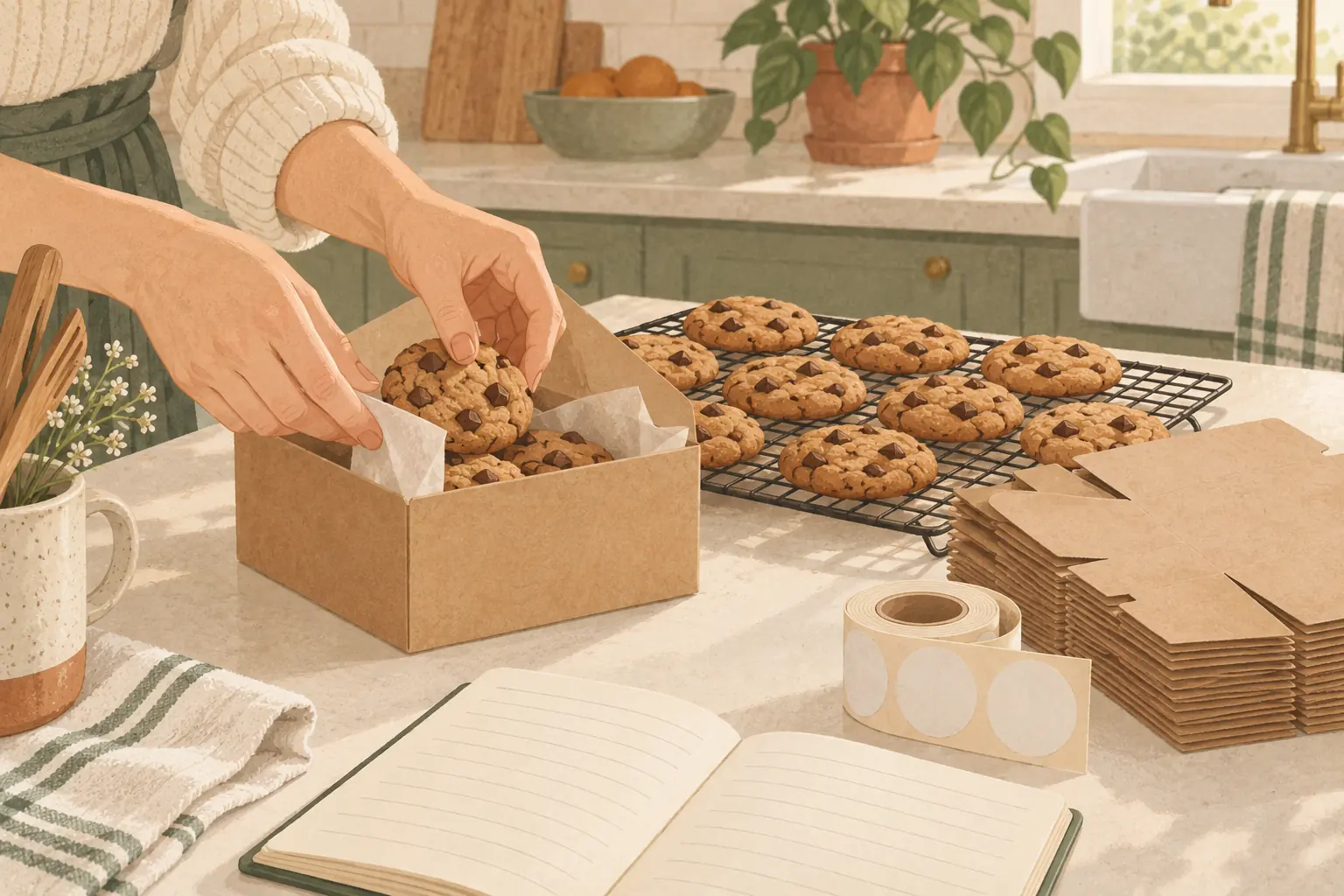
To price homemade food, add up what one batch really costs you (ingredients, packaging, your time and a little overhead), divide by the number of items, then add a profit margin:
Price per item = (ingredients + packaging + labor + overhead) ÷ items in the batch ÷ (1 − margin)
The labor line is the easiest to leave out, and for most baking it's the biggest cost. The worked example below prices a batch of chocolate chip cookies line by line, compares the result with the "multiply ingredients by three" rule of thumb, and shows what changes at a farmers market with a booth fee.
Step 1: work out the ingredient cost from pack prices
The only honest ingredient cost is the share of each pack you actually used, at the price you actually paid:
Ingredient cost = pack price × (amount used ÷ pack size)
Here's a batch of 24 chocolate chip cookies. The prices are an example, not a national average; use the ones on your own receipts.
| Ingredient used | From | Cost in this batch |
|---|---|---|
| Flour, 2¼ cups (about 10 oz) | 5 lb bag at $3.49 | $0.44 |
| Butter, 1 cup (8 oz) | 1 lb at $4.99 | $2.50 |
| White sugar, ¾ cup (about 5.3 oz) | 4 lb bag at $3.29 | $0.27 |
| Brown sugar, ¾ cup (about 5.8 oz) | 2 lb bag at $2.49 | $0.45 |
| Eggs, 2 | A dozen at $2.99 | $0.50 |
| Chocolate chips | One 12 oz bag at $3.79 | $3.79 |
| Vanilla, baking soda, salt | Allowance | $0.35 |
| Total | $8.30, or $0.35 a cookie |
Two things stand out. The chocolate chips and butter are three quarters of the cost, so they're where a price change hits hardest. And the flour, which feels like the main ingredient, is 44 cents.
Our free recipe cost calculator does this sum for any recipe, including the cups-to-ounces conversions that make it fiddly by hand. If one pack is in grams and another in ounces, the unit price calculator converts them. Keeping the usual price of your main ingredients in a grocery price book means you can reprice a recipe without digging out old receipts.
Step 2: add packaging
Anything that leaves the kitchen with the food is part of its cost: bags, boxes, jars, lids, labels, twist ties, a sticker with the ingredients on it.
In this example the cookies sell by the dozen in a small bakery box at $0.60 with a $0.10 label, so packaging is $0.70 a dozen, or about 6 cents a cookie. For jams it's usually much more: the jar and lid can cost as much as the fruit.
Step 3: pay yourself for your time
This is the line that decides whether you're running a small business or subsidizing your customers.
Count the whole job, not just the oven time: shopping for the ingredients, mixing, baking in batches, cooling, packing, labeling and washing up. For a single batch of cookies, an hour and a half is a realistic total.
For the hourly rate, a defensible starting point is what bakers are paid. The Bureau of Labor Statistics occupational wage data for May 2025 puts the median hourly wage for bakers at $17.86.
At that rate, 1.5 hours is $26.79 a batch, or $1.12 a cookie. That's more than three times the ingredient cost. It's also the reason the rules of thumb below come out so low. It's the same hour we set against a takeout order in cooking at home vs eating out.
Step 4: add a little overhead
Overhead is everything the batch uses that isn't on a receipt: oven energy, water, the wear on your mixer and pans. Penn State Extension's guide to pricing food products splits costs into variable costs, which it says rise with the number of units you sell and include ingredients, labor, packaging and sales commissions, and fixed costs, which stay roughly the same however much you sell, like rent, insurance and utilities.
For a home baker, a small flat allowance per batch is enough. This example uses $1.00, which adds about 4 cents a cookie.
Step 5: add a margin
Everything so far is cost. The margin is what's left over, and it's what covers the batch that burns, the dozen nobody buys, and the months when butter goes up.
The cleanest way to add it is to divide by (1 − margin) rather than multiply. A 30% margin means the price is cost ÷ 0.7, so that 30% of the price, not 30% of the cost, is left over.
| Per cookie | Per dozen | |
|---|---|---|
| Ingredients | $0.35 | $4.15 |
| Packaging | $0.06 | $0.70 |
| Labor, 1.5 hours at $17.86 | $1.12 | $13.40 |
| Overhead | $0.04 | $0.50 |
| Full cost | $1.56 | $18.75 |
| Price at a 30% margin | $2.23 | $26.79 |
So a dozen of these cookies should sell for about $27. If that sounds high, compare it with the next table.
How the rules of thumb compare
Most pricing advice gives a multiplier. Here's what each one does to the same batch:
| Method | Per cookie | Per dozen | What it leaves out |
|---|---|---|---|
| Ingredients × 3 | $1.04 | $12.45 | Most of your time |
| Ingredients × 4 | $1.38 | $16.60 | Some of your time, and any margin |
| Full cost, no margin | $1.56 | $18.75 | Anything left over |
| Full cost + 30% margin | $2.23 | $26.79 | Nothing |
Multipliers work when ingredient cost and time move together. They don't for cookies, where the ingredients are cheap and the work isn't, and they break badly for anything decorated, where the time can be ten times the ingredient cost.
Selling at a farmers market: the booth fee
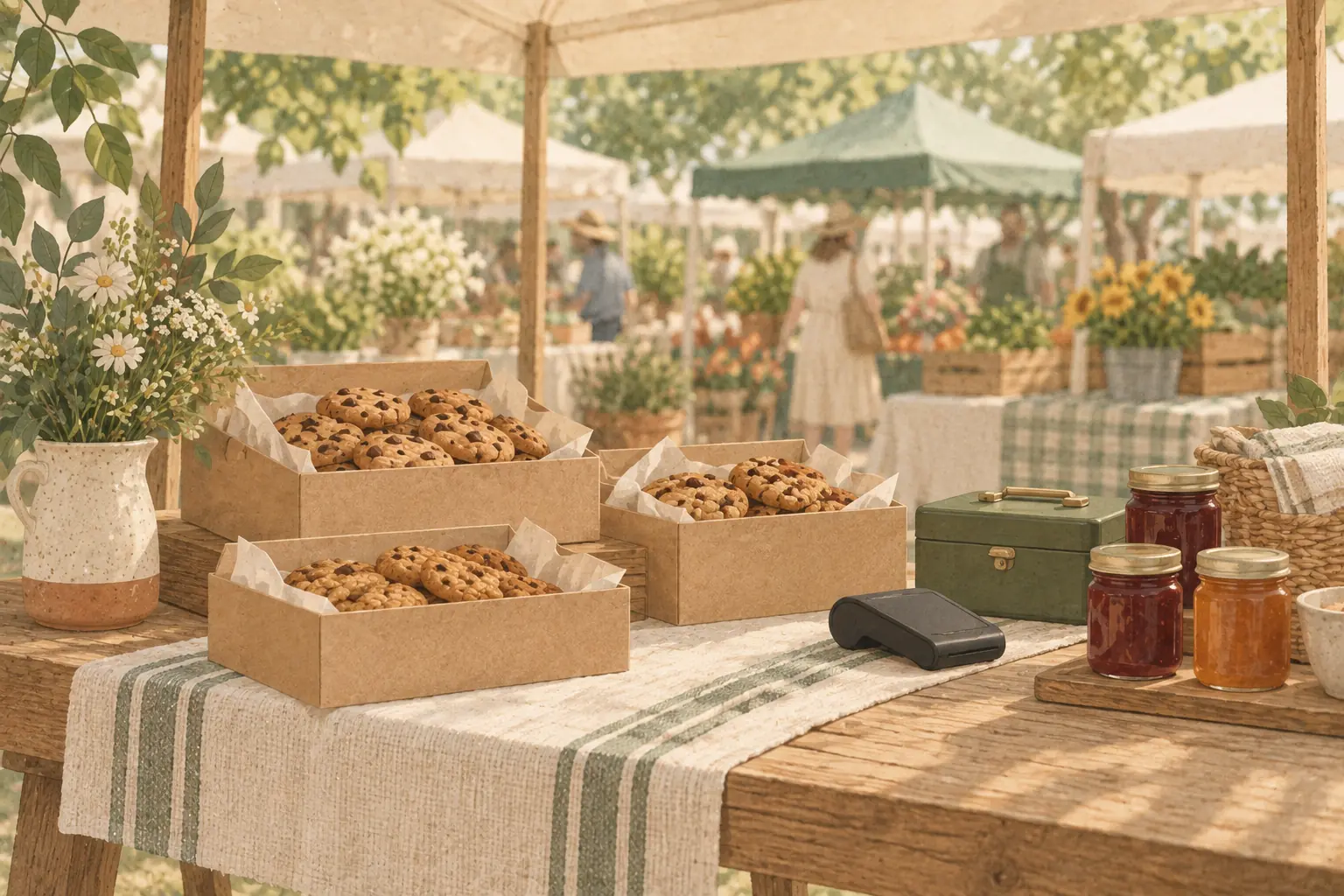
A market adds costs that a sale to a friend doesn't: the booth or stall fee, the percentage your card reader takes, the drive, and whatever you bring home unsold.
The useful number here is the one Penn State's guide calls contribution margin: the price of one unit minus its variable costs. Divide your fixed costs for the day by it and you get how many units you need to sell to break even. Their example is a sauce with $925 a month of fixed costs and $3.70 of contribution margin per bottle, which comes to 250 bottles a month.
For the cookies, say the booth is $40 for the day and your card reader takes 3%:
| Per dozen at $27 | Excluding your time | Including your time |
|---|---|---|
| Ingredients, packaging, card fee | $5.66 | $5.66 |
| Labor and overhead | $13.90 | |
| Contribution per dozen | $21.34 | $7.44 |
| Dozens to sell to cover a $40 booth | 2 | 6 |
The left column is the tempting way to look at it, and it's why a booth fee feels easy to cover. The right column is the honest one: at a fair wage for your time, you need to sell six dozen before the stall has paid for itself, and every unsold box on the way home comes straight off what's left.
Different sales, different prices
The formula is the same, but what goes into it changes with the kind of sale.
- A charity bake sale: people usually donate the ingredients and their time, so price for round numbers that are easy to pay in cash, and let the cause set the level.
- Friends and neighbors: charge at least ingredients and packaging. Whether to add labor is your call, but know what you're giving away.
- A market or pop-up: use the full formula, and add the booth fee and card percentage.
- Regular orders under your state's cottage food law: full formula, plus the cost of whatever labeling and permits your state requires.
Cottage food laws: check your state first
Before you price anything for sale, check what your state allows. Cottage food laws let people sell certain homemade foods without a commercial kitchen, and they vary a great deal.
The National Agricultural Law Center at the University of Arkansas says in its overview of cottage food laws that cottage foods often include baked goods, jams, jellies, dry mixes and candies; that there are usually separate requirements, such as specific labeling or sales caps; and that approaches differ dramatically from state to state and change over time.
In practice that means your state may cap your annual sales, limit which foods you can sell, require a label listing ingredients and your address, or restrict selling online or by mail. Your state department of agriculture or health is the place to check, and some of those rules add costs that belong in the formula above.
What about taxes?
We can't give tax advice, but the IRS draws a line worth knowing. Its fact sheet on the difference between a hobby and a business (FS-2022-38, October 2022) says most people take up hobbies for personal enjoyment, not to make a profit, and that sometimes the line between the two isn't clear cut. If you're not trying to make a profit, the IRS says you can't use a loss from the activity to offset other income, and hobby income is reported on Schedule 1 (Form 1040), line 8.
If you're selling regularly and pricing for a profit, that's a conversation for a tax professional, and keeping every receipt makes it a much shorter one.
Pricing jams, sauces and meals
The same five steps work for anything, with different weights:
- Jams and preserves: packaging is a big line (jars, lids, labels), and the batch yield is exact, so cost per jar is easy to pin down.
- Sauces and pickles: similar to jam, with a longer time line if there's canning involved.
- Meals and meal prep: ingredients are a much bigger share than for baking, and portions need to be consistent, so weigh them once to know how many a batch really makes.
Whatever you're making, the ingredient line is only as good as the prices you put into it. Duneed, our iPhone app, reads the line items and prices from photographed grocery receipts, so the pack prices for step 1 are already there when you sit down to cost a recipe.
Common questions
What is the formula for pricing baked goods?
Price per item = (ingredients + packaging + labor + overhead) ÷ items per batch, then divide by (1 − your margin). For a 30% margin, divide the cost per item by 0.7.
Should I charge for my time?
If you're selling rather than giving, yes. For a batch of cookies your time is usually the biggest cost, bigger than the ingredients. The BLS median wage for bakers, $17.86 an hour in May 2025, is a defensible rate to start from.
How much should I charge for a dozen homemade cookies?
It depends on your ingredients and time, but in our worked example a dozen chocolate chip cookies costs $18.75 to make once your time is counted, and sells for about $27 at a 30% margin. At ingredients times three, the same dozen would be $12.45, which doesn't cover the labor.
Is ingredients times three a good rule?
It's a quick floor, not a price. For cookies it leaves out most of your time. It works better for foods where the ingredients are expensive and the work is short.
Do I need a license to sell homemade food?
It depends on your state. Many states have a cottage food law that lets you sell certain homemade foods without a commercial kitchen, usually with limits on what you sell, where, and how much. Check with your state department of agriculture or health before you start.
Sources
- occupational wage data for May 2025 data.bls.gov
- pricing food products extension.psu.edu
- cottage food laws nationalaglawcenter.org
- difference between a hobby and a business irs.gov
Found a mistake? Tell us and we will correct it: support@duneed.app