
How to thaw frozen food safely: the three methods USDA allows
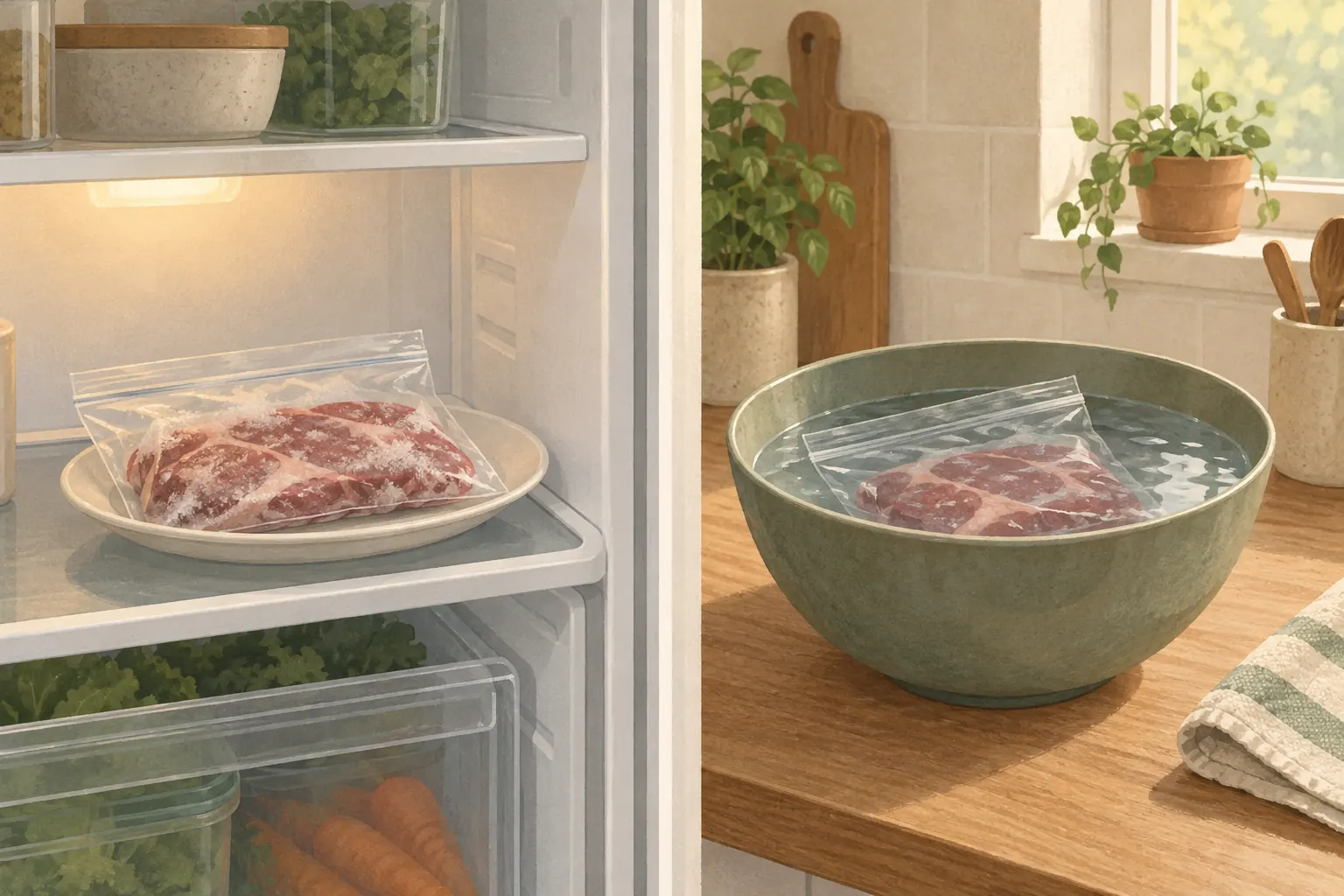
Three: the refrigerator, cold water, and the microwave. Everything else — the counter, hot water, the garage, the dishwasher, the porch — is outside the guidance, and USDA names those by hand rather than leaving them to inference.
The rule underneath all three is one sentence from The Big Thaw: frozen food is "safe indefinitely while frozen", but "as soon as they begin to thaw and become warmer than 40 °F, bacteria that may have been present before freezing can begin to multiply."
Why not the counter
Because the package thaws from the outside in. FSIS puts the objection plainly:
Even though the center of the package may still be frozen as it thaws on the counter, the outer layer of the food could be in the "Danger Zone," between 40 and 140 °F — temperatures where bacteria multiply rapidly.
The frozen middle is what makes counter-thawing feel safe, and it is the part that has nothing to do with the question. The agency's limit on perishable food out of refrigeration applies here too: no more than two hours.
1. The refrigerator
The slow one, and the only one that leaves you options afterwards.
FSIS's planning number is a day for every 5 pounds, and a small package is not exempt: "Even small amounts of frozen food — such as a pound of ground meat or boneless chicken breasts — require a full day to thaw." Our defrost time calculator does that arithmetic for a weight in pounds or kilos.
Two variables the agency flags: some parts of a fridge are colder than others, and a fridge set to 35°F thaws more slowly than one set to 40°F. If you do not know which yours is, an appliance thermometer settles it.
What makes this method worth the wait is what comes after. Thawed in the refrigerator, ground meat, stew meat, poultry and seafood "should remain safe and good quality for an additional day or two before cooking"; red meat cuts get 3 to 5 days. And it is the only method after which food "can be refrozen without cooking, although there may be some loss of quality."
2. Cold water
Faster, and it needs you in the room.
- The food goes in a leak-proof package or plastic bag. FSIS's reason is two-sided: a leak lets bacteria in, and the meat can absorb water and go watery.
- Submerge it in cold tap water, and change the water every 30 minutes so it keeps thawing.
- Timing: about a pound "may thaw in an hour or less"; a 3-to-4-pound package takes 2 to 3 hours; a whole turkey runs about 30 minutes per pound.
- Once it is thawed, cook it immediately.
- Food thawed this way must be cooked before it can be refrozen.
Not warm water, and not a bowl left to come up to room temperature. The changing keeps the water cold, which is the whole mechanism.
3. The microwave
The fastest, and the most committing. Parts of the food start to cook, which puts them in the Danger Zone while the rest is still frozen, so the food goes straight into the pan or the oven.
FSIS: "always cook immediately after, whether microwave cooking, by conventional oven, or grilling." As with cold water, anything thawed in the microwave is cooked before refreezing.
Or skip thawing
The line people miss: "it is safe to cook foods from the frozen state. The cooking will take approximately 50% longer than the recommended time for fully thawed or fresh meat and poultry."
Fifty percent longer is the whole adjustment. For a weeknight, frozen-to-oven is often less trouble than a thaw you forgot to start.
The never list
FSIS names these outright: never thaw food "in a garage, basement, car, dishwasher or plastic garbage bag; out on the kitchen counter, outdoors or on the porch."
Hot water belongs on that list too — it is the example the page opens with, and the answer is no.
Refreezing, in one table
| Thawed in | Cook before refreezing? |
|---|---|
| Refrigerator | No — it can be refrozen raw, with some loss of quality |
| Cold water | Yes |
| Microwave | Yes |
That table is also why the refrigerator is worth planning for: it is the only row that lets you change your mind. What comes back out is subject to the usual quality times, and freezer burn is what eats them.
A fridge thaw starts with knowing, a day ahead, what you have. Duneed, our iPhone app, keeps that list from photographed grocery receipts, though it doesn't track which items went into the freezer.
Common questions
How long does it take to thaw meat in the fridge?
A day for every 5 pounds, in FSIS's guidance, and a full day even for a single pound. The defrost time calculator works it out from a weight.
Can I thaw meat on the counter?
Not in USDA's guidance. The outer layer reaches the 40–140°F Danger Zone while the center is still frozen, and perishable food must not sit at room temperature for more than two hours.
Is it safe to thaw food in hot water?
No. FSIS opens The Big Thaw with exactly that scenario and calls it unsafe. Cold tap water, changed every 30 minutes, is the water method.
Can I refreeze food after thawing it?
Food thawed in the refrigerator can be refrozen without cooking, with some quality loss. Food thawed in cold water or the microwave is cooked first.
How long does a turkey take to thaw in cold water?
About 30 minutes per pound, submerged in cold tap water changed every half hour.
Can I cook food straight from frozen?
Yes, in FSIS's guidance, allowing about 50% longer than the time for thawed or fresh meat and poultry.
Sources
- The Big Thaw fsis.usda.gov
Found a mistake? Tell us and we will correct it: support@duneed.app