What temperature should a fridge be? 40°F, and how to check it
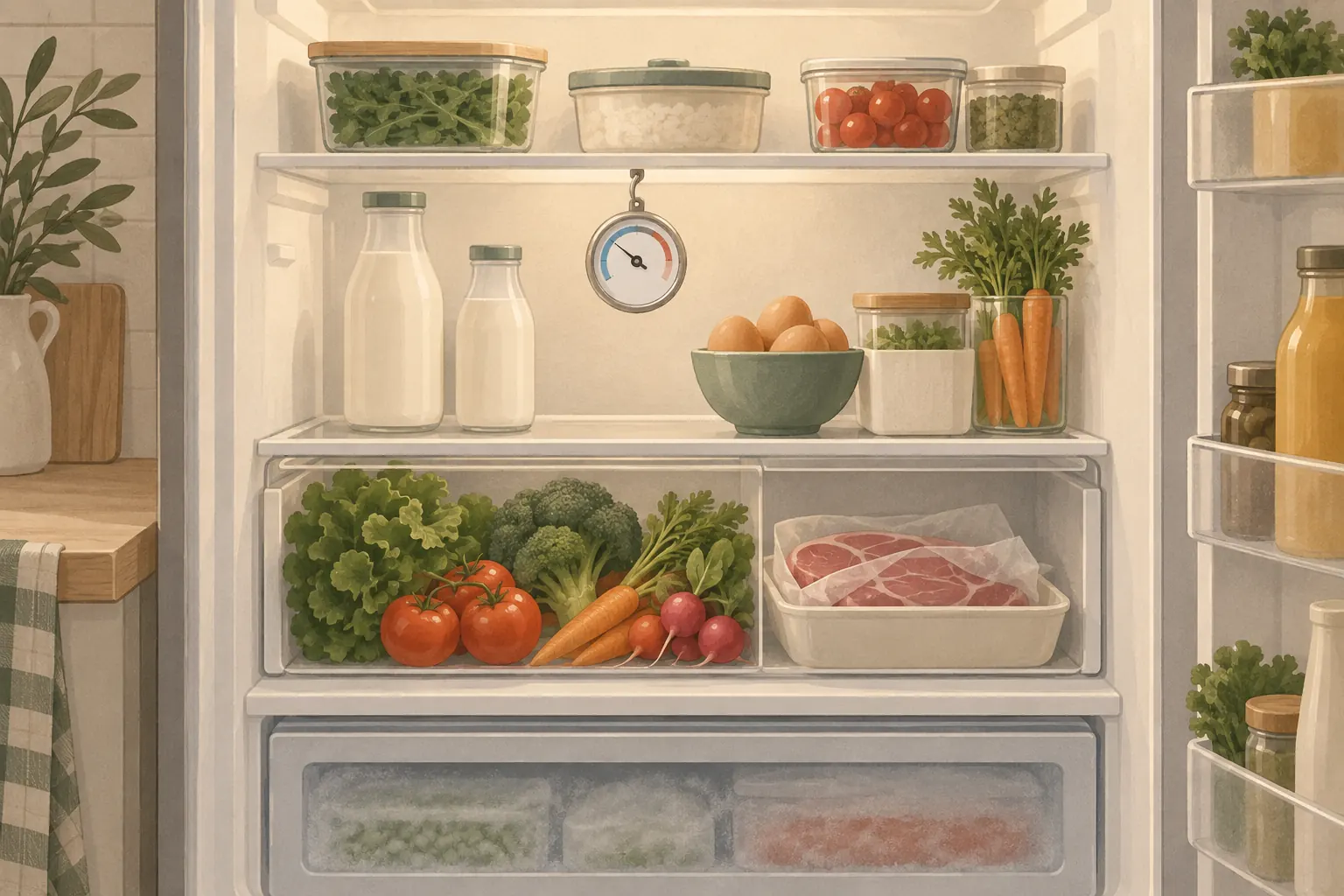
40°F (4°C) or below for the refrigerator, 0°F (-18°C) or below for the freezer. Those are the federal numbers, and the second one is not a typo: a freezer is meant to be well under freezing point, not just at it.
The number that matters most is the one you can actually read. Most fridge dials are marked 1 to 5, or "min" to "max", and none of that tells you the temperature inside. USDA's advice is blunt: "keep an appliance thermometer in the refrigerator to monitor the temperature" (Refrigeration and Food Safety).
Why 40°F
Because of where bacteria multiply. The same page says they "grow most rapidly in the range of temperatures between 40 and 140 °F, the 'Danger Zone,' some doubling in number in as little as 20 minutes", and that "a refrigerator set at 40 °F or below will protect most foods".
There is a second line on that page worth reading twice, because it explains why the thermometer beats the nose:
Pathogenic bacteria can grow rapidly in the "Danger Zone," the temperature range between 40 and 140 °F, but they do not generally affect the taste, smell, or appearance of a food. In other words, one cannot tell that a pathogen is present.
Spoilage bacteria are the other family: they work at fridge temperatures, and they are the ones that make milk smell and meat go slimy. Those two families are why "it smells fine" and "it is fine" are different statements, and why this site quotes agencies rather than making the call.
Checking it takes five minutes
- Buy an appliance thermometer. Not a meat thermometer. FSIS notes that appliance thermometers "are specifically designed to provide accuracy at cold temperatures".
- Put it in the middle of the middle shelf, not the door. Leave it for several hours, or overnight, so it is reading the cabinet rather than the last time the door opened.
- Read it without opening the door if you can. Many models are readable through the glass; if not, open and read fast.
- Adjust one notch at a time, then leave it a day before reading again. Fridges respond slowly, and it is easy to overshoot into freezing the lettuce.
- Repeat for the freezer, where you want 0°F (-18°C) or below.
The temperature should be 40°F or below "throughout the unit", in FSIS's words, so it is worth moving the thermometer around over a week: the door shelves and the front of the top shelf are usually the warmest parts.
What the settings on the dial mean
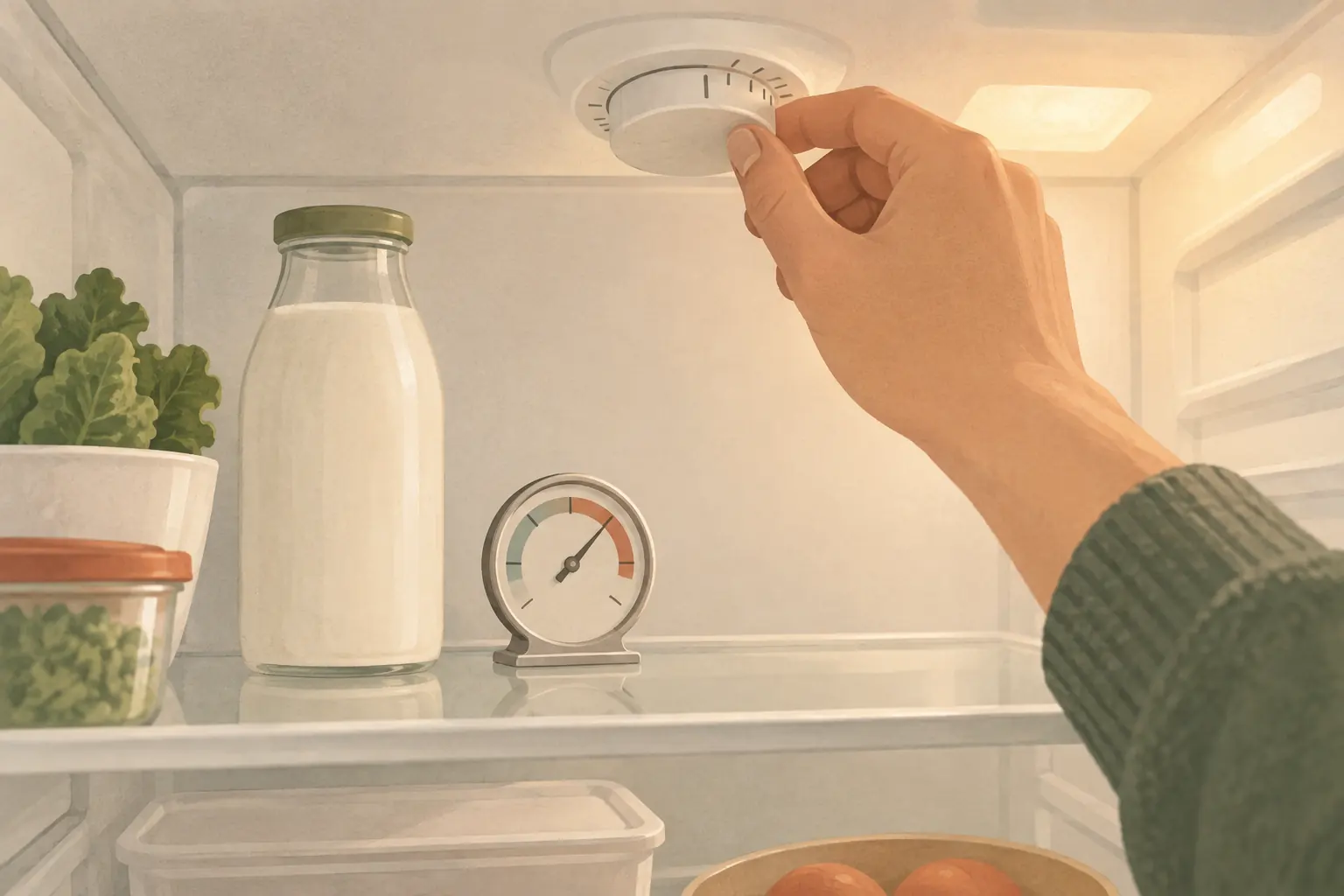
Nothing standard. On most dials, a higher number means more cooling, not a higher temperature, which is the opposite of what people assume. Some European fridges use 1 to 5, some use a snowflake scale, and a few use letters. The only way to know what yours is doing is to measure it.
If your fridge has a digital display, that is the target temperature, not necessarily the actual one. A thermometer on the shelf is still the check.
Packing it so the temperature holds
- Do not block the vents. Cold air is circulated; a shopping bag pressed against the back wall stops that.
- Leave space between packages. A packed fridge cools unevenly, unlike a packed freezer, which holds cold better.
- Wrap raw meat, poultry and seafood, and put them low. FSIS's wording: they "should be in a sealed container or wrapped securely to prevent raw juices from contaminating other foods". The bottom shelf is where a leak does the least harm.
- Cool leftovers in shallow containers. The agency again: a large pot "should be divided into small portions and put in shallow containers before being refrigerated", and hot food can go straight in.
- Close the door. Obvious, and still the most common reason a fridge drifts above 40°F.
The full shelf-by-shelf order, with the drawers and the door, is in how to organize your fridge.
After a power cut
This is where the thermometer earns its price. FSIS: "This can be critical in the event of a power outage. When the power goes back on, if the refrigerator is still 40 °F, the food is safe. Foods held at temperatures above 40 °F for more than 2 hours should not be consumed."
The keep-or-discard list for that situation is a separate chart, and we have written it up in food after a power outage.
How long things keep once the temperature is right
The federal storage times assume a fridge at 40°F or below and a freezer at 0°F or below. That is the point of the number: the chart only means anything if the appliance is holding it. Look a food up in our storage time lookup, or print the fridge and freezer chart for the kitchen door.
Duneed, our iPhone app, doesn't read your fridge's temperature or guess storage times. If you give an item a date, it flags it as the date approaches and sends one evening notification a day listing what needs eating.
Common questions
What temperature should a fridge be in Celsius?
4°C or below, which is the 40°F in the US guidance. The freezer is -18°C, or 0°F.
Is 37°F too cold for a fridge?
No. Anything at or below 40°F meets the guidance; colder is fine as long as food in the coldest spots is not freezing. Many people run 35 to 38°F deliberately for a margin.
Where is the coldest part of a fridge?
It varies by model, but the door is always the warmest part, which is why milk lasts longer on a shelf than in the door bin. Measure yours rather than trusting the layout diagram in the manual.
Do I need a thermometer if my fridge shows a temperature?
The display shows the target. A cheap appliance thermometer tells you what the shelf is actually at, and it is the only thing that helps after a power cut.
What temperature should a freezer be?
0°F (-18°C) or below. At that temperature FSIS says frozen food stays safe indefinitely, and the months on the storage charts are about quality.
Sources
- Refrigeration and Food Safety fsis.usda.gov
Found a mistake? Tell us and we will correct it: support@duneed.app