
What is freezer burn? What USDA says, and how to stop it
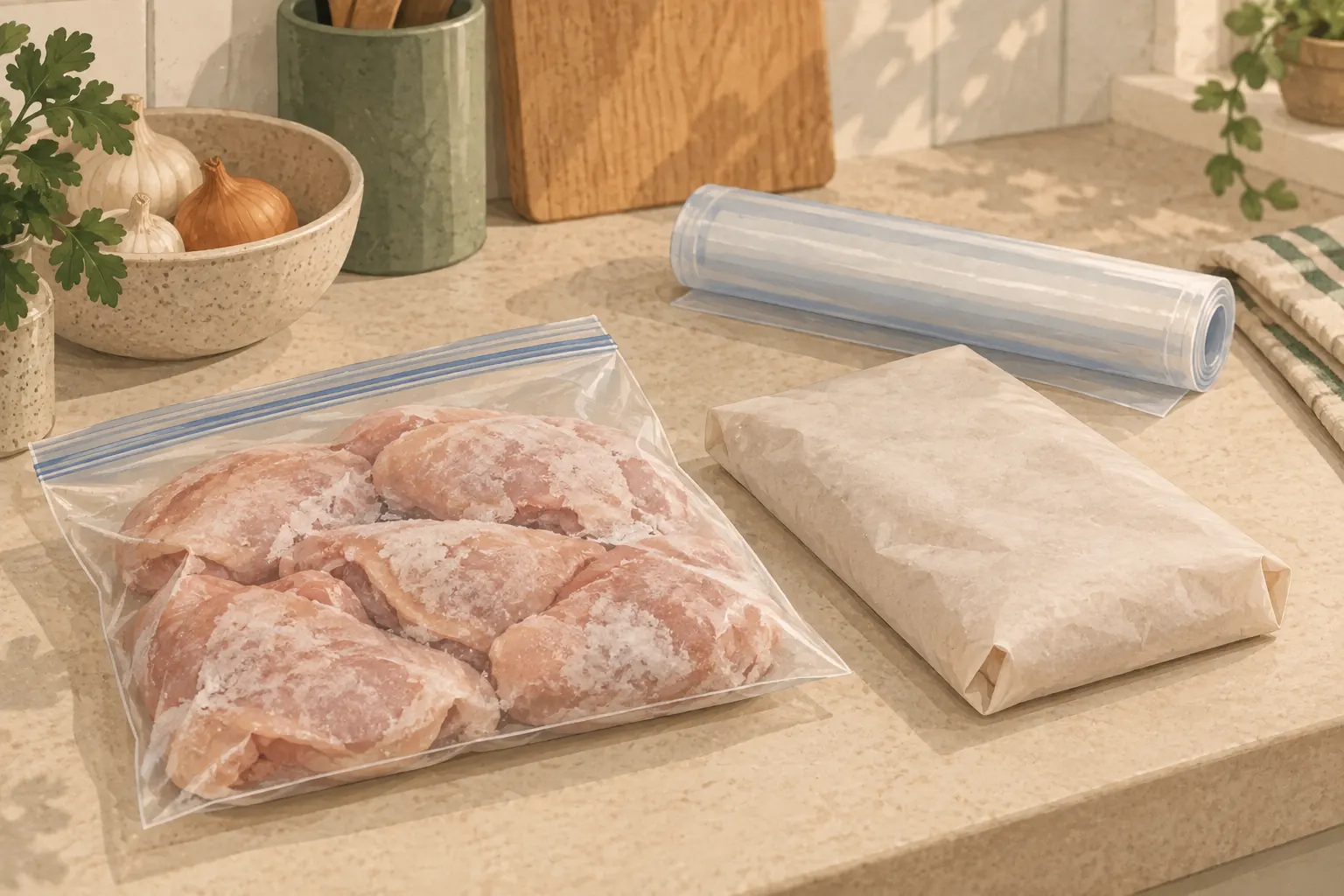
Freezer burn is the grayish-brown leathery patch on frozen food, and USDA's position on it is shorter than most articles about it: "Freezer burn does not make food unsafe, merely dry in spots. It appears as grayish-brown leathery spots and is caused by air coming in contact with the surface of the food."
That is the whole diagnosis, from the Freezing and Food Safety page of the Food Safety and Inspection Service. The agency's instruction is equally short: "Cut freezer-burned portions away either before or after cooking the food. Heavily freezer-burned foods may have to be discarded for quality reasons."
What is actually happening
Water leaves the food and refreezes somewhere else. In a freezer, ice on the surface of unwrapped or badly wrapped food turns straight to vapor, which then settles as frost on the packet or the freezer wall. What it leaves behind is the dry, pale, tough patch.
Two things make it faster: air touching the food, and temperature swings. Every time the freezer warms slightly, a little more moisture moves, which is why the bag at the front of a frost-free freezer suffers more than the one at the back.
The fixes, in order of how much they help
- Get the air out. A bag with the air pressed out beats a half-empty tub every time. Vacuum sealing is better still, but a zip bag rolled flat and squeezed does most of the work.
- Wrap twice for anything staying more than a month. Plastic wrap or foil against the food, then a freezer bag. FSIS's general advice on packaging is to use moisture-vapor resistant materials, the same phrase it uses for freezing cheese.
- Freeze flat and freeze fast. Thin packages freeze quicker and hold their texture better, and they stack.
- Fill the freezer. A full freezer holds its temperature more steadily, which also buys you 48 hours in a power cut rather than 24.
- Label and rotate. Most freezer burn is not a packaging failure, it is a memory failure: the bag that sat there for a year. A freezer inventory sheet on the door fixes that better than better bags do.
Can you eat it?
That is USDA's call, not ours, and the quote above is the agency's answer: the burn itself does not make food unsafe, and the advice is to cut the affected parts away, or to discard food that is heavily affected for quality.
What we can say is what it will taste like. A freezer-burned steak cooks dry and slightly cottony where the patch was. Vegetables go woolly. Ice cream grows crystals and turns grainy. If the food is going into a stew or a curry, the trimmed remainder is usually fine; if it was going to be the center of the plate, it will disappoint.
How long before it shows up
There is no single number, but the storage charts are a good proxy: the months FSIS and FoodSafety.gov give for frozen food are quality times, and freezer burn is the most common way that quality goes. Ground meat gets 3 to 4 months, uncooked roasts 4 to 12, whole poultry 12, and leftovers 2 to 6. You can look any food up in our storage time lookup.
If you'd rather not keep those months in your head, Duneed, our iPhone app, flags an item as a date you give it approaches. It doesn't know which items are in the freezer, so the date is yours to pick.
Food kept at 0°F (-18°C) stays safe indefinitely, in the agency's wording, so what the clock is really counting is texture and flavor. Getting it back out is its own set of rules: the three ways USDA allows you to thaw.
Common questions
Is freezer burn safe to eat?
USDA's wording is that freezer burn "does not make food unsafe, merely dry in spots", and its advice is to cut the burned portions away before or after cooking.
What causes freezer burn?
Air touching the surface of the food, according to FSIS. Moisture leaves those spots and refreezes elsewhere, leaving them dry.
How do you prevent freezer burn?
Press the air out, wrap twice for long storage, freeze flat so it freezes fast, keep the freezer full and use the oldest packages first.
Does vacuum sealing stop freezer burn?
It removes most of the air, which is the cause, so it slows it a great deal. It does not make frozen food last forever: the quality times still apply.
Why does ice cream get icy?
Same mechanism, different result. Moisture escapes and refreezes as crystals, which is why ice cream that has been opened and refrozen several times goes grainy. The federal power outage chart is blunt about ice cream: once it has thawed, discard it.
Sources
- Freezing and Food Safety fsis.usda.gov
- FoodSafety.gov foodsafety.gov
Found a mistake? Tell us and we will correct it: support@duneed.app