
How to split groceries with roommates or a partner: six methods, with the math
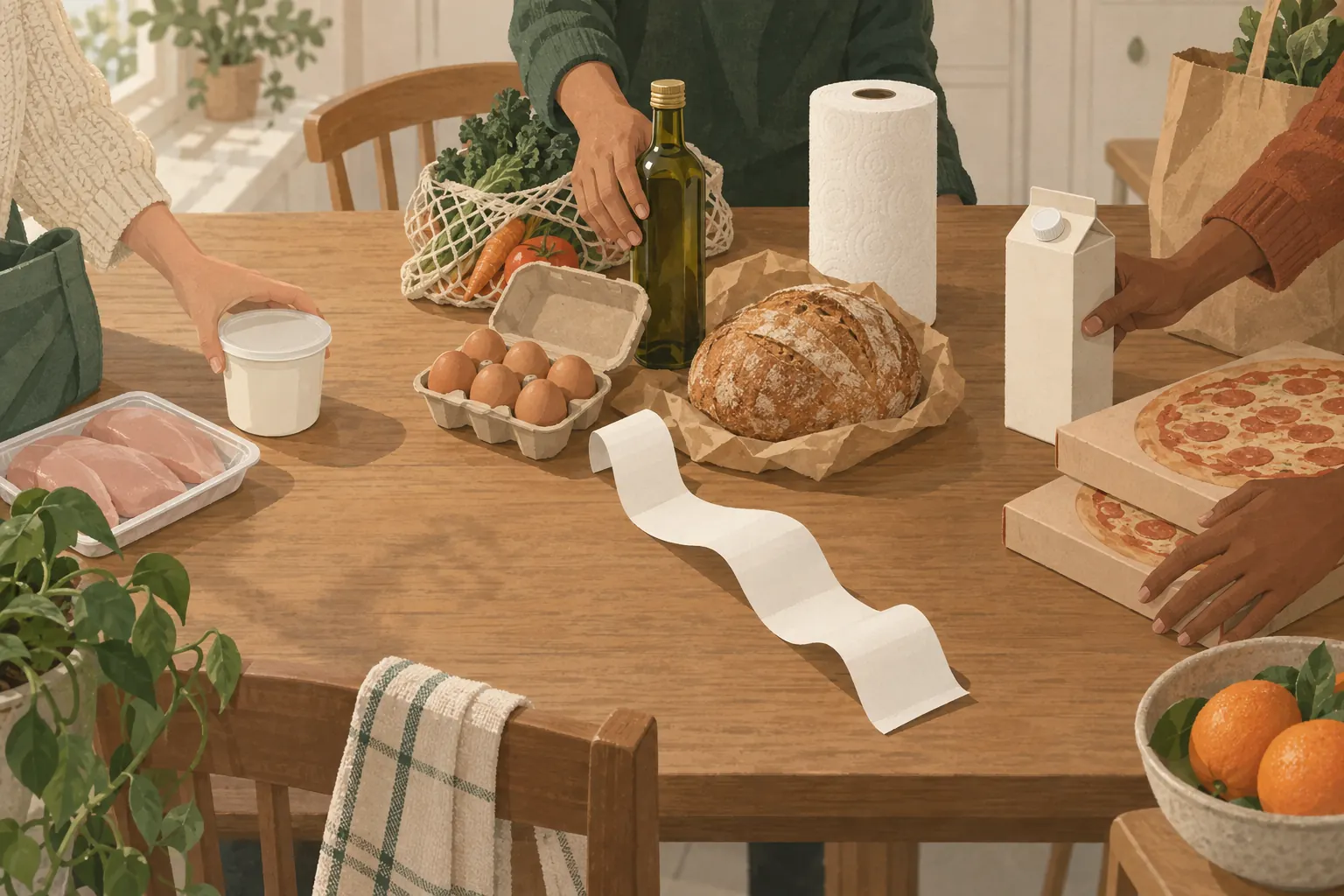
The easiest way to split groceries with roommates is to share only the staples everyone uses (milk, eggs, oil, paper towels) and have each person buy their own food. Couples who eat most meals together usually do better with a kitty or a joint card funded 50/50 or by income. Whatever you pick, settle up on a fixed day each month.
Here's how to split groceries with roommates or a partner, method by method:
| Method | Fairness | Effort | Works when |
|---|---|---|---|
| Even split of every shop | Low if appetites differ | Lowest | Similar diets, similar budgets, cooking together |
| Split by income share | High for couples, odd for roommates | Low | A couple with a real gap in earnings |
| Itemize every receipt | Highest | Highest | Roommates with different diets who shop together |
| Shared staples plus your own food | High | Low to medium | Most roommate households |
| Take turns shopping | Medium, drifts over time | Low | Similar shops, weekly rhythm, nobody keeping score |
| Kitty or joint card | Depends on how it's funded | Lowest once set up | Couples, or roommates who cook together often |
The six ways to split a grocery bill
A grocery split is only two decisions: which purchases count as shared, and in what proportion each person pays for them. Every method below is a different answer to those two questions. The worked examples use the same kind of numbers so you can compare them directly.
Method 1: split every shop evenly
An even split means each person pays the same share of every grocery bill, whatever went in the cart. Two people pay half each; three pay a third. It takes no bookkeeping, which is why most households start here.
It breaks when one person's food is a lot more expensive than everyone else's. On the receipt further down this page, an even split has one roommate paying $4.59 more per shop than she used. That's about $239 a year on a weekly shop, and it's the kind of number that turns into resentment long before anyone says it out loud.
Use it if you cook and eat together most nights and your budgets are close.
Method 2: split by income share
An income-share split means each person pays the same percentage of their income toward groceries, so the higher earner pays more in dollars. It's common among couples and rare among roommates, and for good reason: a roommate's salary is none of your business, and nobody wants to subsidize a flatmate's steak.
The arithmetic for a couple spending $600 a month on groceries, with take-home pay of $4,000 and $2,500:
- Add the incomes: $4,000 + $2,500 = $6,500.
- Work out each share: $4,000 ÷ $6,500 = 61.5%, and $2,500 ÷ $6,500 = 38.5%.
- Apply it to the bill: 61.5% of $600 is $369.23; 38.5% is $230.77.
Compared with an even $300 each, the higher earner pays $69.23 more a month, about $831 a year. Use take-home pay rather than gross if one of you has much bigger deductions, and agree on it once. Recalculating every time someone gets a bonus defeats the point.
Method 3: itemize the receipt
An itemized split assigns each receipt line to whoever it's for, and divides only the shared lines. It's the fairest method and the most work, and it's the one to use when three roommates with different diets do one big shop together.
Say Maya, Theo and Priya do a weekly run and Maya pays at the till. The prices are made up but realistic, and in this example a 7% sales tax applies only to the non-food lines. Your receipt's tax letters tell you which lines were taxed; our guide to grocery receipt codes decodes them.
| Line | Price | Whose |
|---|---|---|
| Milk, 1 gal | 3.79 | Shared |
| Eggs, 18 ct | 4.29 | Shared |
| Sandwich bread | 2.99 | Shared |
| Olive oil, 1 L | 9.49 | Shared |
| Bananas | 1.62 | Shared |
| Paper towels (taxed) | 7.99 | Shared |
| Dish soap (taxed) | 3.49 | Shared |
| Oat milk | 4.49 | Theo |
| Greek yogurt, 32 oz | 5.99 | Maya |
| Chicken breast | 11.47 | Maya |
| Beer, 6 pack (taxed) | 10.99 | Theo |
| Frozen pizza, 2 | 9.98 | Priya |
| Tax on shared lines | 0.80 | Shared |
| Tax on the beer | 0.77 | Theo |
| Total | 78.15 |
The shared lines plus their tax come to $34.46, which is $11.49, $11.49 and $11.48 split three ways (someone absorbs the penny). Add each person's own lines:
| Person | Shared third | Own lines | Owes for this shop | Even split would be |
|---|---|---|---|---|
| Maya | 11.49 | 17.46 | 28.95 | 26.05 |
| Theo | 11.49 | 16.25 | 27.74 | 26.05 |
| Priya | 11.48 | 9.98 | 21.46 | 26.05 |
Maya already paid $78.15, so Theo owes her $27.74 and Priya owes her $21.46. Under an even split Priya would have paid $4.59 extra, all of it covering Maya's and Theo's food.
Tax goes with the line it was charged on. So do discounts: if the olive oil was on sale, the shared line is cheaper and everyone benefits; if Theo used a coupon on his beer, that saving is his.
Method 4: shared staples plus your own food
This hybrid splits a short, agreed list of staples evenly and leaves everything else to each person. It's what most roommate households end up with, because it keeps most of the fairness of itemizing with a fraction of the bookkeeping. You only track the staples.
The list has to be written down, or it grows. A workable one is things everyone uses in small amounts and nobody wants to label: cooking oil, salt, pepper and common spices, sugar, coffee or tea if everyone drinks it, milk if everyone uses it, dish soap, sponges, paper towels, trash bags, toilet paper and foil. Leave out anything one person eats most of. If Theo drinks a gallon of milk a week and nobody else touches it, milk is his.
With a monthly staples bill of $90, three roommates each put in $30, and each buys their own food. The staples section further down covers what to do when someone buys a big pack.
Method 5: take turns shopping
Rotating shops means each person buys the household's groceries in turn and nobody pays anyone back. It feels fair and needs no math, and it works when the shops are similar in size and everyone rotates at the same pace.
It drifts. The week before Thanksgiving costs more than a random week in February, and whoever's turn lands on the pantry restock pays for the $15 olive oil. If you rotate, tally the receipts every three months and square up the difference with the settling-up steps below.
Method 6: a kitty or joint card
A kitty is a pot of money every person pays into on a set day, used only for shared groceries. It can be cash in a jar, a shared account, or a joint card. It's the least friction per shop because nobody owes anybody after the checkout; the only decision is how much each person puts in.
For couples this is usually the end point: a joint account or card for groceries, funded evenly or by income share (Method 2 for the funding, Method 6 for the spending). For roommates, a kitty only for staples works well; a kitty for all food works only if you cook together.
Size it from what you actually spend. Two or three months of receipts will tell you, and our guide to tracking grocery spending shows how to get a real monthly figure out of them. Top up when the pot runs low rather than letting one person float the difference.
How to split groceries with a partner
Couples split groceries with the same methods as roommates, but the answer usually changes once you eat most meals together: itemizing becomes silly, and the real question is how you fund a shared pot. The most common setups are an even split, an income-share split, or a split by what each person eats.
Our grocery budget for two covers what a couple should spend in 2026 and works out a split by appetite from USDA's per-person figures, which is the answer to the "boyfriend who eats more" question. Two things it doesn't cover:
- Combining income and appetite: you can, but don't. Pick the one that matches what feels unfair to you. If the gap is in earnings, split by income. If the gap is in how much each person eats, split by what each eats. Stacking both produces a formula nobody remembers by March.
- Food eaten apart: lunches bought at work, one person's protein shakes, the other's weekend baking project: keep these personal, even if everything else is joint.
Should couples split groceries at all? If you're already sharing rent and most dinners, a joint grocery card funded by a percentage you agreed once is less work than tracking every shop, and a few dollars of drift a month matters less than twelve conversations a year about who owes what. Couples who keep finances fully separate can still use a kitty; they just fund it from two accounts.
How much should each person put in?
A fair share starts from a realistic total. The Bureau of Labor Statistics' Consumer Expenditure Survey for 2024 puts average food-at-home spending at $6,224 per household for the year, about $519 a month, across households of every size.
For a specific household, USDA's food plans are more useful. On the Moderate-Cost plan for July 2026, a woman aged 19 to 50 costs $337.10 a month and a man the same age $398.70, assuming every meal and snack is made at home. USDA then adjusts for household size: add 10% for a two-person household, 5% for three.
| Household (all 19 to 50) | Moderate plan, per month | Per person |
|---|---|---|
| A couple, one man and one woman | $809 | about $405 |
| Three roommates, two women and one man | $1,127 | about $376 |
Our arithmetic from USDA's per-person figures, rounded to the dollar. Roommates rarely eat every meal together, so for them the table is a ceiling for all food, not the size of a staples kitty. A staples-only pot is usually a small fraction of it. If you're budgeting your own food on top of the shared part, our grocery budget for one person has the single-person figures.
Staples: what counts as shared and who buys it
Shared staples are the items the whole household uses in small amounts, bought by whoever notices they're low and paid from the shared pot. The rule that makes this work is that finishing something means adding it to the list, not buying it on the spot out of your own pocket.
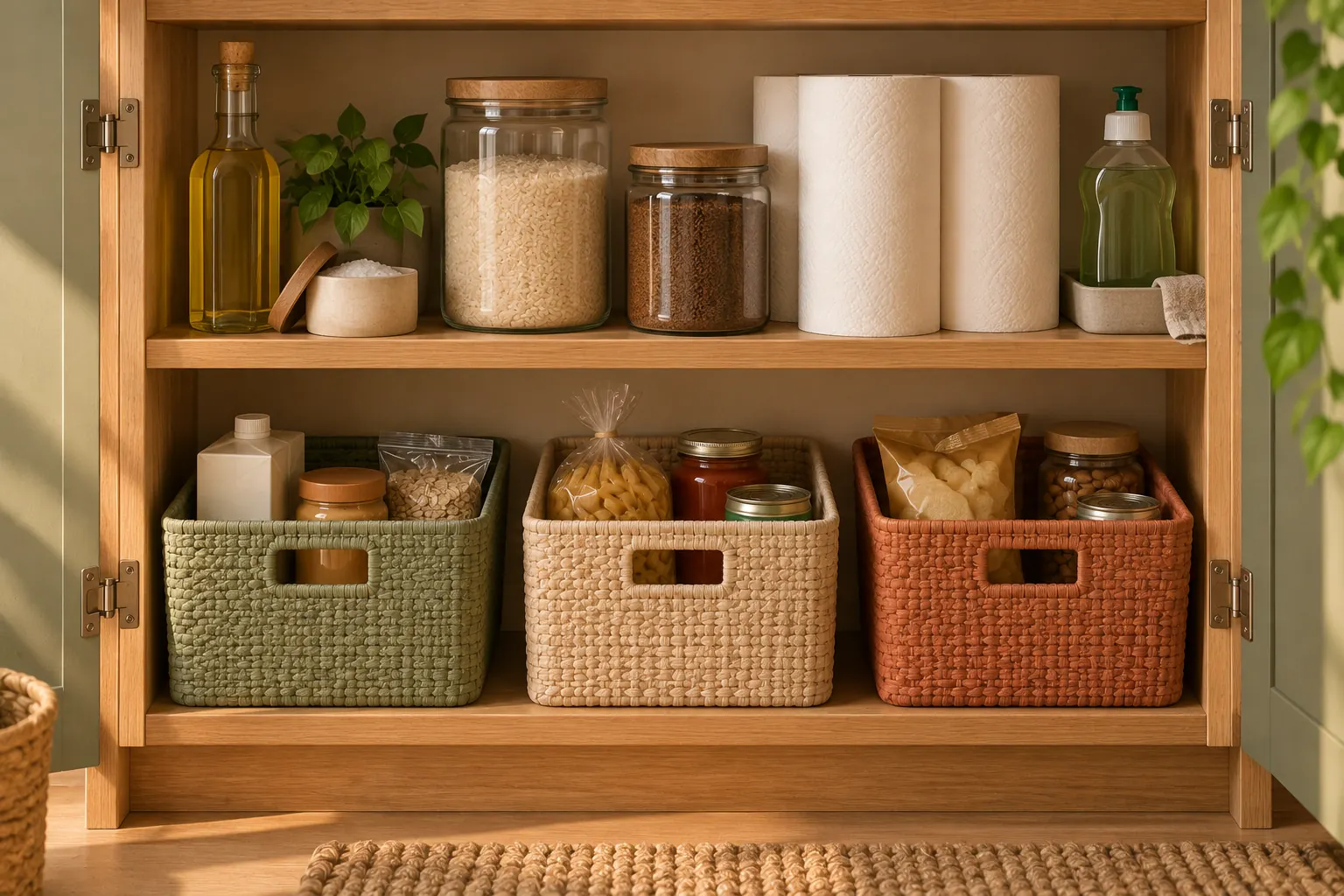
A shared grocery list handles the "we now own three bottles of soy sauce" problem, and that article has the house rules for it. The money side has two more rules:
- Big packs are split when bought, not when used. A $24 warehouse-club pack of toilet paper goes into the shared tally that month, even though it lasts a quarter.
- Someone moving out doesn't get a refund for half a bottle of olive oil. Leftover staples stay with the house. It evens out, because the next person inherits the salt.
When a new roommate arrives, they start paying into staples from their first full month. That's simpler than pro-rating a pantry.
Guests, partners who stay over, and dietary differences
Guests who eat occasionally cost nothing worth tracking. Regular guests do, and the fairest fix is to count them as part of a person.
Say Theo's partner stays four nights a week and uses the staples like everyone else. Count her as 4/7 of a person, about 0.57, attached to Theo. The $90 staples bill is now split across 3.57 shares:
- $90 ÷ 3.57 shares = $25.20 per share.
- Maya and Priya pay one share each: $25.20.
- Theo pays 1.57 shares: $39.60.
That adds back to $90, and it settles the partner question with a number instead of a hint.
Dietary differences are handled by the staples list rather than a separate rule. If the vegetarian and the meat eater both use rice, onions and oil, those are shared. The chicken and the tofu are personal. For allergies, the question is who eats the item: if the whole house has switched to one brand of bread because one person can't eat the other kind, that bread is shared. If only one person eats a pricier version, it's theirs.
How to settle up grocery costs
Settling up means working out, once per period, the difference between what each person paid and what they should have paid for the shared items, and moving that money. Monthly is the right cadence for most households: often enough that the sums stay small, rare enough that nobody's sending $3.12 transfers.
- Add up the shared spending for the month from the receipts (or photos of them), and note who paid each one.
- Work out each person's fair share: the shared total divided by the number of people, or weighted if you use income share or the guest rule.
- For each person, subtract their fair share from what they paid. A positive number means they're owed; a negative number means they owe.
- Have the people who owe pay the people who are owed, in as few transfers as possible.
In a month where three roommates spent $360 on shared items, with Maya paying $210, Theo $95 and Priya $55, the fair share is $120 each. Maya is +$90, Theo is minus $25, Priya is minus $65. Two transfers square it: Theo sends Maya $25 and Priya sends Maya $65.
Apps that split a grocery bill
A bill-splitting app does the settling-up arithmetic for you: you log each shared expense and who paid, and it keeps a running balance of who owes whom. The better-known ones, going by what each says on its own site:
- Splitwise is free for iPhone, Android and the web, and supports equal and unequal splits, including by percentage or shares. It can simplify debts across a group. Splitwise Pro adds receipt scanning, itemization, unlimited expenses and no ads.
- Settle Up is built for flatmates, couples and travelers, runs on iOS, Android and the web, and works out settlements with as few payments as possible.
- Tricount tracks and splits shared costs and describes itself as 100% free.
A shared spreadsheet with one row per receipt, a "paid by" column and a formula for the balance does the same job if you'd rather not add another app.
Duneed doesn't split bills or track who paid; it's for the groceries themselves. Premium's household sharing puts everyone on one pantry and one shopping list, and a scanned receipt gives you each line with the price paid, which is the itemized list Method 3 needs.
Which method should you pick?
Pick the least bookkeeping your household can tolerate without anyone feeling cheated. For most roommates that's shared staples plus your own food, settled monthly. For couples who eat together, it's a kitty or joint card funded evenly or by income share. Itemizing is worth the effort only while diets differ a lot and you shop together. If you're setting up a kitchen from scratch, our first apartment grocery list is a good place to agree on the staples list before anyone buys anything.
Common questions
Is it fair to split groceries 50/50 if one person eats more?
A 50/50 grocery split is fair only when both people eat roughly the same amount and the same kind of food. If one person eats noticeably more, split in proportion to what each person eats, for example by each person's line in USDA's food plans, or move the extra into that person's own food.
Should roommates share food?
Roommates should share staples and keep most other food separate, unless they cook together most nights. Sharing everything works for households that eat as a group; it fails when one person's groceries cost much more than the others'.
How often should roommates settle up for groceries?
Roommates should settle grocery costs once a month, on a fixed date. Weekly settling creates tiny transfers nobody wants to send, and settling only when someone asks lets balances grow into awkward sums.
What if one roommate never buys the staples?
A roommate who never buys staples should pay into a staples kitty instead of taking turns. A fixed monthly amount, paid on the same day as rent, removes the question of who bought the last pack of paper towels.
Sources
- Consumer Expenditure Survey for 2024 bls.gov
- Moderate-Cost plan for July 2026 fns-prod.azureedge.us
- Splitwise splitwise.com
- Splitwise Pro splitwise.com
- Settle Up settleup.io
- Tricount tricount.com
Found a mistake? Tell us and we will correct it: support@duneed.app