
Grocery receipt codes: what the letters, numbers and abbreviations mean
Grocery receipt codes come in two kinds, and telling them apart saves a lot of guessing. Some are shared standards that mean the same thing at every store: the produce PLU, the UPC barcode number, the masked card number, the chip fields like AID. The rest is house dialect, set up in each chain's register software. That includes the single letters after prices (F, N, T, X, A, E) and most of the shorthand in item names.
The long number beside an item is usually its UPC. A 4-digit number is a produce PLU (5 digits starting with 9 means organic). "@" and "LB" show unit price and weight. A letter after the price is a tax flag, and it isn't standardized: it varies by chain and state, so check the tax legend near the total.
Once you can read the lines, the prices on them are worth keeping: a grocery price book turns a stack of receipts into one page that says what each item should cost.
Grocery receipt codes decoder table
Find the code you're staring at. "Usually" is doing real work in the middle column: where a meaning comes only from shopper reports rather than the store itself, the table says so.
| Code on the receipt | What it usually means | Where you'll see it |
|---|---|---|
| 12-digit number | UPC (GTIN-12), the product's barcode number | Next to packaged items, most US chains |
| 13-digit number | EAN (GTIN-13), the barcode number used outside North America | Imported goods; receipts in Europe and elsewhere |
| 4-digit number (3000s or 4000s) | PLU for conventionally grown loose produce | Produce lines everywhere |
| 5-digit number starting with 9 | PLU for organic produce (9 + the 4-digit code) | Produce lines |
| Shorter number that isn't a UPC | The chain's own item number | Costco and some other chains |
| QTY, EA, @ | Quantity, "each," and unit price ("2 @ 2.50") | Multi-unit lines |
| LB, KG, NET WT, /LB | Weight charged and price per pound or kilo | Produce, deli, meat, bulk bins |
| VOID, VD | A line cancelled after scanning (negative amount) | Any store |
| PRICE OVERRIDE, PO, PRC CHG | Price changed by hand at the register | Any store |
| SAVINGS, YOU SAVED, SC, STR CPN | Store discount or store coupon | Any store |
| MC, MFR, MFR CPN | Manufacturer coupon | Any store |
| TPD, IRC | Costco markdown lines (reported: TPD a Costco markdown, IRC a manufacturer rebate) | Costco, unofficial |
| N, X, O | Not taxed, taxed, disputed | Walmart, unofficial |
| A, E | Taxed, tax-exempt | Costco, shopper reports only |
| T, F | Taxed; food (reduced rate or SNAP-eligible) | Target, Kroger and others, shopper reports only |
* (asterisk) next to an item |
Item subject to VAT | Sainsbury's (official); Tesco on older receipts (forum reports) |
| TAX 1, TAX 2 | Separate tax rates, often state and local, or general and food | Tax summary above the total |
| SUBTOTAL, SUBTOT | Items minus discounts, before tax | Money block |
| TEND, AMT TEND | Amount you handed over, by payment type | Money block |
| CHANGE DUE, CHG | Cash returned | Money block |
| EBT, FS, SNAP BAL | SNAP payment and remaining balance | Stores that accept EBT |
| APPR, AUTH, AP CODE | Card approval code from the issuer | Card block |
| AID | EMV Application Identifier, which chip application ran | Card block |
| TVR, TSI, ATC, AC | Chip diagnostic and cryptogram fields | Card block, more on some chains than others |
| CHIP READ, CONTACTLESS, INSERTED, SWIPED | How the card was read | Card block |
| PIN VERIFIED, SIGNATURE | How you were verified | Card block |
****1234 or XXXX1234 |
Masked card number | Card block |
| MID, TID | Merchant ID and terminal ID | Card block |
| REF #, TRN REF # | Payment reference number | Card block |
| ST# | Store number | Header or footer |
| OP# | Operator, meaning the cashier or self-checkout ID | Header or footer |
| TE#, REG# | Terminal or register number | Header or footer |
| TR#, TRANS# | Transaction number on that register | Header or footer |
| TC# | Walmart's transaction code, printed under the bottom barcode | Walmart |
| GV | Great Value (Walmart's store brand) | Walmart item names |
| KS | Kirkland Signature (Costco's store brand) | Costco item names |
| ORG | Organic | Item names, most chains |
How to read a grocery receipt, top to bottom
Every grocery receipt has the same four zones, even when the layout looks nothing alike. The header tells you who sold it (store, address, often ST#, OP#, TE#, TR#). The body lists what you bought, one line per scan, with a tax flag at the end. The money block adds it up. The footer or card block tells you how you paid and gives the numbers the store uses to find the sale again.
Below is a receipt we made up for this article. The layout borrows from common US formats, but it isn't any real store's receipt, and the tax letters (N for not taxed, X for taxed) are only an example scheme.
ST# 1234  OP# 000817  TE# 12  TR# 05531

WHL MLK 1G        012345678905     3.48 N
DICED TOM 14.5Z
   2 @ 2.50                        5.00 N
   SAVINGS                        -1.00 N
BANANAS           000000004011
   2.31 LB @ 0.62 /LB              1.43 N
ORG BANANAS       000000094011
   1.10 LB @ 0.79 /LB              0.87 N
HNY NUT CRL       0xxxxxxxxxx2     4.29 N
HNY NUT CRL       0xxxxxxxxxx2     4.29 N
VOID HNY NUT CRL                  -4.29 N
   MFR CPN                        -0.75 N
PAPER TWL 6RL     0xxxxxxxxxx7     8.97 X

              SUBTOTAL            22.29
     TAX 1    7.000 %              0.63
              TOTAL               22.92
              CREDIT TEND         22.92
              CHANGE DUE           0.00

VISA CREDIT   ************4417
CHIP READ     PIN VERIFIED
APPR# 07Q3RB  AID A0000000031010
TVR 0080008000  TSI E800
# ITEMS SOLD 7
TC# 0000 0000 0000 0000 0000
The arithmetic, so you can check your own the same way:
- Tomatoes: 2 cans at $2.50 is $5.00, then a $1.00 sale saving comes off on the next line. The shelf tag said $2.00 each, and the receipt gets there in two steps instead of one.
- Bananas: 2.31 lb × $0.62/lb = $1.4322, rounded to $1.43. The organic ones use the same code with a 9 in front: 4011 becomes 94011.
- Cereal: scanned twice by accident, so one scan is voided (−$4.29). The manufacturer coupon (−$0.75) applies to the box that stayed.
- Tax: only the paper towels carry X. $8.97 × 7% = $0.6279, which rounds to $0.63.
- Subtotal: 3.48 + 5.00 − 1.00 + 1.43 + 0.87 + 4.29 + 4.29 − 4.29 − 0.75 + 8.97 = 22.29. Add $0.63 tax and you get $22.92.
If you only check two kinds of line on a real receipt, make it the weighed produce and anything with VOID or a minus sign. Those are where a mistake costs you money without looking odd.
Why item names are abbreviated on receipts
Nobody is encoding anything. The item name lives in a short description field set up by the retailer, and it has to share a narrow thermal-paper line with a product number, a price and a tax flag. Point-of-sale software is built around fixed line widths: the LS Central POS system, for example, documents a default receipt layout of 40 characters per line. Take out 12 characters for a UPC, 7 for the price and a couple for the tax letter, and roughly 15 to 18 are left for "Great Value Whole Vitamin D Milk, 1 gallon."
So the names get squeezed, and the squeeze follows patterns you can learn in a minute:
- A brand prefix comes first, shortened to initials. On Walmart receipts that's GV for Great Value, which Walmart describes as its flagship private brand of nearly 10,000 food and consumables items. On Costco receipts it's KS for Kirkland Signature, the private label Costco discusses in its annual report. Lines like "KS ORG CHK" (organic chicken stock) are typical; one shopper's log of decoded Costco receipt lines is a good illustration of how cryptic it gets.
- Vowels get dropped first. WHL MLK, CHKN BRST, SWT POTATOES, HNY NUT.
- Size and count come last, in shorthand: 1G (gallon), 14.5Z or 14.5OZ, 6RL (six rolls), 12CT, 2PK.
- Common words have near-standard short forms: ORG (organic), BNLS (boneless), FRZ (frozen), RDC FAT (reduced fat).
When a line still won't give up its secret, the product number is your best lead. Search the UPC in a search engine or on the store's own website. For produce, look up the 4- or 5-digit PLU in the IFPS PLU database, dropping the leading 9 if it's organic. At Costco, your in-warehouse receipts from the last two years are viewable in your Costco.com account under Orders & Purchases.
If you're decoding receipts because you want to know where the grocery money goes, retyping "HNY NUT CRL" into a spreadsheet gets old fast, which is why some pantry and grocery apps read the receipt for you. Duneed, our iPhone app, reads the line items from a photo of the receipt and writes each one as a plain product name ("HNY NUT CRL" comes back as something like honey nut cereal), puts it in a category with the price you paid, and shows you the list before anything is saved. If it reads a line wrong, you rename it there. The receipt image is deleted once it's read. Best grocery receipt scanner apps sorts the options by what they do with the receipt.
For the spreadsheet route and the other ways to do it, see how to track grocery spending. If you want a number to aim for, how much to spend on groceries breaks it down by household size.
UPC, PLU and store item numbers
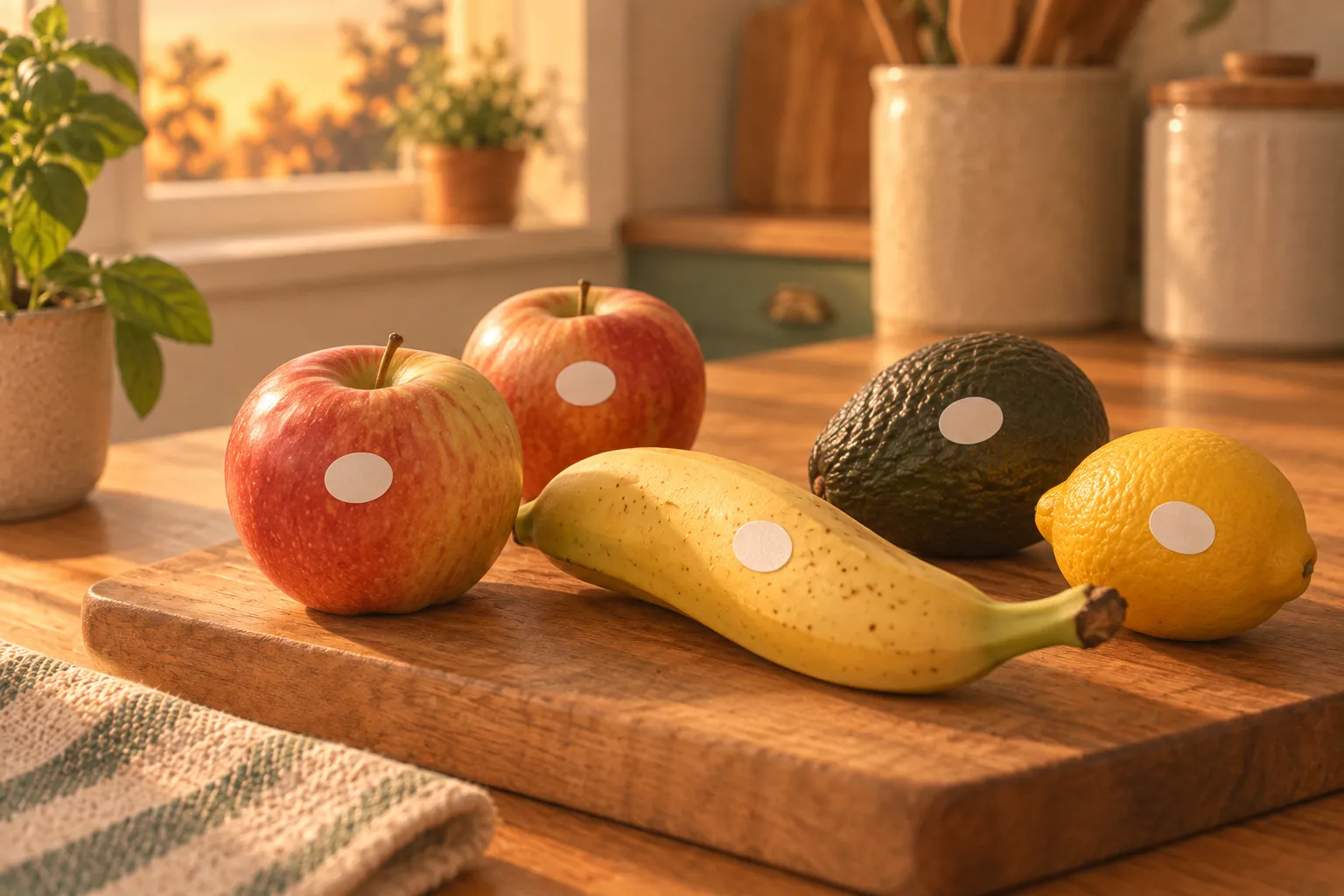
UPC and EAN
A UPC is a 12-digit product number. GS1, the standards body behind barcodes, says GTIN-12 is also called UPC and is mostly used in North America, while the 13-digit EAN is used in Europe and most of the rest of the world. Some receipts print it in full. Others print a store's internal item number instead, or nothing at all. None of these tells you the price or the tax status; it's just the key the register uses to look those up.
PLU codes on produce
A PLU code is the 4- or 5-digit number on the small sticker on loose fruit and vegetables, and it's the one receipt code with a clear public rulebook. The International Federation for Produce Standards (IFPS) assigns them, and its PLU FAQ spells out the rules:
- 4-digit codes in the 3000 and 4000 series are conventionally grown produce. The digits carry no hidden meaning; they're assigned at random within that range.
- A 5-digit code starting with 9 is organic. The 9 goes in front of the conventional code, so a standard yellow banana is 4011 and an organic one is 94011.
- The 9 is the only prefix with a meaning. IFPS itself tells shoppers to look for the USDA organic seal if they want to be sure an item is certified organic.
- The system is voluntary. No government agency requires PLU stickers; retailers do.
- A 6-digit code, or a 5-digit code starting with something other than 9, isn't part of the international list for now. It's likely the store's own numbering.
The 8 prefix is where plenty of guides are still out of date. You'll still read that a code starting with 8 means genetically modified. It was once reserved for that, but IFPS said in a 2015 release that the 8 prefix was never used at retail and would be stripped of that meaning to free up more numbers. When IFPS starts handing out 83000 and 84000 codes, the 8 will mean nothing: the 83000s will be conventional produce and the 84000s their organic versions. A PLU code can't tell you whether produce is GMO.
Quantity and weight lines
The "@" sign means "at." "2 @ 2.50" is two units at $2.50 each. "EA" means each, and "QTY" is quantity.
Weighed items take a second line with the weight, the unit price and the result: "2.31 LB @ 0.62 /LB." Outside the US you'll see KG and a price per kilo. NET WT, where a store prints it, means the weight of the food itself, without the packaging or container.
That's the line to check. Multiply the weight by the price per pound on your phone's calculator and compare it with the amount at the right. Then check the price per pound against the shelf sign, especially on organic produce: a conventional PLU keyed in for an organic item (or the other way round) changes the per-pound price without looking wrong on paper.
Discounts, coupons, voids and price overrides
Sale prices often don't show up as a lower price on the item line. Instead the item rings at the regular price and a separate line below it subtracts the saving, labeled something like SAVINGS, YOU SAVED, or a loyalty program's name. If you compare line prices with shelf tags, include the minus line under each one or everything will look overpriced.
Coupons follow the same pattern. MC, MFR or MFR CPN is a manufacturer coupon (funded by the brand). SC or STR CPN is a store coupon. At Costco, the discount lines are commonly reported as TPD for a Costco-funded markdown and IRC for a manufacturer-funded instant rebate, but Costco doesn't publish that legend.
A VOID line is a scan the cashier cancelled, printed with a negative amount. Voids are normal: a double scan, a change of mind, the wrong size of yogurt. What matters is that the void matches a line above it at the same price. A void for a $1.29 item placed against a $4.29 double scan leaves you paying $3.00 for nothing.
PRICE OVERRIDE, PO or PRC CHG means someone typed a new price by hand, usually after a price check. If you asked for one, make sure the new price is the one you agreed to.
Tax codes on receipts: F, N, T, X, A, B and the rest
There is no standard for these letters. Each chain configures its own in its register software, and even inside one chain the same product can get a different letter depending on state and local tax rules. No large US grocer we could find publishes an official key.
The reason the same box of cereal can be flagged differently in two states is that grocery tax itself varies. AARP counts eight states that still tax groceries in 2026, usually at a reduced rate, and notes that Illinois dropped its 1% state grocery tax on January 1, 2026 while letting municipalities keep a local one. In some states candy, soda or prepared food fall outside the grocery rate too, so one trip can produce two or three different letters.
The practical way to decode your letter: look just above or below the total. Many receipts print a legend like "TAX 1 7.000%" or "X = 7.00%," and the lines with that letter are the ones that tax applies to.
What's known by store, and how well it's known:
| Store | Letters | Reported meaning | How reliable |
|---|---|---|---|
| Walmart | N, X | N not taxed, X taxed | Shopper and employee reports; consistent for years, but no Walmart key |
| Walmart | O | Either a non-taxed sale item or a reduced tax rate | Forum reports that contradict each other |
| Costco | A, E | A taxed, E tax-exempt | Shopper reports only |
| Target | T, N | T taxed, N not taxed | Shopper reports only |
| Kroger | F, T | F food or SNAP-eligible, T taxed | Shopper reports only |
| Aldi (US) | Various | No consistent meaning found | Nothing reliable found |
| Trader Joe's | Various | No consistent meaning found | Nothing reliable found |
| Sainsbury's (UK) | * |
Item subject to VAT | Official Sainsbury's help page |
| Tesco (UK) | * |
Standard-rate VAT item | Accountants' forums; newer receipts reportedly dropped the mark |
For UK readers, the pattern of asterisks has a simple explanation. Under HMRC's VAT notice on food, most food is zero-rated, but confectionery, crisps, soft drinks, alcohol and ice cream are standard-rated. So on a Sainsbury's receipt the stars cluster on the snacks and drinks, plus anything non-food.
"F" gets asked about more than most letters. At many US grocers it's reported to mark a food item, which often lines up with what you can buy with SNAP. Treat it as a hint, not a ruling: the letter comes from the store's configuration, not from USDA.
The payment block: APPR, AID, TVR and the masked card
The card section looks technical because much of it is printed for the store's payment processor, not for you. The fields come from EMV chip processing, and processors list what should appear. Payment company Shift4's receipt printing guide, for instance, covers the application identifier, application label, entry mode, cardholder verification method, TVR and TSI.
- APPR, AUTH or AP CODE is the approval code from your card issuer. Worth having if you ever need to dispute the charge.
- AID (Application Identifier) names the chip application that ran. A0000000031010, for example, is a Visa application; the application label next to it says the same thing in words, such as VISA CREDIT.
- CHIP READ, INSERTED, CONTACTLESS or SWIPED is how the card was read. PIN VERIFIED or a signature line shows how you were verified, when you were.
- TVR (Terminal Verification Results) and TSI (Transaction Status Information) are diagnostic codes for what the terminal checked. ATC and AC are a transaction counter and a cryptogram. You can ignore all four.
- MID and TID identify the merchant account and the specific terminal. REF # or TRN REF # is a reference number the store can use to find the payment.
The masked card number is regulated. Under the Fair and Accurate Credit Transactions Act, a business may print no more than the last 5 digits of the card number, and not the expiration date, on an electronically printed receipt. If a register receipt ever shows your full number or expiry date, that's a violation, and the receipt should be shredded rather than tossed.
SNAP purchases get their own lines. Federal rules require the receipt for an EBT transaction to show, among other things, the transaction amount and the remaining balance, which is where lines like "EBT FS BAL" come from.
Transaction numbers: ST, OP, TE, TR and TC
The row of short codes at the top or bottom identifies the sale:
- ST# is the store number.
- OP# is the operator: the cashier's ID, or a self-checkout lane's.
- TE# is the terminal or register.
- TR# is the transaction number on that register.
Together, those plus the date and time pin down one sale in one store.
What does TC mean on a receipt?
TC# is Walmart-specific. It's the long number printed under the barcode at the bottom of a Walmart receipt, and it's consistently described as a transaction code that identifies the purchase in Walmart's systems. We couldn't find a Walmart page that defines it, so treat that meaning as consistent reporting rather than official documentation. If you keep only one number from a Walmart receipt, keep that one. At other chains TC isn't a common label; TR# or TRANS# does a similar job.
Store notes: Walmart, Costco, Target, Kroger, Aldi and Trader Joe's
Walmart receipt codes
Walmart receipts typically put ST#, OP#, TE# and TR# on one line, list items with a UPC and a tax letter, and end with the TC# and a barcode. N and X are the tax letters reported most often; O is the one to be careful with, because reports disagree on what it means. Item names lean on GV for Great Value and ORG for organic. The unique survey code on the receipt is for Walmart's customer satisfaction survey, and completing it counts as a sweepstakes entry under Walmart's official rules.
Costco receipt codes
Costco receipts identify items by Costco's own item number rather than a UPC, next to a heavily abbreviated name (KS for Kirkland Signature is everywhere). The A and E letters on item lines are reported to mean taxed and tax-exempt. Discounts print as separate negative lines under the item, reported as TPD or IRC.
The Costco asterisk question usually comes from mixing up the price tag and the receipt. The asterisk shoppers talk about sits on the warehouse shelf sign, and it's widely reported to mean the item won't be reordered once current stock sells through. That's shopper and former-employee lore; Costco hasn't published it. We also looked for a reliable explanation of a "Y" on Costco receipts and didn't find one, so we won't guess.
Target receipt codes
Shoppers report a T or N at the end of Target item lines, meaning taxable and non-taxable. There's no Target-published key, so confirm it against the tax legend at the bottom.
Kroger receipt codes
Kroger receipts are reported to carry F on food items (food or SNAP-eligible) and T on taxed items. As with the others, Kroger doesn't publish what its letters mean, so the tax summary on your own receipt is the tiebreaker.
Aldi and Trader Joe's
We couldn't find a reliable, consistent explanation of the letters on either chain's US receipts, only scattered forum guesses. Use the tax legend on your own receipt. Aldi UK receipts are reported to use letters for VAT bands, but accounts of which letter is which disagree, so the same advice applies.
Sources
- default receipt layout of 40 characters per line help.lscentral.lsretail.com
- nearly 10,000 food and consumables items corporate.walmart.com
- annual report sec.gov
- log of decoded Costco receipt lines doyoureallyknowwhatyoureeating.blogspot.com
- IFPS PLU database ifpsglobal.com
- in-warehouse receipts from the last two years customerservice.costco.com
- Costco.com costco.com
- GTIN-12 is also called UPC and is mostly used in North America support.gs1.org
- PLU FAQ ifpsglobal.com
- 2015 release ifpsglobal.com
- eight states that still tax groceries in 2026 aarp.org
- Official Sainsbury's help page help.sainsburys.co.uk
- VAT notice on food gov.uk
- receipt printing guide docs.shift4.com
- no more than the last 5 digits of the card number, and not the expiration date law.cornell.edu
- transaction amount and the remaining balance law.cornell.edu
- official rules corporate.walmart.com
Found a mistake? Tell us and we will correct it: support@duneed.app