How to organize your fridge: a shelf-by-shelf chart and an eat-first bin
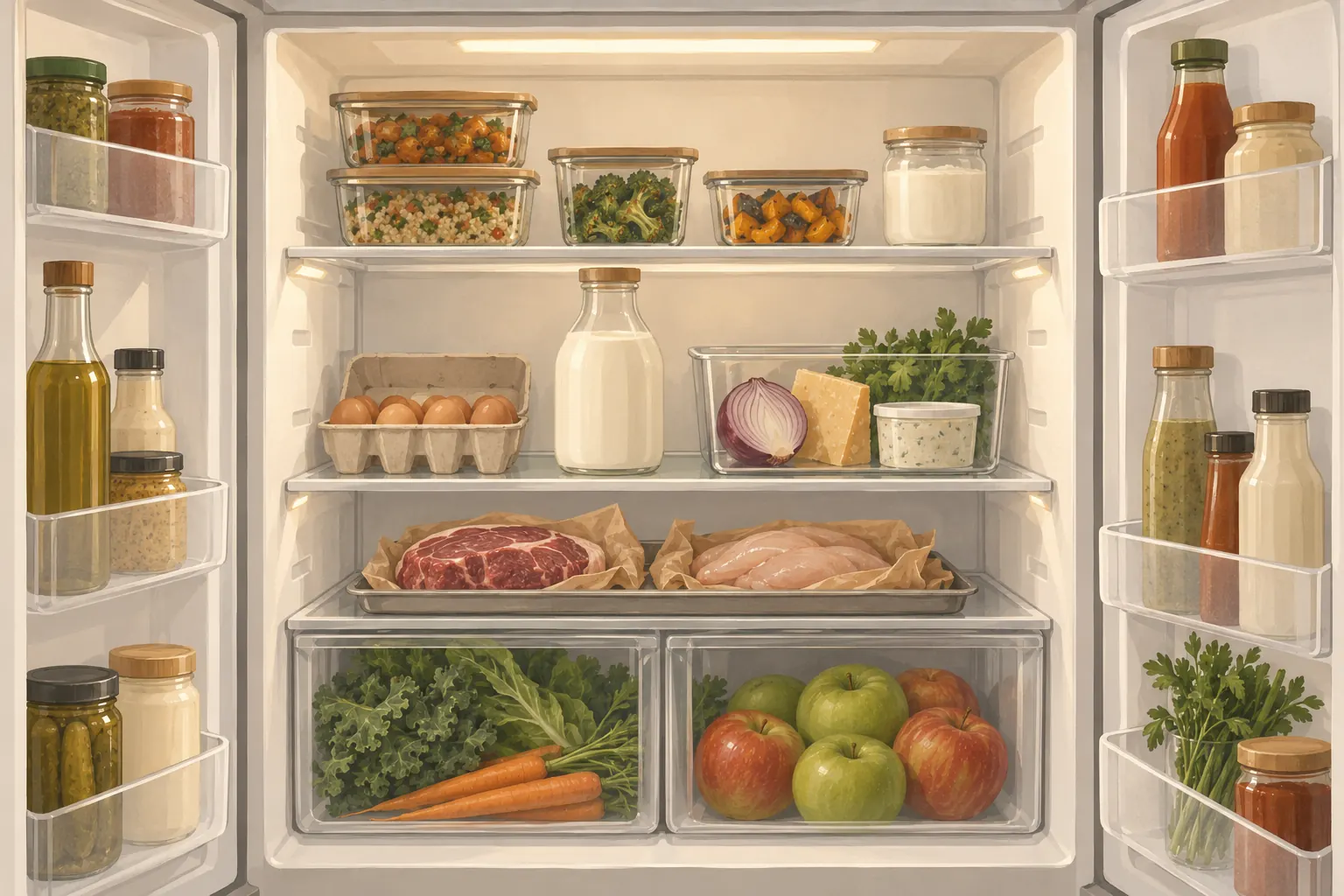
To organize your fridge, put ready-to-eat food and leftovers on the upper shelves, raw meat, poultry and fish sealed on the bottom shelf, fruit and vegetables in the crisper drawers, and only condiments and drinks in the door. Then give food that needs eating soon one clear bin at eye level, and put new groceries behind the old ones.
The chart below says what goes where and why. The steps after it take about an hour, and the food waste section covers how to stop the fridge filling up with things nobody remembers buying.
Fridge organization chart: what goes on each shelf
A fridge organization chart sorts food by two things: what could drip onto what, and how much each spot's temperature swings. Raw meat goes lowest so its juices can't reach anything else, and perishables stay out of the door because the door is where the temperature changes most.
| Zone | What goes there | Why |
|---|---|---|
| Top shelf | Leftovers, yogurt, cheese, deli meat, hummus, anything ready to eat | Food that won't be cooked again sits above anything raw |
| Middle shelf | Eggs in their carton, milk, cream, opened jars that need to stay cold, the eat-first bin | Away from the door, at eye level, where you'll see it |
| Bottom shelf | Raw meat, poultry and fish, sealed or on a tray; defrosting meat | A leak lands on the shelf, not on your salad |
| Crisper drawers | Vegetables in one, fruit in the other | Drawers hold humidity; vegetables want more of it than fruit |
| Door | Ketchup, mustard, pickles, soy sauce, jam, butter, juice, sodas | The door warms up every time it opens, so it gets the sturdy stuff |
The federal Food Safety and Inspection Service (FSIS) says the fridge should be at 40°F or below "throughout the unit", so the shelf order is mostly about drips and door swings. Some guides print a temperature for every shelf. Those numbers vary by model; a thermometer tells you what yours does, and what temperature a fridge should be walks through the five-minute check.
Why does raw meat go on the bottom shelf?
Raw meat goes on the bottom shelf of the fridge so that if the package leaks, the juices can't drip onto food that won't be cooked. The UK Food Standards Agency tells people to store raw meat, poultry and fish in their packaging or sealed containers "on the bottom shelf of the fridge, so they can't touch or drip onto other food".
The US agencies put the weight on the wrapping. FSIS says raw meat, poultry and seafood "should be in a sealed container or wrapped securely to prevent raw juices from contaminating other foods". Clemson University's Home and Garden Information Center adds the practical part: put it on the bottom shelf on a plate or tray to prevent leakage. A rimmed quarter-sheet pan under the chicken thighs is the cheapest meat drawer there is.
How to organize a fridge like a chef
Restaurant kitchens take the same logic one step further. As The Kitchn describes it, they stack food by the temperature it will be cooked to: ready-to-eat food at the top, raw chicken at the bottom. Using FSIS's safe minimum internal temperatures, that order is:
- Ready-to-eat food and leftovers (not cooked again, or only reheated).
- Fish and whole cuts of beef, pork and lamb (145°F).
- Ground meat (160°F).
- All poultry, whole or ground (165°F), on the lowest shelf.
At home, one bottom shelf usually holds all three raw groups. Put the chicken on the tray and the steaks beside it rather than stacking one on the other.
Fridge door shelves: what belongs there
The fridge door is for condiments, drinks and anything preserved with salt, sugar or vinegar, because the door shelves change temperature more than the rest of the fridge. FSIS is direct about it: "Don't store perishable foods in the door. Eggs should be stored in the carton on a shelf."
The FDA's Are You Storing Food Safely? says the same about eggs: keep them in their carton "in the refrigerator itself rather than on the door, where the temperature is warmer". The egg tray molded into the door is better left empty.
Milk is the item people argue about. The UK's Love Food Hate Waste campaign says milk does not belong in the door, and we agree: put the gallon on a middle shelf, toward the back. Butter and opened juice are fine in the door.
How to organize fridge drawers
Fridge drawers work best with vegetables in one and fruit in the other, because the drawers hold humidity and FSIS notes that "vegetables require higher humidity conditions while fruits require lower humidity conditions". If your drawers have a slider, set the vegetable drawer to high and the fruit drawer to low.
The catch is that drawers sit right under the raw meat. The Kitchn's fix: if one drawer is above the other, give the lower one to meat and clean it often. If both drawers hold produce, a clear bin on the bottom shelf becomes the meat drawer.
Which produce belongs in the fridge at all (berries yes, bananas and potatoes no) is in our guide to how to store produce.
How to organize your fridge in 7 steps
Organizing a fridge from scratch takes about an hour, most of it emptying and wiping. Do it the day before a grocery run, when the fridge is emptiest.
- Take everything out. Put the raw meat and dairy in a cooler or on the coldest counter spot first, and work fast. Check dates as things come out and set aside anything that needs using this week.
- Clean the shelves and drawers. FSIS says to clean surfaces "thoroughly with hot, soapy water; then rinse", and to wipe spills straight away. Pull the drawers out and wash them in the sink; that's where the sticky onion skins live.
- Check the temperature. The FDA says to keep the fridge at or below 40°F (4°C), and to place an appliance thermometer at the front, where it's easy to read, and check it at least once a week. In the UK, the Food Standards Agency's figure is between 0 and 5°C.
- Load from the bottom up. Raw meat on its tray on the bottom shelf, produce in the drawers, then eggs, milk and dairy on the middle shelf, then leftovers and ready-to-eat food on top.
- Set up an eat-first bin at eye level on the middle shelf (more on this below).
- Leave gaps. The FDA says not to crowd the fridge "so tightly that air can't circulate". A fridge packed to the walls cools unevenly.
- Door last. Condiments, sodas, jam and butter. Throw out the third bottle of the same hot sauce while you're at it.
If other people put the groceries away, label the shelves. Masking tape that says "raw meat" on the bottom shelf does more than matching bins.
How to organize your fridge to prevent food waste
Organizing a fridge to prevent food waste comes down to one rule: what needs eating first should be the first thing you see when the door opens. The usual losses are the half bag of spinach behind the milk and the container of rice nobody remembered.
The EPA puts the cost of food bought and never eaten at $728 per person a year, or $2,913 for a household of four, in 2023 prices. That covers food wasted at home and when eating out, not only what spoils in the fridge. The habits beyond the fridge itself are in how to reduce food waste at home.
The eat-me-first bin
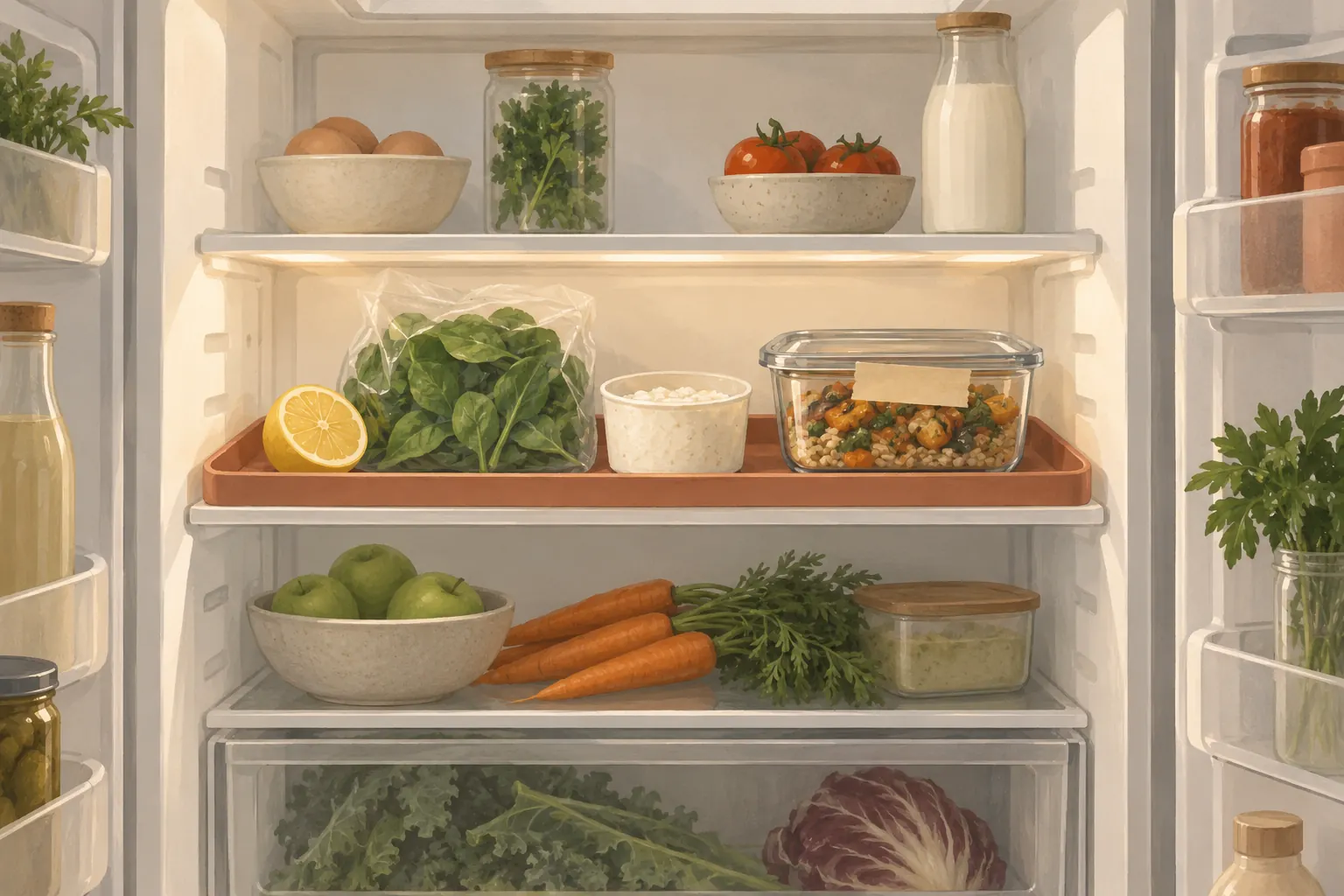
An eat-first bin is one container in the fridge that holds everything that should be eaten in the next few days. The idea was popularized by professional organizer Holly Blakey and written up by The Kitchn: leftovers, the open tub of sour cream, half an onion, the cheese nearing its best-by date.
To make it work:
- Use a clear, washable bin, not a basket, so you can see inside and rinse it.
- Label it "eat first" so everyone in the house knows it's the first place to look for a snack.
- Put it front and center on the middle shelf.
- Refill it every time you unpack groceries: before anything new goes in, move the oldest items into the bin.
- Check it before you cook, and before you write the shopping list.
Say it's Sunday and the bin holds a third of a rotisserie chicken, half a bag of spinach and two tortillas. That's Monday's quesadillas, and three items that would otherwise have been found on Friday.
First in, first out on every shelf
New groceries go behind the ones already there, so the oldest item on every shelf is always the one at the front. It's the same rule that runs a pantry, and our guide to organizing a pantry applies it to cans and jars.
A weekly check
FSIS suggests a weekly habit: once a week, throw out perishable foods "that should no longer be eaten". Do it the night before a grocery run, when you can see the back wall. How long each food keeps is on the federal chart in how long food lasts in the fridge; for cooked leftovers, FSIS gives 3 to 4 days.
Fridge inventory: list, magnet or app
A fridge inventory is a list of what's in the fridge and when each thing needs using, kept somewhere you'll see it without opening the door. It matters most in a big fridge, a shared household, or a garage fridge that nobody checks.
Three versions that work, from least to most effort:
- A magnetic whiteboard on the fridge door. List only what's in the eat-first bin, with dates.
- A printable list. Our expiration date tracker is a one-page sheet with a column for the date, and the freezer inventory sheet does the same for the freezer.
- An app. Duneed, our iPhone app, builds the list from a photographed grocery receipt, so what you bought is listed without typing it, and if you give an item a date, it flags it as that date gets close. You set the dates; it doesn't guess them, and it doesn't track which shelf or which appliance something is in.
A list only helps if it's short. Tracking every condiment is how fridge inventories get abandoned in week two; track the perishables and leave the mustard alone.
Fridge organization bins and containers: which are worth buying
Most fridges need three things at most: one clear bin for eat-first food, one tray or bin for raw meat, and clear containers with lids for leftovers. Everything past that is optional.
Decanting everything into matching containers looks good in photos and throws away the date printed on the pack. If you decant, write the date on the lid. A turntable helps on a deep shelf of jars. Liners make cleaning faster but don't replace wiping a spill straight away.
Organizing a fridge with a top freezer
A top-freezer fridge uses the same shelf order below the freezer. The FDA says the freezer should be at 0°F (-18°C). Freeze food flat in bags, date each one, and file them upright like folders so the labels show. At 0°F, the FDA says food "will remain safe" indefinitely, though quality drops over time; what freezer burn is covers what happens to the texture. The full freezer layout, chest and drawer freezers included, is in how to organize a freezer.
Common questions
What is the correct order to store food in the fridge?
From top to bottom: ready-to-eat food and leftovers, then dairy and eggs, then raw meat, poultry and fish sealed on the bottom shelf. Produce goes in the crisper drawers and condiments in the door. The UK Food Standards Agency and Clemson University both say raw meat belongs on the bottom shelf.
Where should eggs go in the fridge?
On a shelf, in their original carton. FSIS and the FDA both say not to store eggs in the door, because the door's temperature changes more than the rest of the fridge.
What is an eat me first bin?
An eat-me-first bin is a clear container in the fridge that holds everything that needs eating in the next few days: leftovers, opened packs and produce close to its best. Keep it at eye level and check it before cooking or shopping.
How often should you clean out your fridge?
FSIS suggests throwing out perishable food that should no longer be eaten once a week, and wiping spills as they happen. The FDA's advice is to clean the fridge out frequently.
How do you organize a fridge with ADHD?
Make everything visible and give every category one fixed home. Clear bins, an eat-first bin at eye level, labels on the shelves and a short whiteboard list on the door all rely on seeing food rather than remembering it.
Sources
- 40°F or below "throughout the unit" fsis.usda.gov
- "on the bottom shelf of the fridge, so they can't touch or drip onto other food" gov.uk
- on a plate or tray to prevent leakage hgic.clemson.edu
- The Kitchn thekitchn.com
- safe minimum internal temperatures fsis.usda.gov
- Are You Storing Food Safely? fda.gov
- milk does not belong in the door lovefoodhatewaste.com
- $728 per person a year epa.gov
- The Kitchn thekitchn.com
Found a mistake? Tell us and we will correct it: support@duneed.app