
How long does food last in the fridge? The federal chart, plus a printable
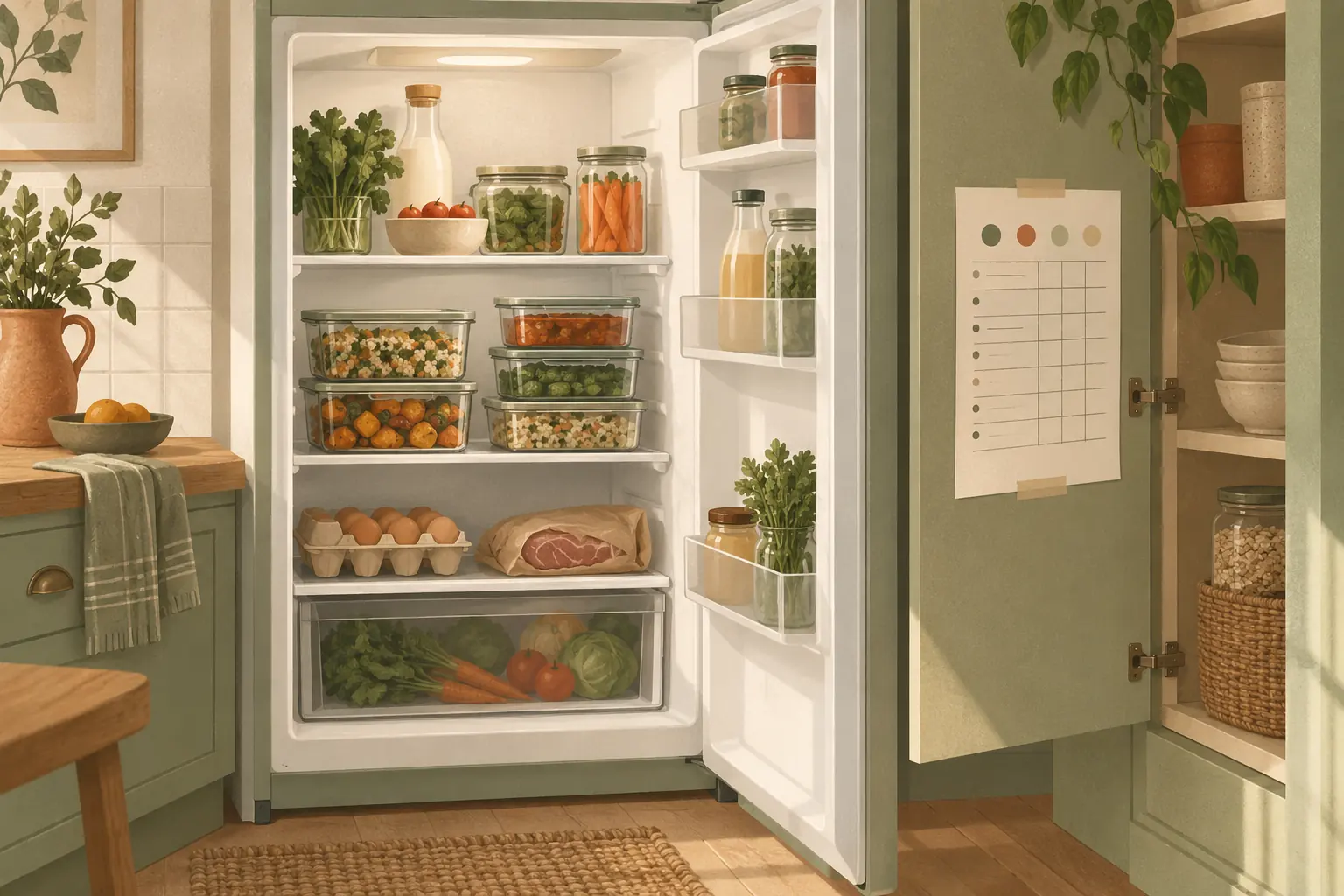
According to the federal FoodSafety.gov chart, cooked leftovers last 3 to 4 days in the fridge, raw ground meat and raw chicken 1 to 2 days, raw steaks, chops and roasts 3 to 5 days, and raw eggs in the shell 3 to 5 weeks. In the freezer, raw chicken pieces keep their best quality for about 9 months and ground meat for 3 to 4 months.
Those times assume a fridge at 40°F (4°C) or below and a freezer at 0°F (-18°C) or below. The full chart is below, and there's a one-page printable of it to put on the fridge door. Whether yours is actually there is a separate question: how to check the temperature.
We're not a food safety authority, so every time on this page is the federal chart's, credited, and nothing here says whether a particular food in your fridge is safe to eat. What we add is how to keep track of it.
Fridge and freezer storage chart
These are from FoodSafety.gov's Cold Food Storage Chart (last reviewed September 19, 2023):
| Food | Refrigerator (40°F or below) | Freezer (0°F or below) |
|---|---|---|
| Raw meat and poultry | ||
| Ground meat and ground poultry | 1 to 2 days | 3 to 4 months |
| Steaks, chops and roasts | 3 to 5 days | 4 to 12 months |
| Chicken or turkey, whole | 1 to 2 days | 1 year |
| Chicken or turkey, pieces | 1 to 2 days | 9 months |
| Sausage, raw | 1 to 2 days | 1 to 2 months |
| Deli and cured meats | ||
| Bacon | 1 week | 1 month |
| Hot dogs, opened | 1 week | 1 to 2 months |
| Luncheon meat, opened or deli sliced | 3 to 5 days | 1 to 2 months |
| Luncheon meat or hot dogs, unopened | 2 weeks | 1 to 2 months |
| Ham, cooked, slices, half or spiral cut | 3 to 5 days | 1 to 2 months |
| Fish and shellfish | ||
| Fatty fish (salmon, tuna, mackerel) | 1 to 3 days | 2 to 3 months |
| Lean fish (cod, flounder, haddock) | 1 to 3 days | 6 to 8 months |
| Shrimp | 3 to 5 days | 6 to 18 months |
| Eggs | ||
| Raw eggs in shell | 3 to 5 weeks | Don't freeze in the shell |
| Hard-cooked eggs | 1 week | Don't freeze |
| Leftovers | ||
| Cooked meat or poultry | 3 to 4 days | 2 to 6 months |
| Soups and stews | 3 to 4 days | 2 to 3 months |
| Pizza | 3 to 4 days | 1 to 2 months |
| Egg, chicken, tuna and macaroni salads | 3 to 4 days | Doesn't freeze well |
The chart has 53 rows in all (more ham types, live shellfish, squid, egg substitutes, eggnog, pies and quiche); the printable carries 34 of them in the agency's own words, and the lookup below has every one. To search the whole chart instead of scanning it, the food storage time lookup takes a food and returns its two times. For what survives the freezer at all, can you freeze it has the list of foods that come back limp or watery.
Free printable fridge and freezer chart
The printable puts 34 of the federal chart's 53 rows on one page, in the agency's own groups and words: the meat, poultry, fish, egg and leftover rows people look up most. The less common rows (most ham types, live shellfish, squid, egg substitutes and eggnog) are in the lookup. The source is printed at the bottom so anyone reading it knows whose numbers they are, and which rows it left out.
- Fridge and freezer storage chart, US Letter (PDF)
- Fridge and freezer storage chart, A4 (PDF)
- Same chart as a CSV, for a spreadsheet or a notes app
Tape it inside a cupboard door near the fridge rather than on the front, where it fades and gets covered in magnets. The chart starts when the food is refrigerated; for the time before that, see how long food can sit out.
Freezer times are about quality
FoodSafety.gov says the freezer times in its chart are for quality only, and that frozen foods stored continuously at 0°F (-18°C) or below can be kept indefinitely.
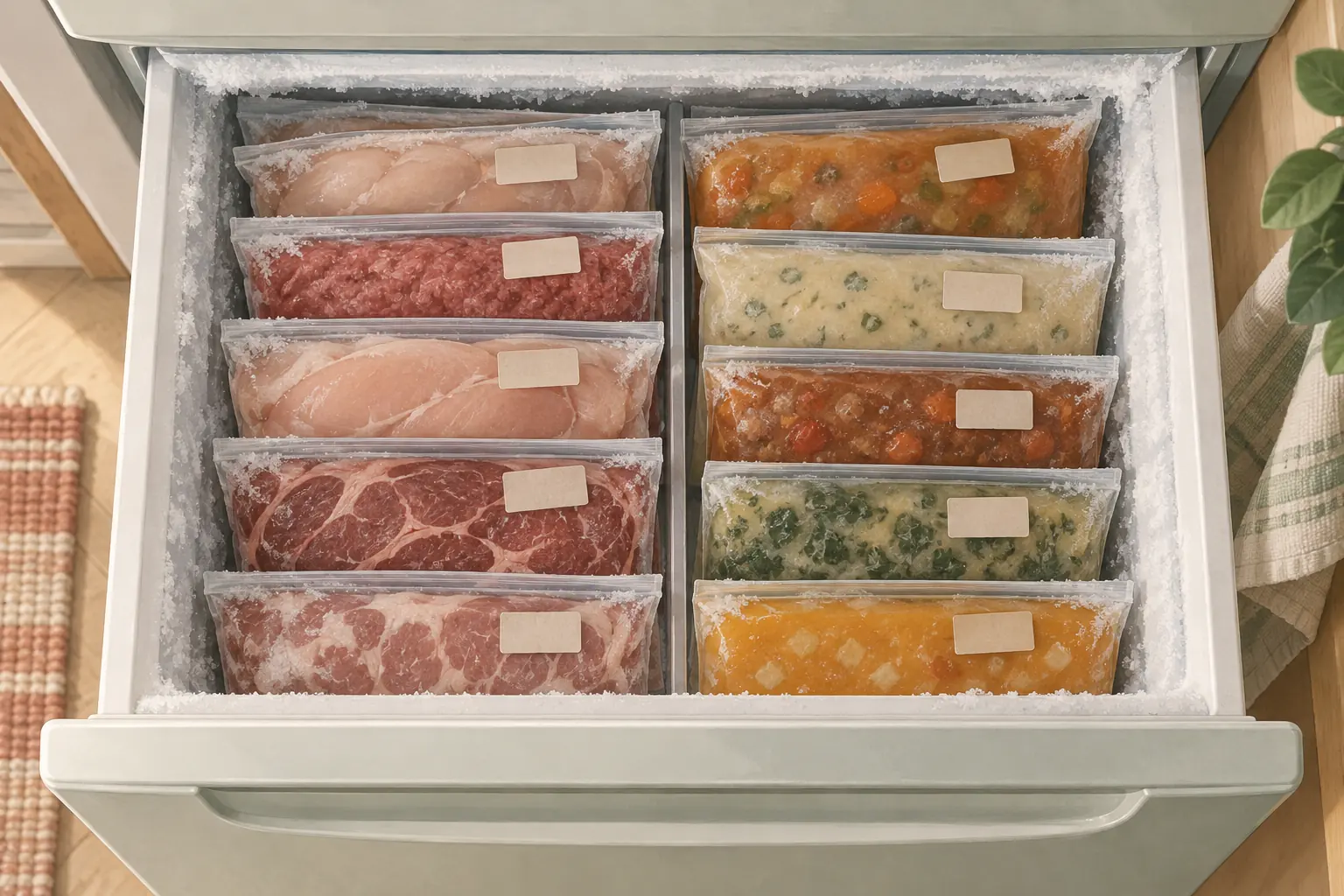
So the freezer column answers a different question from the fridge column: not "how long" but "how long before it's noticeably worse". A pack of chicken thighs frozen a year and a half ago is past the chart's 9 months for pieces. What you'll notice is texture and freezer burn, the dry, pale patches where air got to the surface.
What keeps frozen food at its best is mostly packing: squeeze the air out of bags, wrap meat tightly, and write the date on it. Our freezer inventory sheet has a column for the date frozen and one for the best-quality date, so you can see at a glance what to eat first.
How long do leftovers last in the fridge?
3 to 4 days for cooked meat, poultry, soups, stews, pizza and casseroles, according to the chart. That's the number that matters most in a normal week, because leftovers are what gets forgotten.
A few habits make it easy to stay inside it:
- Put leftovers in clear containers at eye level, not at the back of a shelf.
- Write the day on the lid with a marker or a strip of tape.
- Plan one "leftovers night" a week, a couple of days after the big cook.
- If you won't eat it in time, freeze it the same day rather than on day 4.
Our meal planning from your pantry routine starts with what's already cooked for exactly this reason.
What to do when the power goes out
FoodSafety.gov's power outage guidance (last reviewed August 8, 2024) gives these times:
- A refrigerator keeps food safe for up to 4 hours during a power outage if the door stays closed as much as possible.
- A full freezer holds a safe temperature for about 48 hours, and a half-full one about 24 hours, if the door stays closed.
The same page has a food-by-food chart for what to keep and what to discard afterward, and says never to taste food to decide. Follow that chart from the source. A fridge thermometer is what tells you afterward how warm it got, which is one more reason to keep one inside.
Keep the fridge at 40°F or below
Every time in the chart assumes the fridge is at 40°F (4°C) or below. An inexpensive appliance thermometer on a middle shelf tells you the real temperature; check it after the door has been shut for a while, not straight after a big shop.
The freezer should read 0°F (-18°C) or below.
Keeping track of what's in the fridge
The chart tells you how long; the hard part is remembering when. Three ways to do it:
- Write the date on everything that goes in without one: leftovers, opened packs, defrosted meat.
- Keep a short list on the fridge door of anything with a date in the next few days. Our expiration date tracker is a free one-page sheet for that.
- Let an app remind you.
Duneed, our iPhone app, builds a list of what's in your kitchen from a photographed grocery receipt, and if you give an item a date it flags it as the date approaches and sends one evening reminder a day of what needs eating. The dates are the ones you set; it doesn't guess them.
Where things sit matters as much as the dates. An eat-first bin at eye level, set up as in how to organize your fridge, puts the dated items where you'll see them.
The cost of getting this wrong is real money. The EPA puts food bought and not eaten at $728 per person a year, and our food waste calculator puts a number on your own household's share.
Common questions
How long does cooked chicken last in the fridge?
3 to 4 days, according to FoodSafety.gov's chart for cooked meat and poultry leftovers. In the freezer, it gives 2 to 6 months for best quality.
How long can you freeze chicken?
FoodSafety.gov gives raw chicken or turkey pieces 9 months and a whole bird 1 year in the freezer, and says freezer times are for quality only: food kept at 0°F or below can be kept indefinitely.
How long can you freeze ground beef?
3 to 4 months for best quality, according to the chart. In the fridge, raw ground meat gets 1 to 2 days.
How long do eggs last in the fridge?
Raw eggs in the shell get 3 to 5 weeks in the fridge on the FoodSafety.gov chart. Hard-cooked eggs get 1 week. The chart says not to freeze eggs in the shell. Why US eggs need the fridge at all when European ones do not is a question about washing.
How long does food last in the fridge without power?
FoodSafety.gov says up to 4 hours with the door kept closed. A full freezer holds for about 48 hours and a half-full one about 24 hours.
Are these times the same as the date on the package?
No. The date on a pack is the manufacturer's, and in the US it's usually about quality rather than safety; best before vs use by vs sell by explains each label. The chart gives storage times for food once it's in your fridge or freezer.
Sources
- FoodSafety.gov foodsafety.gov
- Cold Food Storage Chart foodsafety.gov
- power outage guidance foodsafety.gov
- $728 per person a year epa.gov
Found a mistake? Tell us and we will correct it: support@duneed.app