Emergency food supply list: what to store for 3 days and 2 weeks
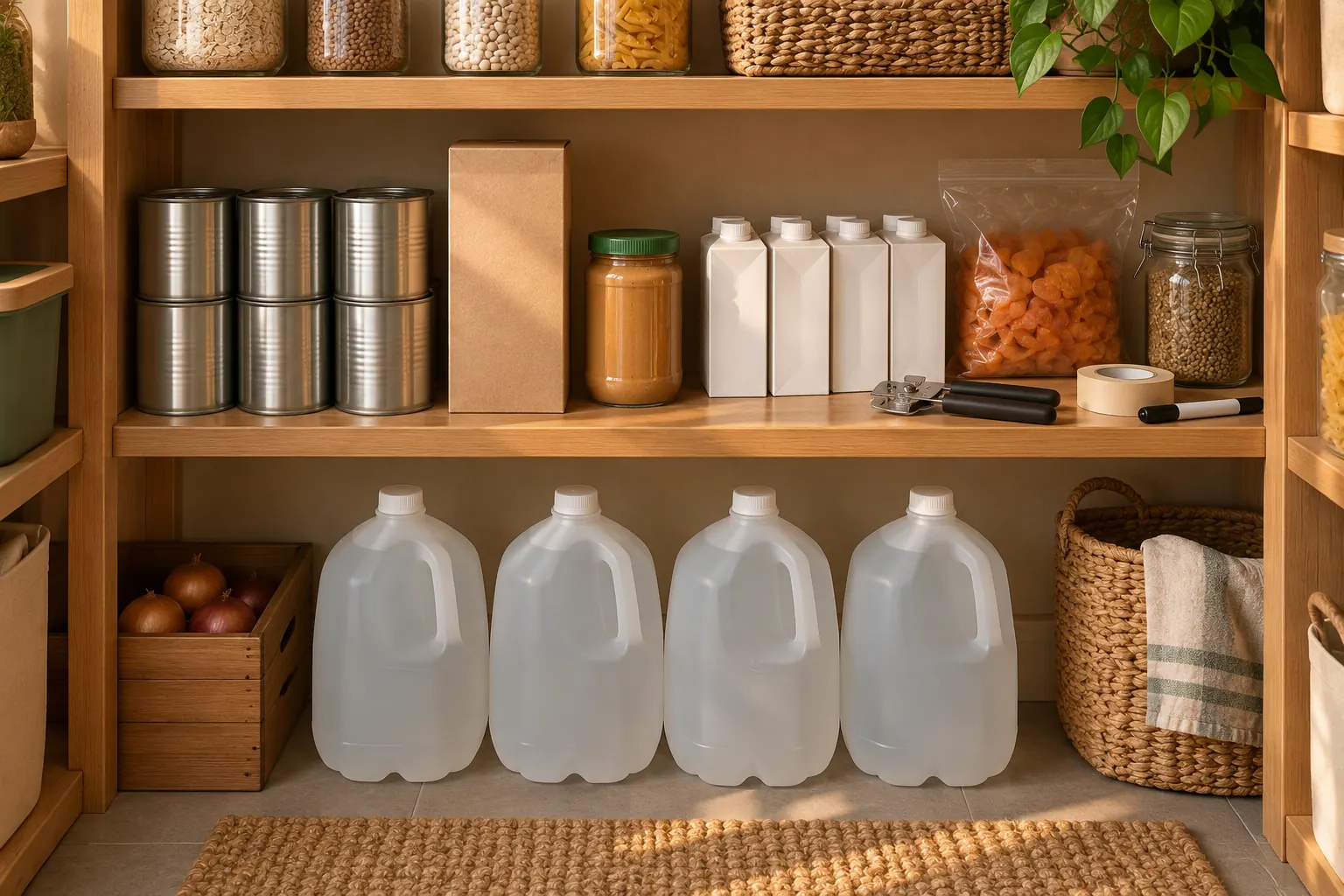
An emergency food supply list only has to answer three things: how long it should last, how much water goes with it, and which foods you can eat with no power and no stove. The American Red Cross gives the numbers: one gallon of water per person per day, and a 3-day supply of food and water for evacuation, a 2-week supply for home. The rest of this page turns that into a shopping list and two tables you can copy.
None of it needs a freeze-dried kit. FEMA's own booklet points at the cupboard first: "You can use the canned goods, dry mixes, and other staples on your cupboard shelves."
How much emergency food and water do you need?
Store one gallon of water per person per day and enough non-perishable food for at least 3 days if you have to leave, and 2 weeks if you stay home. Those are the American Red Cross figures. Ready.gov asks for "at least a several-day supply" of food and the same gallon a day.
| Agency | Water | Food | How long |
|---|---|---|---|
| American Red Cross | 1 gallon per person per day | Non-perishable, easy-to-prepare | 3 days to evacuate, 2 weeks at home |
| Ready.gov (FEMA) | 1 gallon per person per day, for drinking and sanitation | Non-perishable | "Several days" |
| CDC | At least 1 gallon per person per day | Not covered on its water page | At least 3 days; "try to store a 2-week supply if possible" |
| FEMA and Red Cross booklet (2004) | At least 1 gallon per person per day; at least a half gallon of it for drinking | Familiar foods that need no refrigeration, water or cooking | 2 weeks |
The agencies mostly agree, and where they differ it's on length, not quantity. We'd plan for the Red Cross numbers because they're the most specific: a 3-day bag you could carry out the door, and a 2-week supply that stays on a shelf at home.
The gallon a day is a floor. Ready.gov says "children, nursing mothers and sick people may need more water" and that "in very hot temperatures, water needs can double." The CDC adds pregnant women and pets to that list.
The emergency food list, by category
The best emergency foods need no refrigeration, no water and no cooking. That's FEMA's rule in Food and Water in an Emergency, and it rules out dry pasta, rice and pancake mix. Those are fine for a pantry with a working stove. They're a poor bet for the week the stove is off and the water is rationed.
This list follows Ready.gov's food page and adds the everyday supermarket items that fit its description.
Protein
- Canned tuna, salmon and chicken, ideally in pull-tab cans
- Ready-to-eat canned chili, beef stew and baked beans
- Canned black beans, chickpeas or kidney beans (rinsing is optional; cold beans are still dinner)
- Peanut butter or another nut butter
- Nuts, seeds and trail mix
- Jerky or shelf-stable meat sticks
Grains and breakfast
- Dry cereal or granola
- Crackers and rice cakes (FEMA suggests salt-free crackers if water is short)
- Shelf-stable tortillas
- Instant oatmeal, only if you can boil water safely
Fruit and vegetables
- Canned fruit in juice, and single-serve fruit cups
- Dried fruit: raisins, apricots, prunes
- Canned corn, peas, green beans and carrots, all edible straight from the can
- Canned juice
- A few apples, oranges and potatoes for the first days (FEMA lists potatoes with the foods to use within six months)
Milk and drinks
- Shelf-stable (UHT) milk in single-serve cartons
- Powdered milk, which needs water you might not want to spend
- Instant coffee, tea and cocoa, if you'll have a way to heat water
Ready-made meals
- Canned soup that doesn't need diluting (condensed soup wants a can of water)
- Canned ravioli or pasta in sauce
- Protein bars and granola bars
Comfort and the non-food bits
- Something you like: hard candy, chocolate, cookies. Ready.gov puts "comfort/stress foods" on its list, and FEMA says familiar foods "lift morale and give a feeling of security in times of stress."
- A manual can opener, even if every can has a pull tab
- Paper plates, cups and plastic utensils, so you don't spend water on dishes
Leave out anything nobody in the house eats. FEMA's advice is to stock for "your family's unique needs and tastes", and a case of canned sardines that nobody touches is money and shelf space gone. The everyday version of this list is our pantry staples list, 57 items most kitchens run on. The canned tuna, canned beans and peanut butter on it double as emergency food; the rice, flour and dried beans need a stove and water.
3-day emergency food supply: one person and a family of four
A 3-day supply is 9 meals per person, plus 3 gallons of water each. The table below is our worked example of what those 9 meals could be. The water line is the Red Cross figure; the food lines are a sample built from the list above, not an agency quantity, so swap items freely.
| Item | 1 person, 3 days | Family of 4, 3 days |
|---|---|---|
| Water (1 gallon per person per day) | 3 gallons | 12 gallons |
| Breakfast: cereal or granola | 3 servings | 12 servings |
| Shelf-stable milk, single-serve cartons | 3 | 12 |
| Lunch: canned tuna, chicken or salmon | 3 cans | 12 cans |
| Crackers | 1 box | 2 to 3 boxes |
| Dinner: ready-to-eat chili, stew, beans or soup | 3 cans | 12 cans |
| Canned vegetables | 3 cans | 6 to 12 cans |
| Fruit cups or canned fruit | 3 | 12 |
| Peanut butter | 1 jar | 1 to 2 jars |
| Bars (protein or granola) | 6 | 24 |
| Dried fruit and nuts | 1 bag each | 2 bags each |
The family column assumes adult portions, so adjust it for the people you feed: a toddler won't finish a 15-ounce can of stew, and a teenager might eat two.
2-week emergency food supply: one person and a family of four
A 2-week supply is 42 meals and 14 gallons of water per person, which for a family of four comes to 168 meals and 56 gallons. The water is the heavy part. At a little over 8 pounds a gallon, 56 gallons weighs close to 470 pounds and takes up a closet floor, so it's worth deciding where it'll live before you buy it.
As before, the water line is the Red Cross figure and the food is our sample.
| Item | 1 person, 14 days | Family of 4, 14 days |
|---|---|---|
| Water (1 gallon per person per day) | 14 gallons | 56 gallons |
| Cereal or granola | 14 servings | 56 servings |
| Shelf-stable milk cartons | 14 | 56 |
| Canned tuna, chicken, salmon or beans | 14 cans | 56 cans |
| Crackers or rice cakes | 3 boxes | 10 to 12 boxes |
| Ready-to-eat chili, stew, soup or ravioli | 14 cans | 56 cans |
| Canned vegetables | 14 cans | 56 cans |
| Canned fruit or fruit cups | 14 | 56 |
| Peanut butter | 2 jars | 6 to 8 jars |
| Bars | 14 to 28 | 56 to 112 |
| Dried fruit, nuts, trail mix | 2 to 3 bags | 8 to 10 bags |
| Comfort food, coffee or tea | A few | A few per person |
If you have a camp stove or grill and room for more water than the gallon a day, you can swap some dinners for pasta, rice or instant soup. Ready.gov's warning applies: "Charcoal grills and camp stoves are for outdoor use only."
Infants, pets and medical diets
Ready.gov, the CDC, the Red Cross and FEMA each add items for babies, pets and people on medication or a special diet, and a standard food list leaves all of them out.
- Infants: the CDC says "ready-to-feed (RTF) infant formula is safest because it does not need to be mixed with water," and asks for enough to feed your child "for several days." It also says unopened RTF formula doesn't need refrigeration, and to check the kit's supply regularly for dates. For breastfed babies, the CDC's advice is to plan to keep breastfeeding. Ready.gov's kit list adds bottles, diapers, wipes and diaper rash cream.
- Pets: Ready.gov says to keep "several days' supply of food in an airtight, waterproof container," a water bowl and several days of water, plus any medicine your pet takes. That water is on top of the gallon a day for people.
- Medications: the Red Cross lists a 7-day supply of medications and medical items. Ready.gov's kit adds prescription and non-prescription medicines, glasses and contact lens solution.
- Special diets and allergies: FEMA's booklet says people with special diets and allergies "will need particular attention, as will babies, toddlers, and the elderly," and suggests canned dietetic foods, juices and soups for ill or elderly people. For a medical diet, the person who prescribed it is the one to ask what should be in the kit.
Hurricane food list: what changes for a storm
A hurricane food list is the same list with a deadline. The Atlantic hurricane season runs from June 1 to November 30, and NOAA puts the peak on September 10, "with most activity occurring between mid-August and mid-October." The season still has more than two months to run after that peak.
Two things are different for a storm. You get warning, so it's worth doing the fridge and freezer prep in food after a power outage before landfall (thermometers in, containers of water frozen, cooler ready). And you may have to leave, which is where the Red Cross split matters: the 3-day supply goes in a bag you can carry, and the 2-week supply stays.
If you're in the UK, the government's Prepare guidance gives water in litres, citing the World Health Organisation: a minimum of 2.5 to 3 litres of drinking water per person per day, and 10 litres to cover cooking and hygiene too.
How to rotate an emergency food supply
An emergency food supply stays useful only if the food in it is eaten and replaced before it gets old, which FEMA's booklet calls "first-in, first-out." The steps below come from FEMA and Ready.gov, with two habits of ours added.
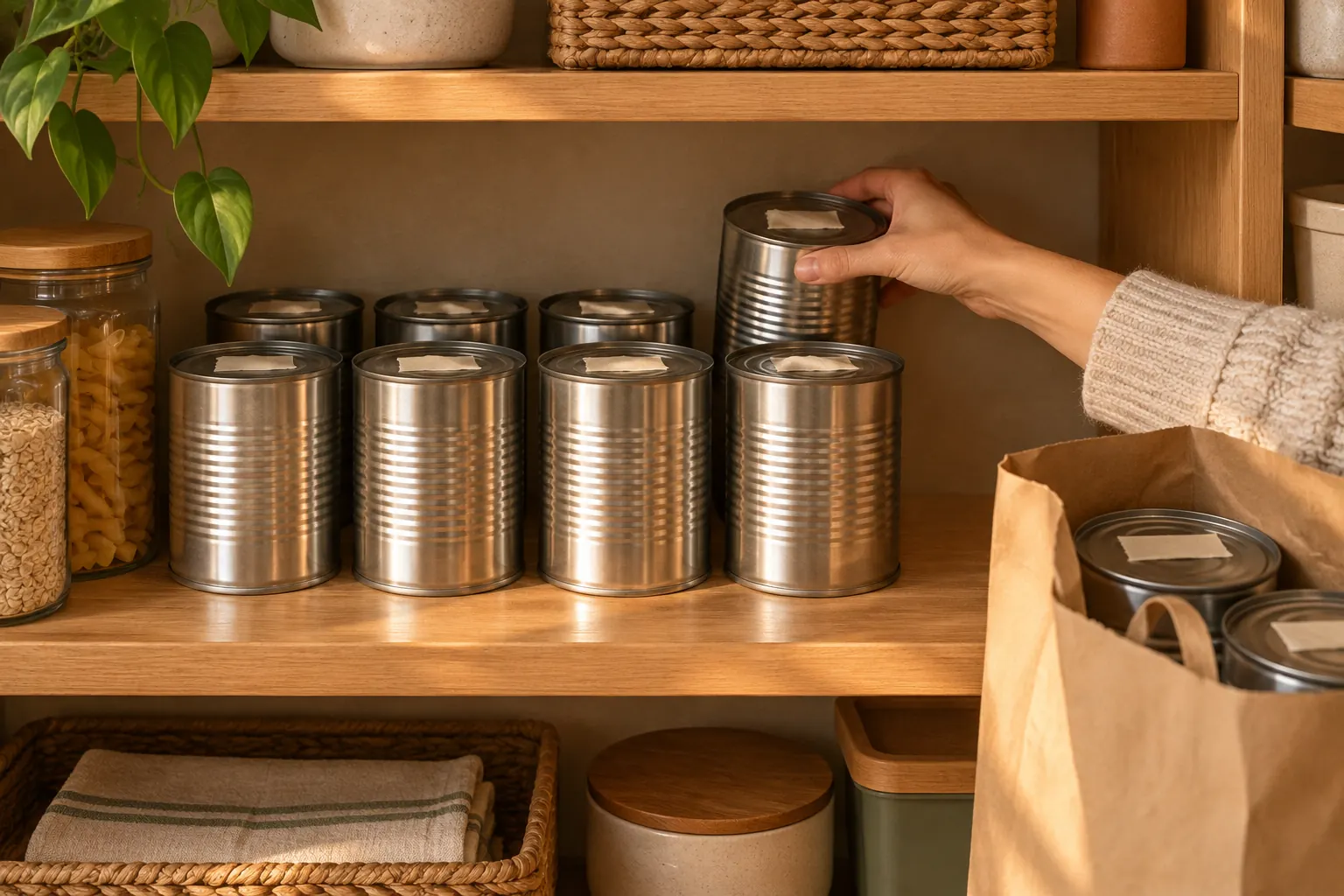
- Date everything as it goes in. FEMA says to replace food "with fresh supplies, dated with ink or marker." A can with a big date on the lid is easier to rotate than one with a stamped code (our Julian date converter reads those codes).
- Put new items at the back and older ones at the front. That's FEMA's wording too, and it's the same habit as any pantry.
- Eat from it. FEMA's line is "Use foods before they go bad, and replace them." We'd make it a routine: one dinner a month from the kit, then buy the replacement on the next shop.
- Check it twice a year. Water you bottled yourself should be replaced every six months, per Ready.gov and FEMA. For commercially bottled water, FEMA says to keep it sealed and observe its use-by date. Ready.gov's kit page says to "replace expired items as needed" and to "re-think your needs every year," the point at which a baby has outgrown formula or a new pet has arrived.
- Take out damaged cans. Ready.gov says not to eat from cans that are swollen, dented or corroded, and FEMA says to throw them out. Our canned food shelf life guide has the USDA figures for how long unopened cans keep their quality.
FEMA's booklet also gives rough replacement times. It dates from 2004, so treat it as a guide and let the date on the package win.
| FEMA says | Foods |
|---|---|
| Use within six months | Boxed powdered milk, dried fruit, dry crisp crackers, potatoes |
| Use within one year, or before the date on the label | Canned condensed soups, canned fruit, fruit juice and vegetables, ready-to-eat cereal, peanut butter, jelly, hard candy, canned nuts, vitamins |
| May be stored indefinitely in proper containers and conditions | Wheat, vegetable oils, dried corn, baking powder, soybeans, instant coffee, tea and cocoa, salt, white rice, bouillon, dry pasta, powdered milk in nitrogen-packed cans |
Where you keep it matters as much as what's in it. FEMA says "a dry, cool spot, a dark area if possible," and the CDC says to keep stored water at a cool 50°F to 70°F, away from direct sunlight. In a hot state, that usually rules out the garage.
The rotation works when you know what's there and when you meant to eat it. A sheet taped inside the cupboard door does that job. So does Duneed, our iPhone app: you list the items, give each one the date you want it used by, and the pantry flags it amber a few days ahead and red once that date has passed. It also works offline, without an account.
When the power goes out: fridge and freezer first
Eat the fridge food first, then the freezer, then the emergency supply. That's the order in FEMA's booklet, and it keeps the shelf-stable food for when nothing else is left.
The CDC's food safety guidance for emergencies gives the time limits with the doors closed: food will stay safe up to "4 hours in a refrigerator, 48 hours in a full freezer, 24 hours in a half-full freezer." After 4 hours without power or ice, the CDC says to throw out perishable fridge food such as meat, fish, cut fruit and vegetables, eggs, milk and leftovers. It also says you can refreeze or cook thawed food "that still contains ice crystals or is at 40 °F or below," and to throw out food that may have come in contact with floodwater or stormwater.
The CDC adds one rule for every item: "Never taste food to know if it is safe to eat." Our article on food after a power outage goes through the federal keep-or-discard chart item by item, the fridge temperature guide covers the thermometer that makes that call possible, and the food storage time lookup has the normal fridge and freezer times for when the power is back.
Common questions
How much water per person per day in an emergency?
One gallon per person per day, according to the American Red Cross, Ready.gov and the CDC. That covers drinking and basic sanitation. Ready.gov says children, nursing mothers and sick people may need more, and that water needs can double in very hot weather.
What is a 3-day emergency food supply?
A 3-day emergency food supply is enough non-perishable food for 9 meals per person, plus 3 gallons of water each. The Red Cross recommends it for an evacuation bag. Choose food that needs no cooking, water or refrigeration.
How much food does a family of 4 need for 2 weeks?
A family of four needs 168 meals and 56 gallons of water for two weeks, going by the Red Cross 2-week home supply and one gallon per person per day. In our sample table, that's 56 cans for lunches and 56 cans for dinners, plus breakfasts and snacks.
Do you need freeze-dried emergency food?
None of the Ready.gov, Red Cross, CDC or FEMA lists above calls for freeze-dried food for a 3-day or 2-week supply. FEMA says you can build one from canned goods and staples already in your cupboard. Freeze-dried meals also need water to prepare, and FEMA says the best emergency foods need no water or cooking.
How often should you check an emergency food supply?
Check an emergency food supply at least once a year, as Ready.gov and FEMA suggest, and replace water you bottled yourself every six months. Eating from the supply and replacing what you use keeps it from expiring on the shelf.
Sources
- American Red Cross redcross.org
- Ready.gov ready.gov
- Ready.gov ready.gov
- Ready.gov ready.gov
- CDC cdc.gov
- Food and Water in an Emergency fema.gov
- Ready.gov's food page ready.gov
- CDC cdc.gov
- Ready.gov ready.gov
- Atlantic hurricane season nhc.noaa.gov
- Prepare prepare.campaign.gov.uk
- food safety guidance for emergencies cdc.gov
Found a mistake? Tell us and we will correct it: support@duneed.app