
Pantry staples list: 57 items to shop from, with a printable checklist
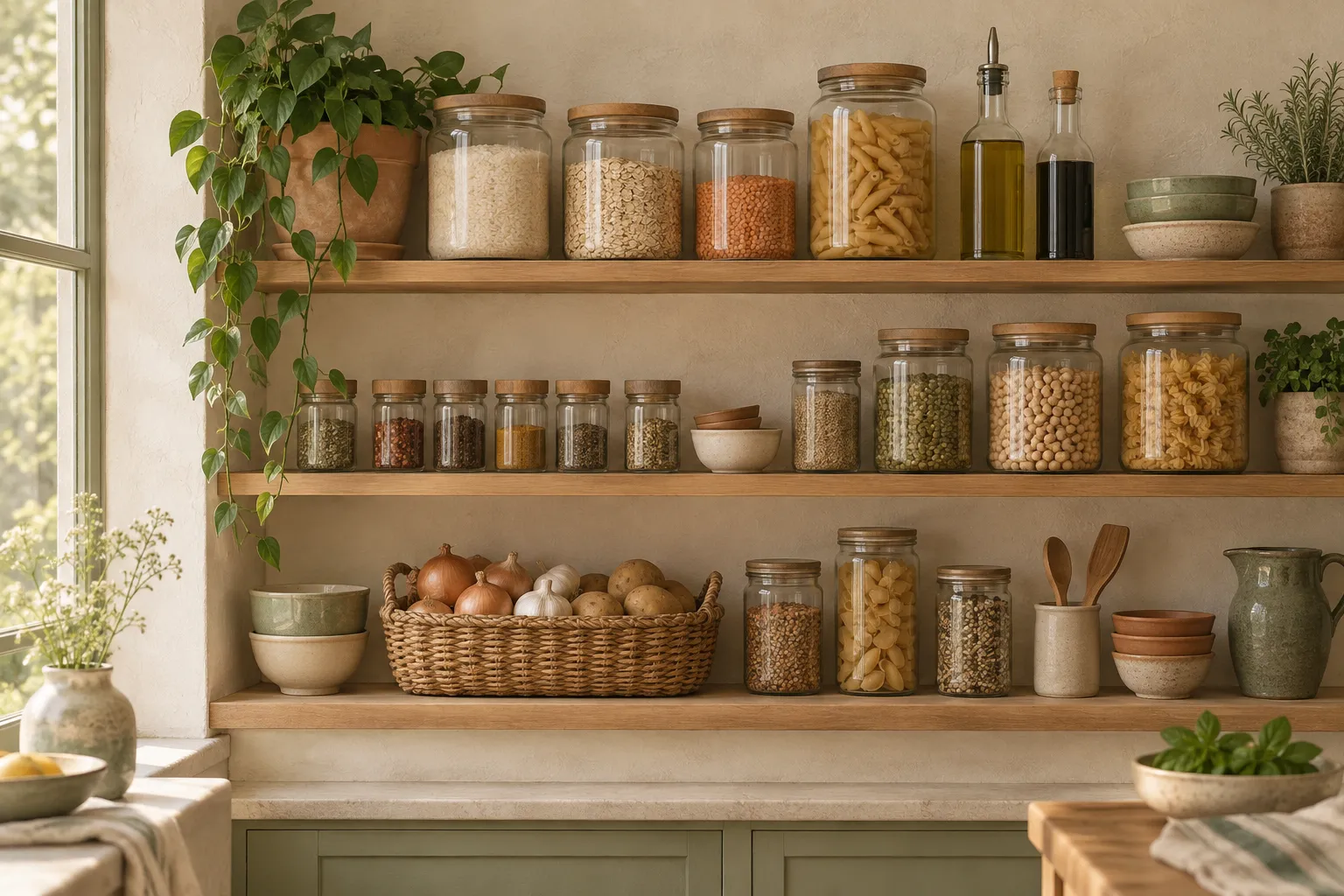
This pantry staples list is built to be shopped from: 57 items in eight groups, each with a short reason it earns shelf space. It also covers what to buy first in a new apartment, which staples are cheapest per serving, how long each one keeps its quality once opened, and five dinners you can make without buying anything else. If you only want the list, print it: US Letter PDF or A4 PDF.
A basic pantry covers eight groups: grains and pasta, beans and canned protein, canned tomatoes and other jars, oils and sauces, spices, baking basics, long-keeping produce, and a few fridge and freezer items. With rice, pasta, dried beans, canned tomatoes, onions, garlic, eggs and oil on hand, you can cook most weeknight dinners.
The pantry staples list, by category
Fridge and freezer basics are on the list on purpose, and once the freezer starts filling up, a freezer inventory sheet keeps track of what's in it. A cupboard with no eggs, butter or frozen vegetables cooks far fewer meals, and most first-apartment grocery lists include them for the same reason.
Grains and pasta
- Long-grain white rice: the base for stir-fries, curries, beans and rice. Unopened, it keeps 2 years in the cupboard.
- Spaghetti: the fastest dinner in the kitchen.
- Short pasta (penne or fusilli): holds chunky sauces and survives a baked dish better than long noodles.
- Rolled oats: breakfast, and they keep 6 to 12 months after opening.
- All-purpose flour: pancakes, gravy, a coating for chicken. Buy the 5-lb bag, not the 25.
- Flour tortillas: quesadillas, wraps, and a stand-in for bread when you're out.
- Panko breadcrumbs: crunch on top of pasta bakes, fish or anything fried.
Beans and canned protein
- Dried lentils: no soaking, so they're the dried legume you'll actually cook on a weeknight.
- Dried black or pinto beans: the cheapest protein on this list per cup (numbers below).
- Canned chickpeas: for the nights you didn't plan ahead.
- Canned black beans: tacos, bowls, soup.
- Canned tuna: pasta, sandwiches, a rice bowl. USDA's FoodKeeper gives it 3 years on the shelf.
- Peanut butter: toast, oats, and a noodle sauce with soy sauce and hot sauce.
Cans and jars
- Canned whole or diced tomatoes: sauce, soup, chili, shakshuka. Whole peeled tomatoes crush by hand into any texture you want, which is why we'd pick them if you only buy one kind.
- Tomato paste: buy a tube. USDA's FoodKeeper gives an opened can about 5 days in the fridge, and most recipes use a tablespoon.
- Bouillon cubes or paste: FoodKeeper gives an opened carton of broth 3 to 4 days in the fridge, while bouillon keeps its best quality for a year.
- Coconut milk: turns lentils and curry powder into dinner.
- Salsa: eggs, quesadillas, rice bowls.
- Jarred pasta sauce: the backup for tired nights. FoodKeeper allows about 4 days in the fridge once it's open, so buy the size you'll finish.
Oils, vinegars and sauces
- Neutral oil (canola or vegetable): high-heat cooking and frying eggs.
- Extra-virgin olive oil: dressings and finishing. It holds its quality 3 to 5 months after opening, so skip the 3-liter tin unless you go through a lot.
- Vinegar (apple cider or red wine): you need one, not four. It's for dressings, and a splash wakes up a pot of beans.
- Soy sauce: salt plus depth in fried rice, noodles and marinades.
- Hot sauce: rice, eggs and beans all taste better with a few shakes.
- Dijon mustard: holds a vinaigrette together and livens up sandwiches.
- Mayonnaise: sandwiches and tuna. Opened, it keeps about 2 months in the fridge, so a small jar beats the warehouse size.
- Ketchup: you'll want it the day you don't have it.
Spices and seasonings
- Kosher salt: easier to pinch and measure by feel than table salt.
- Black peppercorns: buy them in a grinder bottle. Freshly ground pepper tastes sharper than the pre-ground kind.
- Garlic powder: for rubs and for the night the garlic bulb is gone.
- Red pepper flakes: heat for pasta, eggs and pizza.
- Ground cumin: beans, tacos, chili.
- Smoked paprika: makes eggs, potatoes and beans taste like they took longer.
- Chili powder: chili, taco filling, roasted chickpeas.
- Dried oregano: tomato sauce and anything vaguely Italian or Mexican.
- Curry powder: one jar that turns lentils, rice and coconut milk into a meal.
- Ground cinnamon: oats, pancakes, a pinch in chili.
Baking, sweeteners and drinks
- Granulated sugar: baking, and a pinch to balance tomato sauce.
- Brown sugar: cookies, glazes, oatmeal. Keep it airtight or it turns into a brick.
- Baking powder: pancakes and quick breads.
- Baking soda: cookies and anything with buttermilk or yogurt.
- Cornstarch: thickens stir-fry sauce and makes coatings crisp.
- Honey: tea, dressings, glazes, and it keeps its quality for 2 years.
- Vanilla extract: only if you bake. Skip it until you do.
- Coffee or tea: for the first morning, before anything else is unpacked.
Long-keeping produce
- Yellow onions: the start of almost every savory dish on this page.
- Garlic: whole bulbs keep about a month in the pantry.
- Potatoes: roast, mash, hash. Store them in the cupboard, not the fridge (more on that below).
- Carrots: fried rice, soup, snacking. Kept in the fridge, 2 to 3 weeks.
- Lemons: a squeeze fixes a flat dish better than more salt.
Fridge and freezer basics
- Eggs: the fastest protein you can buy.
- Butter: cooking, toast, and it freezes well for 6 to 9 months.
- Cheddar or Parmesan: a hard cheese outlasts soft ones and goes on pasta, eggs and tortillas.
- Plain yogurt: breakfast, a sauce base, a sour cream swap.
- Frozen peas: fried rice, pasta, soup, straight from the bag.
- Frozen chopped spinach: stir a block into pasta, eggs or lentils.
- Sliced bread (freezer): toast slices straight from frozen and none of the loaf goes stale.
Print the pantry staples checklist
The printable version holds the same 57 items in the same eight groups, on one page in two columns, so you can take it into the kitchen and the store. Download the US Letter PDF or, outside the US and Canada, the A4 PDF. No email sign-up.
How to use it: walk it through your cupboards once and tick what you already have. Everything unticked is your shopping list, and our printable grocery list by category has a section for each of these groups to write it on. After the first stock-up, the checklist is less useful than an inventory of what's actually on the shelf and when it was opened; for that, use our pantry inventory list template. Where each group goes on the shelves is in how to organize a pantry.
What beginners over-buy (and what to skip)
Some first-apartment grocery lists run past 200 items. Shopping from a list that long is how a kitchen ends up with a 24-jar spice rack and three open bags of flour. These are the usual places money goes to waste.
The pre-filled spice rack is the classic. You'll use eight or ten of those jars. Buy the ten above, add others when a recipe you actually cook calls for them, and don't buy Italian seasoning if you already own oregano.
Big bags of shelled nuts go stale in the cupboard sooner than people expect. USDA's FoodKeeper data gives shelled walnuts and pecans only 2 to 4 weeks in the pantry, against 9 months or more in the fridge and 2 years in the freezer. If you buy nuts in bulk, the freezer is where they live. They are also on the list of foods pantry moths get into first.
Warehouse-size jars of anything that goes in the fridge after opening are a trap for one or two people. Mayonnaise gets about 2 months once opened, jarred pasta sauce about 4 days, salsa about a month. A gallon jar of mayo is a lot of sandwiches in 60 days.
A giant can of pre-ground coffee is another. FoodKeeper lists opened commercial ground coffee at 2 weeks in the pantry for best quality. Buy what you'll drink in a few weeks, or buy beans.
Specialty flours (almond, coconut, bread flour, self-rising) can wait until you have a recipe that needs them. Coconut flour, for one, is a fridge item in the FoodKeeper data, not a cupboard one.
Cooking spray, truffle oil and a second and third vinegar can also wait. Oil in a pan does what the spray does.
A first-apartment starter pantry
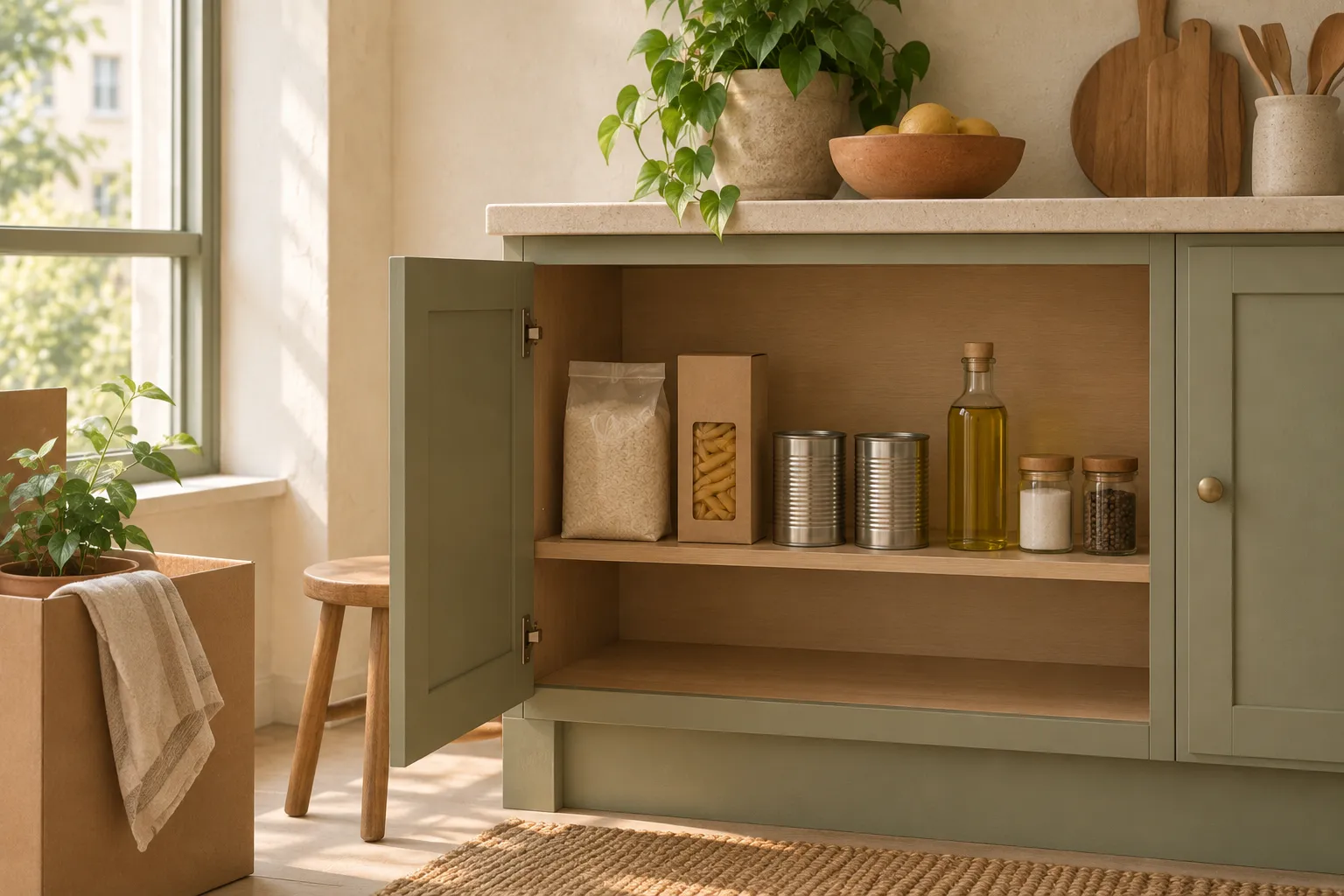
You don't need all 57 items in week one. This subset of 20 covers breakfast, a packed lunch and a week of simple dinners, and leaves out anything that needs a recipe to justify it:
- Long-grain white rice
- Spaghetti
- Rolled oats
- Dried lentils
- Canned black beans
- Canned tuna
- Peanut butter
- Canned whole or diced tomatoes
- Bouillon cubes or paste
- Neutral oil (canola or vegetable)
- Soy sauce
- Hot sauce
- Kosher salt
- Black peppercorns
- Potatoes
- Yellow onions
- Garlic
- Eggs
- Butter
- Frozen peas
Add the rest a few items per trip, as the meals you actually cook ask for them. For the rest of a first kitchen, from the day-one shop to the non-food basics, see our first apartment grocery list.
What the base staples cost in the US
The Bureau of Labor Statistics publishes national average retail prices for a short list of foods. They don't cover oil, canned tomatoes or spices, so we won't guess at those. For the items they do cover, the August 2026 US city averages are:
| Item (BLS series) | Unit | Aug 2026 average |
|---|---|---|
| Flour, white, all purpose | per lb | $0.55 |
| Rice, white, long grain, uncooked | per lb | $1.11 |
| Spaghetti and macaroni | per lb | $1.37 |
| Beans, dried, any type | per lb | $1.63 |
| Sugar, white | per lb | $1.02 |
| Potatoes, white | per lb | $0.98 |
| Eggs, grade A, large | per dozen | $2.27 |
| Cheddar cheese, natural | per lb | $5.98 |
| Coffee, 100% ground roast | per lb | $9.30 |
A worked example with the four starter items BLS does price: 2 lb of rice ($2.22), 2 lb of spaghetti ($2.75), a dozen eggs ($2.27) and a 5-lb bag of potatoes ($4.88) come to $12.12 at those averages. That buys roughly 20 label servings of rice, 16 of pasta and 12 eggs. The other 16 starter items, from lentils and oats to soy sauce and butter, aren't in the BLS series, so we've left them unpriced rather than invent a number. And these are national averages across stores and package sizes, so your receipt will land near them, not on them. For what a whole month of groceries should cost by household size, see how much to spend on groceries.
Pantry staples on a budget
The cheapest staples are the dry ones, by a wide margin. At the BLS averages above, a pound of spaghetti is $1.37 and a pound holds 8 servings at the 2-ounce serving printed on most US pasta boxes, so about 17 cents a serving before sauce.
Dried beans beat canned by even more. USDA's Economic Research Service prices vegetables per cup-equivalent, which accounts for the water a dried bean soaks up. In its 2023 data:
| Bean | Canned, per cup | Dried, per cup |
|---|---|---|
| Black beans | $0.78 | $0.26 |
| Pinto beans | $0.72 | $0.23 |
| Kidney beans | $0.71 | $0.31 |
| Lentils | not listed | $0.31 |
So dried black and pinto beans cost about a third of canned per cup. The trade-off is time: dried beans need soaking and a long simmer, which is why the list keeps a couple of cans for busy nights and relies on lentils, which skip the soak, for everyday use.
The same ERS data shows why onions, potatoes and carrots are on the list. Per cup-equivalent, fresh potatoes were $0.30, raw carrots $0.31, green cabbage $0.35 and onions $0.42, while fresh grape tomatoes were $1.71. Canned tomatoes, at $0.65, fell between fresh Roma tomatoes ($0.51) and large round ones ($0.88), with the advantage that the can waits on the shelf until you need it.
If money is tight, this is the budget-stretching core we'd shop first:
- Dried lentils and dried pinto or black beans
- White rice and pasta
- Rolled oats
- All-purpose flour
- Canned tomatoes
- Onions, potatoes and carrots
- Eggs
- Frozen peas
- Peanut butter
- Oil, salt, cumin and chili powder
That set alone makes lentil soup, beans and rice, fried rice, potato hash, pasta with tomato sauce and a pot of oats.
Which staples to stock up on, and which to buy small
"Stock up" should mean a long quality window, not just a low price. Using the FoodKeeper times further down, the list splits like this.
| Fine to buy in bulk | Buy small and often |
|---|---|
| White rice (2 years unopened) | Opened ground coffee (2 weeks in the pantry) |
| Dry pasta (2 years unopened) | Shelled nuts (2 to 4 weeks in the pantry) |
| Low-acid canned goods like beans and tuna (2 to 5 years) | Opened olive oil (3 to 5 months) |
| Sugar and salt (indefinitely) | Mayonnaise (2 months in the fridge once opened) |
| Honey and vinegar (2 years) | Baking powder (3 to 6 months once opened) |
| Dried beans (1 to 2 years) | Flour tortillas (3 months) |
The right column isn't a list to avoid. Those items belong in the pantry, just in the size you'll finish inside their window, which for one person living alone is often the smallest bottle on the shelf.
Which column an item belongs in is arithmetic rather than category. The break-even math for buying in bulk puts a number on it, using the discount on the bigger pack and the share you end up throwing out.
How long pantry staples keep once opened
The times below come from the USDA's FoodKeeper, developed by the Food Safety and Inspection Service with Cornell University and the Food Marketing Institute. The FoodKeeper app describes these as storage times for freshness and quality. They are not a safety cutoff, and they aren't a promise that a food is good up to that day. For what the dates printed on packages mean, see best before vs use by vs sell by. For any other pantry food in the dataset, the pantry shelf life lookup searches the same FoodKeeper times.
| Staple | Unopened, in the pantry | After opening |
|---|---|---|
| White flour | 6 to 12 months | 6 to 8 months in the pantry, 1 year in the fridge |
| White rice | 2 years | 1 year |
| Brown rice | 1 year | 1 year in the pantry, 6 months in the fridge |
| Dry pasta (no egg) | 2 years | 1 year |
| Oatmeal (cook-before-eating cereal) | 12 months | 6 to 12 months |
| Dried beans | 1 to 2 years | 1 year |
| Dried lentils | 1 year | 1 year |
| Canned low-acid foods (beans, fish, soups, corn) | 2 to 5 years | 3 to 4 days in the fridge |
| Canned high-acid foods (fruit, pickles, tomato soup) | 12 to 18 months | 5 to 7 days in the fridge |
| Tomato paste | 27 months | 5 days in the fridge |
| Coconut milk (canned) | 2 to 5 years | 4 days in the fridge |
| Olive or vegetable oil | 6 to 12 months | 3 to 5 months in the pantry |
| Peanut butter (commercial) | 6 to 24 months | 2 to 3 months in the pantry |
| Jarred pasta sauce | 18 months | 4 days in the fridge |
| Ketchup | 1 year | 6 months in the fridge |
| Mayonnaise (commercial) | 3 to 6 months | 2 months in the fridge |
| Mustard | 1 to 2 years | 1 year in the fridge |
| Salsa | 1 year | 1 month in the fridge |
| Honey | 2 years | not listed separately |
| Vinegar | 2 years | not listed separately |
| Ground spices | 2 to 3 years | 2 to 3 years |
| Dried herbs | 1 to 2 years | 1 to 2 years |
| Baking powder | 6 to 18 months | 3 to 6 months |
| Baking soda | 2 to 3 years | 6 months |
| Granulated or brown sugar | indefinitely | best within 18 to 24 months |
| Cornstarch | 18 to 24 months | 18 months |
| Bouillon cubes | 1 year | 1 year |
| Vanilla extract | 2 years | 12 months |
| Ground coffee (not vacuum-packed) | 2 years | 2 weeks in the pantry, 1 month in the fridge |
| Tea bags | 18 to 36 months | 6 to 12 months |
Two notes. Sources disagree on spices: Ohio State University Extension's pantry storage fact sheet gives ground spices only 6 months and whole spices 1 to 2 years, far shorter than FoodKeeper. Ground spices don't go off so much as fade, so smell the jar before you rely on it. And for produce, FoodKeeper recommends the pantry for whole potatoes (1 to 2 months) and passes on the US Potato Board's note that refrigeration can make them darken when cooked and taste unpleasantly sweet.
On cans, the FoodKeeper's own guidance is that canned items stay safe well past a "best by" date as long as the can shows no dents, rust or swelling. That is USDA's position, and for any question about a specific can, the FoodKeeper is the place to check. FSIS's full chart for canned goods, and its rules for dented or rusted cans, are in canned food shelf life.
Opened dates are the easiest thing to forget, which is what an expiration date tracker is for. A strip of masking tape and a marker on each jar works. If you'd rather keep it on your phone, Duneed (an iPhone app) builds your pantry list from a photo of a grocery receipt, and when you give an item an expiry date it flags it as that date gets close.
Staples are also the right things to track in a grocery price book, because you buy them often enough for a floor price to mean something. If you cook from these staples often, the recipe cost calculator turns their pack prices into a cost per serving, which is the quickest way to see which dish is actually the cheap one.
5 meals you can make from pantry staples only
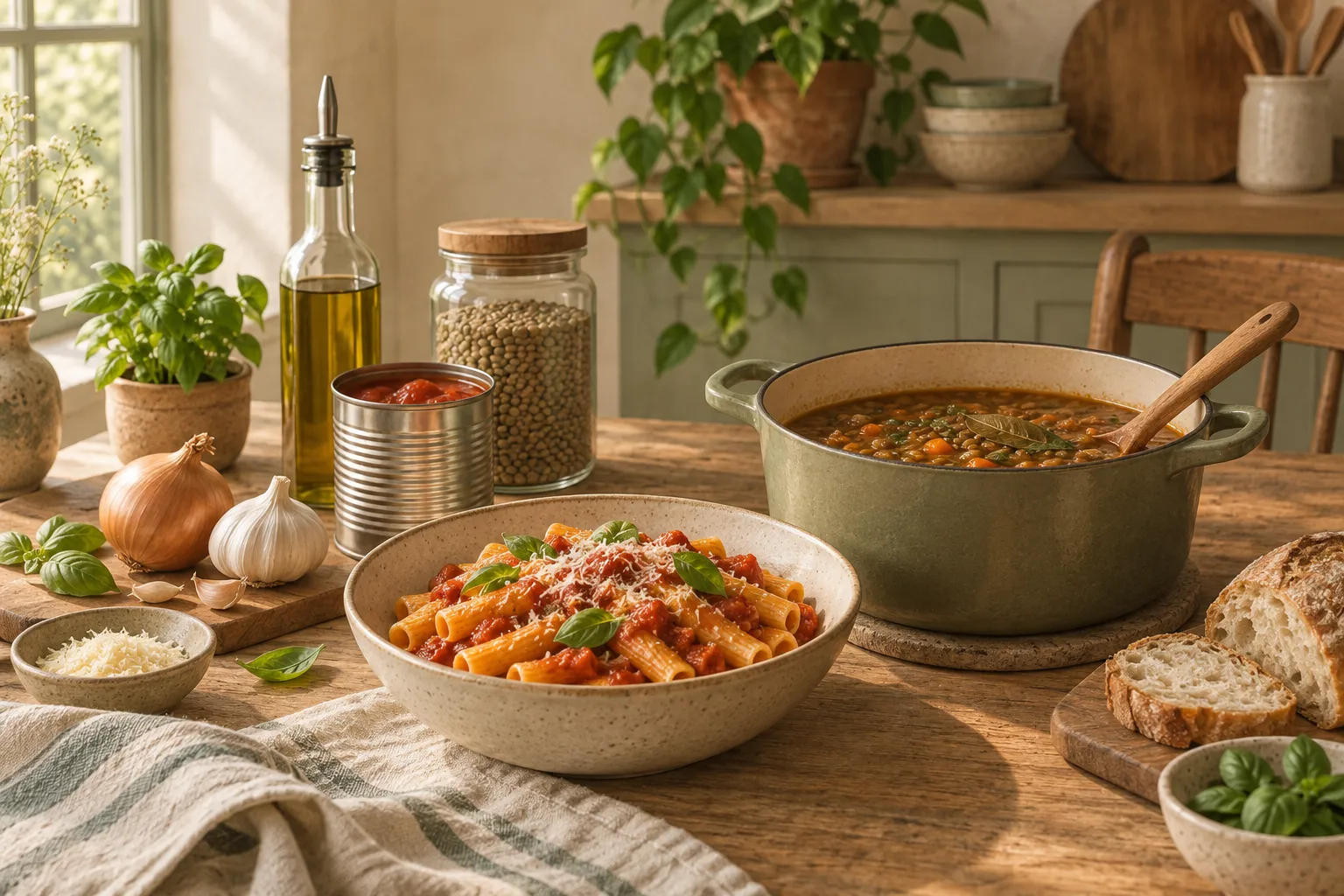
Every ingredient in these comes from the list above. No extra shopping. For a whole week planned this way, starting from what needs using first, see how to meal plan from your pantry.
Spaghetti with garlic, chili and Parmesan
Warm plenty of olive oil with sliced garlic and red pepper flakes over low heat until the garlic is just golden. Toss in cooked spaghetti with a splash of the pasta water, then Parmesan, black pepper and a squeeze of lemon. Frozen peas can go into the pasta pot for the last two minutes.
Coconut lentil curry with rice
Soften a chopped onion and garlic in neutral oil, stir in curry powder for a minute, then add dried lentils, a can of tomatoes, a can of coconut milk and a crumbled bouillon cube with enough water to cover. Simmer until the lentils are soft (red lentils are fastest). Stir in a block of frozen spinach at the end and serve over rice.
Black bean quesadillas
Mash a drained can of black beans with cumin, chili powder, garlic powder and salt. Spread it on a flour tortilla, add grated cheddar, fold, and cook in a dry or lightly buttered pan until crisp on both sides. Salsa and plain yogurt go on the side.
Egg fried rice
Rice cooked the day before works best. Scramble two eggs in oil and set them aside, then fry diced onion, carrot and garlic, add the cold rice and frozen peas, and season with soy sauce. Fold the eggs back in and finish with hot sauce.
Eggs in spiced tomato sauce
Cook a sliced onion and garlic in olive oil with cumin and smoked paprika, add a can of tomatoes crushed by hand, and simmer until thick. Make wells, crack in eggs, cover and cook until the whites set. Eat it with toast made straight from frozen bread.
FAQ
What are the 10 most basic pantry staples?
If you can only buy ten: rice, pasta, dried or canned beans, canned tomatoes, oil, salt, black pepper, onions, garlic and eggs. It's a narrow list, but beans and rice, pasta with tomato sauce, and a fried egg over rice are all inside it.
Should pantry staples include fridge and freezer items?
For a working kitchen, yes. Strictly, a pantry is the shelf-stable cupboard, but eggs, butter, a hard cheese and frozen vegetables are what turn cupboard staples into meals, so the checklist gives them their own section.
How often should you restock pantry staples?
Run through the checklist before each big shop rather than on a fixed schedule, and buy the long keepers (rice, pasta, cans) when they run low instead of when they run out. Short-window items like opened oil, nuts and coffee are the ones to buy in small amounts more often.
Sources
- FoodKeeper data catalog.data.gov
- average retail prices bls.gov
- prices vegetables per cup-equivalent ers.usda.gov
- FoodKeeper app foodsafety.gov
- pantry storage fact sheet ohioline.osu.edu
Found a mistake? Tell us and we will correct it: support@duneed.app