
Is Instacart more expensive than in store? Item prices, fees and the math

Whether Instacart is more expensive than in store has a short answer: for a delivered order, yes, at practically every store. Instacart doesn't set item prices. Each retailer does, and some keep them equal to the shelf while others add a markup. The fees are what reliably push the total up: a delivery fee, a service fee and the tip you choose.
A delivered Instacart order costs more than the same items bought in store, even at a store with no markup, because Instacart adds a delivery fee (from $3.99 on same-day orders over $35, as listed in September 2026), a service fee and a tip. Item prices match the shelf at some stores and are marked up at others.
The one case that can come out close to even is a pickup order from a store that doesn't mark up, because Instacart charges no service fee on pickup. Everything below is dated. Fees change, and the last section shows how to check your own store in about 20 minutes with a recent receipt.
Are Instacart prices the same as in store?
Instacart item prices are the same as in store only at retailers that choose not to mark them up. Instacart's help center says retailers set the item prices on its marketplace, and that while many offer everyday store prices, some set different ones.
Instacart's own pricing document, read in September 2026, is blunter. Some retail partners keep store prices, and others "choose to apply a markup to help offset the cost of providing same-day delivery." Retailers upload a catalog file with prices and any markup instructions, and Instacart displays them. The same document says Instacart is encouraging retailers toward no-markup pricing and that the app lets you filter a search to show only no-markup retailers.
Three smaller differences catch people out:
- In-store sales and promotions may not apply online, and Instacart honors only the coupons listed in the app (Instacart item pricing).
- Items weighed in store (loose produce, deli, meat, seafood) are charged at the actual weight picked, so the final receipt can differ from the cart.
- Taxes, bottle deposits and bag fees are the same as in a physical store, per Instacart's fees and taxes page.
To see a store's policy, open its storefront in the app or on the website and tap the pricing policy line under the store's logo.
What stores and delivery services say about their own online prices
Several retailers state in their own help pages whether delivered items cost more. These are their words, as read in September 2026.
| Store or service | What it says about delivered item prices | Source |
|---|---|---|
| Costco Same-Day (powered by Instacart) | "Item prices are marked up higher than your local warehouse," and Instacart uses the markup to pay for delivery. $35 order minimum. | Costco FAQ, dated 04/08/2026 |
| Aldi (through Instacart) | Online items "may be priced higher to cover the cost of personal shopping or delivery," and some in-store promotions may not apply. | Aldi help: in-store vs online pricing |
| Shipt (Target and other stores) | No markups for Target Circle 360 members on most items. Otherwise prices "vary slightly": a loaf of Wonderbread is $2.29 in store and $2.59 on Shipt, and a $35 in-store order runs about $5 more before delivery fees. | Shipt pricing help |
| Whole Foods Market (through Amazon) | Every delivery order carries a $9.95 service fee so Whole Foods can keep "the same competitive everyday pricing in-store and online." | Amazon customer service |
Shipt's own example works out to roughly 14% on a $35 order ($5 on $35). That is Shipt's figure for Shipt, not a measurement of any Instacart store. Costco doesn't publish a percentage. If you shop Costco for the prices, the delivered markup eats into the same savings the membership is supposed to buy; our Costco membership break-even shows how thin that margin can be.
You'll see markup percentages quoted all over the web for Instacart as a whole. We didn't use any of them here: the ones we traced came from small news tests several years old or from secondary reporting, and each store sets its own markup, so a single number would mislead. Measure your store instead.
What Instacart charges on top of the items
Instacart's fees on a delivered order are a delivery fee, a service fee and an optional tip, plus a few situational charges. Instacart doesn't publish a service fee rate. It says the fee varies with location and the number and type of items in your cart, and every fee is shown before you place the order.
| Charge | What Instacart says (September 2026) | Can you avoid it? |
|---|---|---|
| Delivery fee | Starts at $3.99 for same-day orders over $35; varies for one-hour delivery, club stores and orders under $35 (Instacart home page FAQ) | $0 on orders of $10 or more with Instacart+ ($35 at Costco) |
| Service fee | Amount not published; varies by location and cart; does not go to the shopper; not charged on pickup orders (fees and taxes) | Only by choosing pickup |
| Tip | Optional; Instacart suggests a default from order details and your tip history; 100% goes to the shopper (tipping) | You set it |
| Priority fee | For a faster delivery window; optional | Pick a standard window |
| Long-distance fee | When the delivery route is 15 minutes or more, or includes a toll | No |
| Pickup fee | Some retailers charge one on pickup orders; at Aldi it starts at $1.99 (Aldi help) | $0 with Instacart+ at Aldi on orders of $10 or more |
| Bag fees, deposits, taxes | Same as the store, per local rules | No |
The service fee is the one people underestimate. In December 2025 the FTC sued Instacart and settled for $60 million in refunds. The FTC's complaint, filed December 18, 2025, alleged that "free delivery" offers were false because mandatory service fees, which it said add at least 7.5% to 15% to the order cost, were hidden until checkout. Those are the FTC's allegations about how Instacart charged, not a current rate card, but they are the only published range we found from a primary source.
A worked example: one $80 basket, four ways to buy it
This is an example, not a quote. Say a basket costs $80.00 at the shelf. The delivery fee is Instacart's listed starting figure of $3.99. The service fee is set at 7.5% of the items, the low end of the FTC's alleged range. The tip is $6.00, which you'd choose yourself. The pickup fee is Aldi's starting $1.99.
| How you buy it (store with no markup) | Items | Delivery or pickup fee | Service fee | Tip | Total | More than in store |
|---|---|---|---|---|---|---|
| In store | $80.00 | $0.00 | $0.00 | $0.00 | $80.00 | none |
| Instacart pickup | $80.00 | $1.99 | $0.00 | $0.00 | $81.99 | $1.99 (2%) |
| Instacart delivery, Instacart+ member | $80.00 | $0.00 | $6.00 | $6.00 | $92.00 | $12.00 (15%) |
| Instacart delivery, no membership | $80.00 | $3.99 | $6.00 | $6.00 | $95.99 | $15.99 (20%) |
The member line leaves out the membership itself. At $99 a year spread over two orders a month, that adds about $4.13 per order.
Now add a markup. The rates below are illustrations, not measurements of any store; find your own store's rate with the method in the next section.
| Non-member delivery, same $80 basket | Items | Delivery fee | Service fee (7.5%) | Tip | Total | More than in store |
|---|---|---|---|---|---|---|
| No markup | $80.00 | $3.99 | $6.00 | $6.00 | $95.99 | 20% |
| Items 10% above shelf | $88.00 | $3.99 | $6.60 | $6.00 | $104.59 | 31% |
| Items 20% above shelf | $96.00 | $3.99 | $7.20 | $6.00 | $113.19 | 41% |
At the top of the FTC's alleged range (15%), the service fee on the no-markup basket would be $12.00 and the total $101.99, 27% over the shelf. So for a typical small order, the fees matter more than the markup. The markup matters more as the basket grows, because the delivery fee stays flat while a percentage markup scales with every item.
How to check Instacart prices against your own receipt
The reliable way to find your own store's markup is to price items from a recent in-store receipt in the Instacart app, for the same store location. It takes about 20 minutes and doesn't require placing an order.
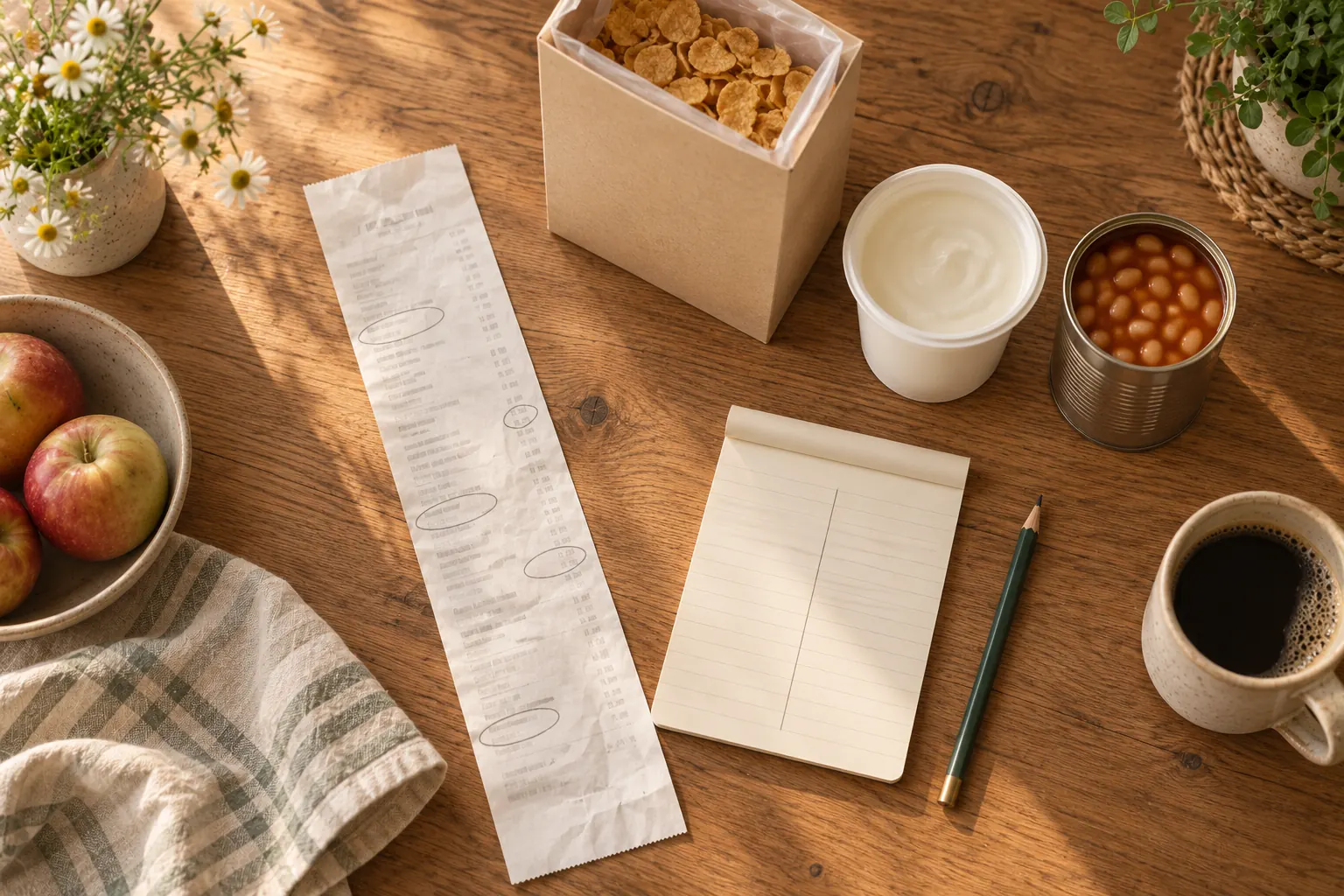
- Pick a receipt from the last week or two at a store you'd order from on Instacart. Newer is better, since shelf prices move.
- Circle 8 to 10 packaged items with a fixed size: a 32 oz yogurt, a box of cereal, a can of beans. Skip anything sold by weight, because the app charges the weight actually picked. If the abbreviations are cryptic, our guide to grocery receipt codes decodes them.
- Note the regular price for each one. If the receipt shows a sale or loyalty discount on a line, write down both numbers, since in-store promotions may not carry over.
- In the Instacart app, choose the same store location, check its pricing policy line under the logo, then search each item in the same size and write down the app price.
- Work out the markup per item: (app price minus receipt price) divided by receipt price. Average the results. If sizes differ, compare with the unit price calculator instead of the sticker.
- Add the items to the cart and go to the checkout screen without placing the order. Instacart shows the delivery fee, service fee and suggested tip for your address there.
- Add it up: app item total plus fees plus tip, against the receipt total for the same items. That percentage is your real delivery premium at that store.
If you keep a grocery price book, the in-store column is already filled in, and the app prices slot in next to it.
Compare a delivery month with an in-store month
A single basket tells you the markup. A month tells you what delivery actually costs your household, because ordering from an app can change what ends up in the cart as well as what each item costs. Total a month you mostly ordered delivery against a month you mostly shopped in person, split by category, using the steps in how to track grocery spending.
That comparison only works if the delivery receipts get recorded too. Duneed reads the prices off a photo of a paper receipt or a screenshot of a digital one, such as the receipt a delivery order emails you, and builds monthly spending by category from them. It won't compare prices between stores or tell you Instacart's markup; the check above does that. What it gives you is the two months side by side.
Is Instacart+ worth it?
Instacart+ is worth it only if you'd pay more in delivery fees over a year than the membership costs. As listed in September 2026, Instacart+ costs $99 a year or $9.99 a month, with a two-week free trial that auto-renews to the $99 annual plan. It removes the delivery fee on grocery orders of $10 or more ($35 at Costco), but service fees still apply.
The break-even at the cheapest listed delivery fee:
- Annual plan: $99 divided by $3.99 is about 25 orders a year, or roughly one every two weeks.
- Monthly plan: $9.99 divided by $3.99 is 2.5, so three or more orders in a month.
Instacart's page says the membership can pay for itself at two orders a month. That holds if your delivery fees average more than about $4.13, which is plausible for one-hour or small orders but not at the $3.99 floor. Per Instacart's benefits page, the membership doesn't give you faster delivery or earlier time slots, and pickup and prescription orders don't get the $0 delivery benefit. It does include Peacock Premium in the US. Instacart's pricing document says SNAP households get the membership at 50% off.
If you start the trial, set a reminder. Undisclosed auto-renewal after the free trial was one of the FTC's allegations in the December 2025 case.
Instacart vs Walmart+ vs Shipt vs Amazon Fresh
The four big US grocery delivery options differ more on fees than on how they describe item prices. Here's what each one listed on its own pages in September 2026.
| Service | Membership price | Delivery with membership | Delivery without membership | Item prices vs the store |
|---|---|---|---|---|
| Instacart | $99/year or $9.99/month | $0 on orders $10+ ($35+ Costco); service fee still applies | From $3.99 (same-day, over $35), plus service fee | Set by each retailer; some same, some marked up |
| Walmart+ | $98/year or $12.95/month | Free on orders of $35+; Express $10 | Express $17.95 to $19.95 (Walmart's own comparison) | Not stated on the Walmart+ page |
| Shipt | $99/year or $10.99/month | $0 over $35; $7 under $35 | $10 one-time delivery fee, plus service fee | No markups on most items for Target Circle 360 members; otherwise "vary slightly" |
| Amazon Fresh | Requires Prime for the member tiers | Free over $100 (2-hour window); $6.95 for $50 to $100; $9.95 under $50 | $4.95 to $13.95 by basket size | Not stated; Whole Foods says same pricing in store and online, with a $9.95 service fee |
The practical difference: Walmart+ and Amazon Fresh sell their own stores' groceries, so there's one price list to check. Instacart and Shipt sit between you and many retailers, so the answer changes store by store. The receipt check above works for all four.
Grocery delivery vs pickup cost
Pickup is almost always the cheaper way to use a grocery app, because Instacart charges no service fee on pickup orders and there's no delivery to tip for. What can remain is a pickup fee at some retailers (Aldi's starts at $1.99, and is $0 for Instacart+ members on orders of $10 or more) and any item markup, since Aldi's statement covers the cost of "personal shopping or delivery," not delivery alone.
In the worked example, pickup from a no-markup store cost $1.99 more than walking the aisles, against $15.99 more for non-member delivery. With a 10% markup, pickup comes to $89.99, still well under any delivered version. Amazon says pickup at its Fresh stores and pickup points is free for all customers.
Why two people once saw different prices for the same item
Until December 2025, some retailers ran price tests on Instacart that showed different shoppers different prices for the same item at the same store. Consumer Reports and the Groundwork Collaborative tested this in September 2025 with 437 volunteers (193 usable submissions) at Safeway and Target stores in Seattle, Washington DC, Saint Paul and North Canton, Ohio. They found 74% of items shown at more than one price, with an average gap of 13% between the lowest and highest price and a maximum of 23%.
Instacart ended all item price tests on December 22, 2025. Its pricing document now commits that shoppers ordering from the same store location at the same time see the same item prices. The study compared Instacart shoppers with each other, not with shelf prices, so it doesn't answer the in-store question. It does explain why older forum posts about "my price was different from my friend's" exist.
The FTC isn't finished with the topic. In April 2026 it asked for public comment on delivery-app fees, including whether delivered item prices match the prices of the same items in the store.
Common questions
Is Instacart more expensive on weekends?
Instacart's item prices shouldn't change by day of the week. Instacart commits in its pricing document not to change item prices based on supply and demand. Fees are different: the service fee can rise when fewer shoppers are available, such as in severe weather, and priority windows cost extra, so a busy Saturday slot can cost more in fees.
Do in-store sales and coupons apply on Instacart?
In-store sales and promotions may not apply to Instacart orders, and Instacart honors only the coupons listed in its app. Aldi says the same about its own online orders. Instacart does run app-only promotions, so an item can occasionally be cheaper in the app than on the shelf that week.
Does the Instacart service fee go to the shopper?
The Instacart service fee does not go to the shopper. Instacart says it covers operating costs such as insurance, background checks and customer support. The tip is the part that goes to the shopper, and Instacart says 100% of it does.
Does Instacart+ get rid of the service fee?
Instacart+ does not remove the service fee. It sets the delivery fee to $0 on orders of $10 or more ($35 at Costco), and Instacart's own membership page says service fees still apply.
How much more expensive is Instacart at Costco?
Costco doesn't publish a percentage. Its Same-Day FAQ says item prices are marked up above your local warehouse and that the markup pays for Instacart's delivery service. Price five or six items from your last warehouse receipt in the app to get your own figure, and see how to save money on groceries for the cheaper habits that don't depend on delivery.
Sources
- retailers set the item prices instacart.com
- pricing document company.instacart.com
- fees and taxes page instacart.com
- Costco FAQ customerservice.costco.com
- Aldi help: in-store vs online pricing help.aldi.us
- Shipt pricing help help.shipt.com
- Amazon customer service amazon.com
- Instacart home page FAQ instacart.com
- tipping instacart.com
- Aldi help help.aldi.us
- settled for $60 million in refunds ftc.gov
- complaint ftc.gov
- Instacart+ instacart.com
- benefits page instacart.com
- $98/year or $12.95/month walmart.com
- Consumer Reports and the Groundwork Collaborative github.com
- ended all item price tests company.instacart.com
- asked for public comment ftc.gov
Found a mistake? Tell us and we will correct it: support@duneed.app