
How to save money on groceries: the ways that move the bill, in order
The fastest way to save money on groceries is to find out where the money goes first, then work on the two things that usually cost the most: food bought and thrown away, and meals bought out instead of cooked. After that come the shelf-level habits, like checking unit prices and knowing your usual prices, which save less per trip but add up.
Most lists of grocery tips give twenty ideas equal weight. This one puts them in rough order of how much they can move the bill, shows the numbers behind each where there's a source for them, and links to the page that goes into detail.
1. Measure before you cut
You can't cut a bill you haven't looked at. Before changing anything, collect four weeks of grocery receipts and add them up by category: produce, meat, dairy, pantry, snacks, drinks, household.
Two numbers come out of that month:
- Your total, which you can set against USDA's own figures. How much to spend on groceries has the July 2026 food plans for households of one to five, and our grocery budget calculator works it out for your ages.
- Your three biggest categories. Those decide which of the tips below matter for you. Cheaper toilet paper won't move a bill that's mostly meat and takeout.
Our guide to tracking grocery spending compares five ways to do this, from a notebook to a receipt scanner.
2. Cook more of the meals you currently buy
For many households the biggest food cost isn't on the grocery receipt at all. The Bureau of Labor Statistics Consumer Expenditure Survey for 2024 puts the average household at $6,224 a year on food at home and $3,945 on food away from home.
A home-cooked meal on USDA's Moderate plan works out to about $4.45 to $5.26 per person for one adult in July 2026. Replacing five $18 takeout meals a week with home cooking saves about $3,300 a year at that rate, even though the grocery bill itself goes up. Cooking at home vs eating out has the full table, including what your time is worth and the nights you buy food and order in anyway.
3. Throw less away
The EPA's April 2025 estimate of what consumers pay for food they don't eat is $728 per person a year, or $2,913 for a household of four. Halving it would be worth $364 a person a year, and it doesn't involve buying anything.
What cuts it:
- Shop for four or five dinners a week, not seven.
- Check the fridge, freezer and cupboards before you write the list. Meal planning from your pantry is a half-hour routine for this.
- Write down dates on the things that go off, with an expiration date tracker, and put them at eye level.
- Freeze what you won't reach in time, and keep a freezer inventory sheet so it gets eaten.
Our food waste calculator puts a yearly dollar figure on what your household throws away, and food waste statistics has every national figure with the year it describes. The habits that cut it most, ranked by what causes the waste, are in how to reduce food waste at home.
4. Shop from a list, with a pantry check
A list stops two kinds of spending: impulse buys and duplicates, the second jar of something you already had.
The evidence is observational rather than proof, but it points one way. A nationally representative Australian study of 1,462 households who kept a 7-day diary (Ananda and colleagues, 2025) found that more frequent grocery shopping went with more fruit and vegetable waste, and higher use of a shopping list with less.
Our printable grocery list is set out in store order with a "Have" column, so the pantry check happens on the same sheet, and there's a CSV if you'd rather keep it in a spreadsheet.
5. Compare unit prices, not shelf prices
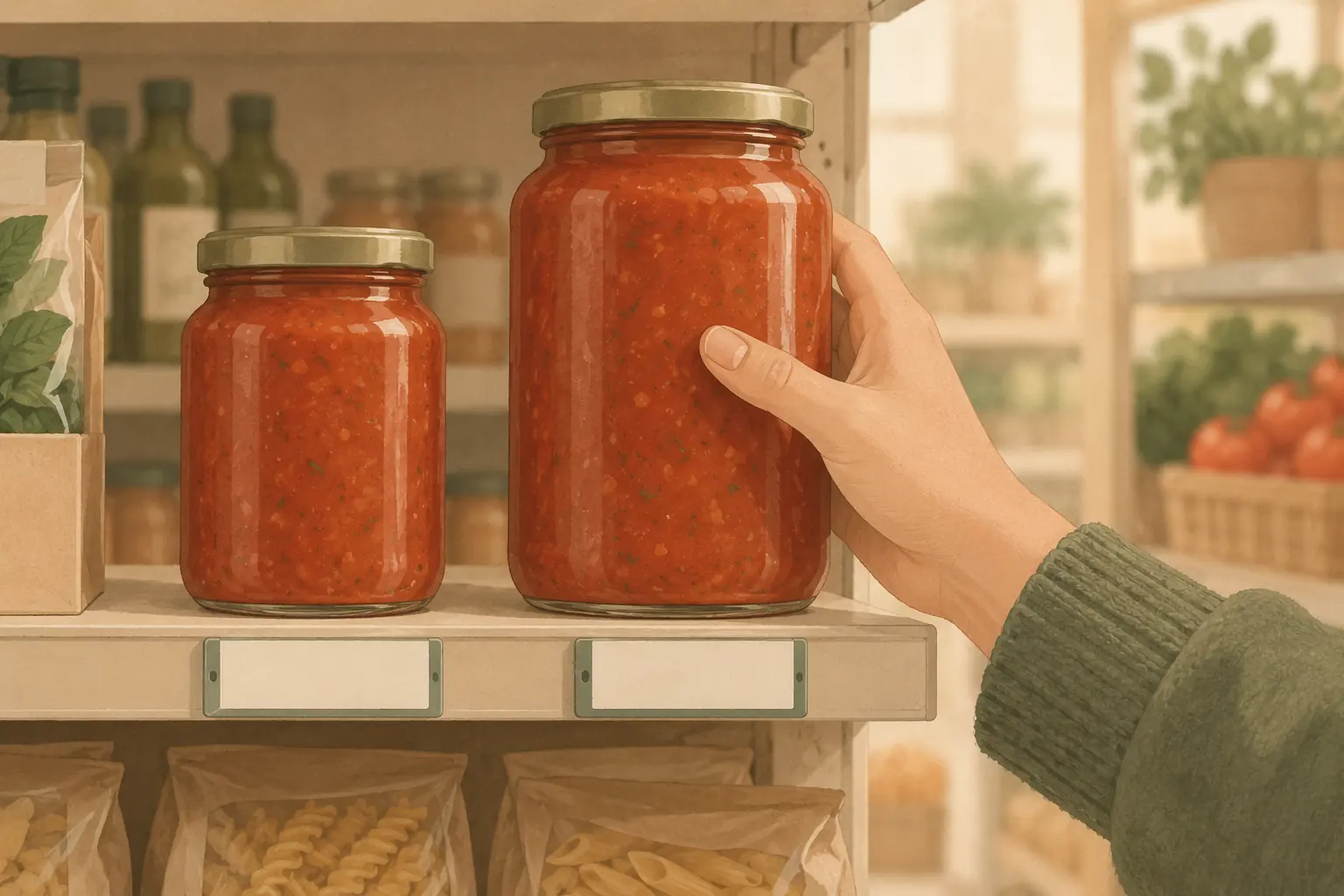
The price that matters is the price per ounce, pound or item, not the price on the pack. No federal law requires unit prices on shelf tags: NIST's Unit Pricing Guide (June 2025) says unit pricing is voluntary unless state laws or regulations require it, and lists sixteen states plus DC, Puerto Rico and the Virgin Islands where they do. Where a tag is missing, or one tag says per ounce and the next per 100 grams, work it out.
Our unit price calculator does the conversion. Two things it catches that a glance doesn't: shrinkflation, where the pack gets smaller at the same price, and the bigger pack that costs more per ounce than the small one.
6. Know your usual prices
A sale is only a sale if the price is below what you normally pay, and it's hard to remember what you normally pay for more than a handful of things.
A grocery price book is a page where you write down the price of the 20 or so things you buy every week, each time you buy them. After a few weeks it shows you the low price each item comes back to, which is when to stock up, and which store is actually cheaper for your basket rather than on a few things you rarely buy.
7. Buy in bulk only when the numbers work
Bulk buying is on most lists of grocery tips, and it's the one that most often backfires. The rule is simple: the bigger pack wins only when its discount is bigger than the share of it you throw away. A 20% discount on a pack you throw a quarter of away is a loss.
Is buying in bulk cheaper has the break-even table, how to spread a warehouse club fee across the items you actually buy, and the evidence that bigger packs sometimes cost more per ounce. If you're weighing a warehouse club, our warehouse club calculator sets the membership fee against your own discount and waste.
8. Build a small pantry and cook from it
A pantry of staples that keep for months (rice, pasta, oats, dried and canned beans, canned tomatoes, oil, a few spices) is what makes the cheap nights possible. It's the difference between "there's nothing to eat" and pasta with garlic and a can of chickpeas.
Build it a few items per trip rather than all at once. Our pantry staples list has 57 staples with a printable checklist, and which ones are worth buying big and which to buy small. If you're starting from an empty kitchen, first apartment grocery list does it in stages.
9. Share one list if you shop with someone
Two people shopping separately often buy the same things twice. One shared list, visible to both, fixes most of it. Shared grocery list covers the free options for iPhone, Android and Alexa, and grocery budget for 2 people sets out what a couple's budget should look like and three ways to split it.
10. Price what you cook
Once you know what a recipe costs per serving, it's easy to see which weeknight meals are cheap and which only feel cheap. Our recipe cost calculator prices a recipe from the packs you bought. If you sell what you bake, how to price homemade food adds your time and packaging.
What about coupons, cash-back apps and store brands?
They save money, but how much depends almost entirely on what you buy, and we haven't found a primary source for how much they save a typical household, so we won't put a number on them.
Two conditions make them worth it. The coupon or rebate has to be on something you'd have bought anyway, at a price that still beats the store brand after the discount. And the time it takes has to be worth it to you: an app that saves $4 a week for 20 minutes of scanning is paying you $12 an hour. How the two main receipt rewards apps work, and how they differ from apps that track spending, is in best grocery receipt scanner apps.
Where to start this week
If you only do three things:
- Keep this week's receipts, and next week's, and add them up.
- Before the next shop, check what's already in the kitchen and plan four dinners around it.
- Shop from a list with quantities on it.
Duneed, our iPhone app, turns photographed grocery receipts into monthly totals by category, keeps a list of what's in the kitchen with dates flagged as they approach, and has a shopping list you tick off. With Premium it also counts what was thrown away and what it cost. That's steps 1 to 3 in one place, though every one of them works on paper.
Common questions
What is the best way to save money on groceries?
Measure first: a month of receipts by category shows where the money goes. For most households the biggest savings then come from cooking more of the meals currently bought out and throwing less food away, before any shelf-level tip.
How much can I save on groceries?
It depends on where your money goes now. As a reference, the EPA puts the cost of food consumers buy and don't eat at $728 per person a year, and replacing five $18 takeout meals a week with home cooking saves about $3,300 a year.
Does meal planning save money?
It usually does, mainly by cutting the food you buy and throw away. Research on it is observational: a large French study found meal planners more likely to have a healthier, more varied diet, and an Australian study linked shopping lists to less fruit and vegetable waste.
Is buying in bulk worth it?
Only when the discount is bigger than the share of the pack you'd throw away. It works for dry goods and household items, and rarely for perishables in a small household.
How much should I spend on groceries?
USDA's food plans for July 2026 put a couple aged 19 to 50 at $630 to $1,009 a month and a family of four at $1,025 to $1,683, depending on the plan. The full table is in how much to spend on groceries.
Sources
- Consumer Expenditure Survey bls.gov
- $728 per person a year epa.gov
- Ananda and colleagues, 2025 doi.org
- Unit Pricing Guide nvlpubs.nist.gov
- large French study doi.org
Found a mistake? Tell us and we will correct it: support@duneed.app