
Weekly grocery list for a family of 4, built from USDA's own market basket
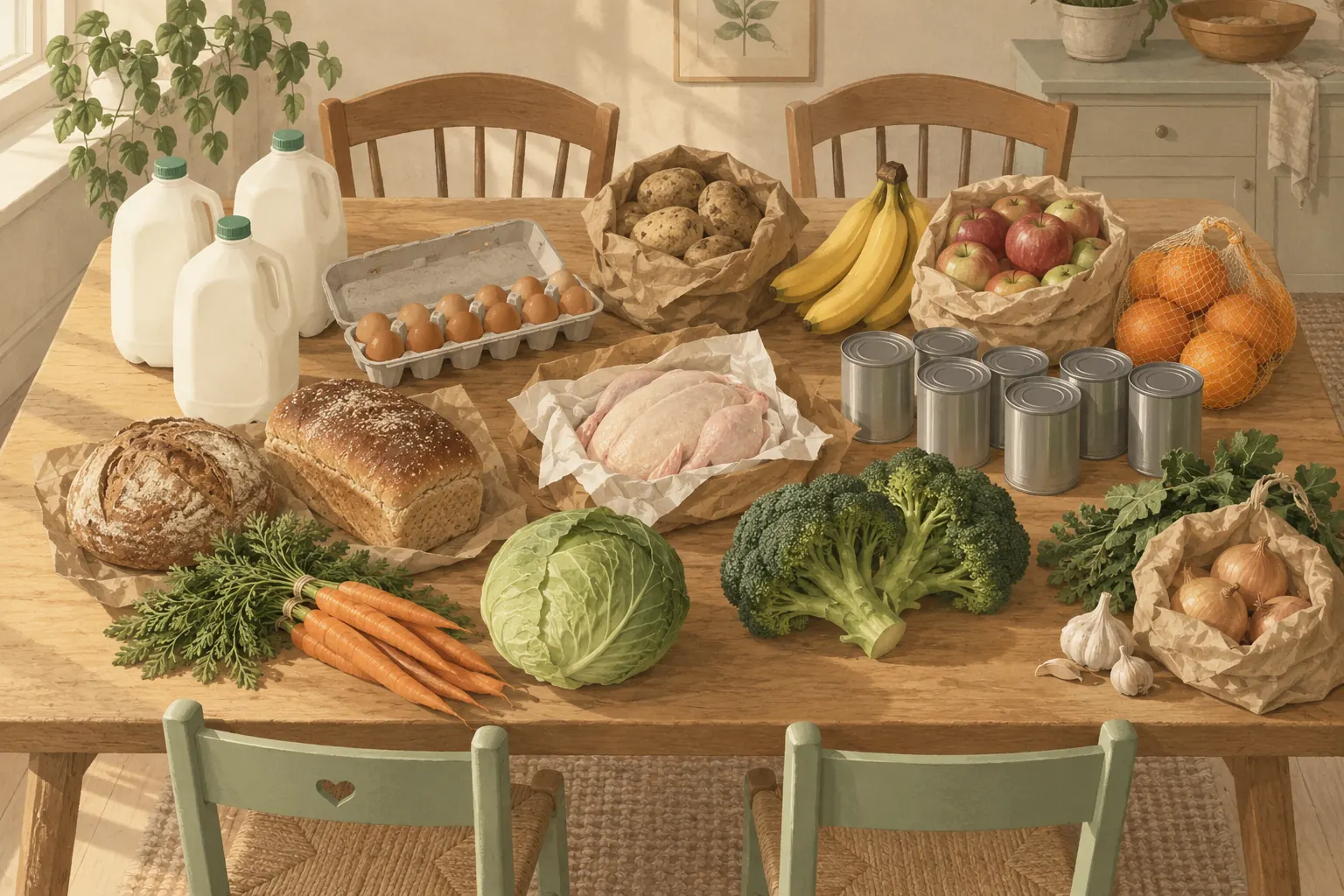
USDA's Thrifty Food Plan buys 140.94 pounds of food a week for a family of four: two adults aged 20 to 50, a child aged 6 to 8 and a child aged 9 to 11. This weekly grocery list for a family of 4 turns those pounds into a cart you'd recognize. It comes to roughly 4.9 gallons of milk, 17 eggs, 7 pounds of chicken, 18 pounds of whole fruit and about 35 pounds of vegetables.
Most lists that rank for this search are one family's receipt from one store in one year. This one starts from the quantities in USDA's Thrifty Food Plan, 2021 report, so you can see where each number comes from and change it for your own children.
The family of 4 weekly grocery list at a glance
USDA's weekly market basket for a family of four weighs 140.94 lb, split into six groups in Table 1 of the Thrifty Food Plan, 2021 report. The pounds below are USDA's. The right-hand column is our translation into things you'd buy.
| Food group | USDA pounds per week | Roughly what that is in the cart (our conversion) |
|---|---|---|
| Dairy | 41.30 | 4.9 gallons of milk (some of it can be yogurt) and an 11-ounce piece of cheese |
| Vegetables | 35.37 | 10 lb potatoes and corn, 8 lb carrots, tomatoes and sweet potatoes, 6 or 7 cans of beans, plus greens, onions and cabbage |
| Fruits | 26.91 | About 18 lb of whole fruit and just over a gallon of 100% juice |
| Protein foods | 16.18 | 7 lb chicken, 2 lb other meat, 3 lb fish, 17 eggs, a jar of peanut butter |
| Grains | 14.13 | 3 loaves of bread, 4 lb rice, 2 lb pasta, tortillas, cereal, crackers |
| Other foods | 7.05 | Cooking fat, condiments, coffee or tea, a frozen pizza or soup, a small treat |
| Total | 140.94 | About 20 lb of food a day, as bought |
"As bought" matters. USDA counts foods in their as-purchased form, so the weight includes banana peels, chicken bones and the liquid in a can of beans.
The weekly grocery list for a family of 4, line by line
Table 1 breaks the six groups into 24 categories, and the tables below keep all of them. In every table, the first number is USDA's (Table 1, pages 38 to 39 of the report, "June 2021, weekly amounts"). The example column is ours: one reasonable way to buy that weight at a US supermarket, using common package sizes. Swap freely within a line; the report expects you to.
Vegetables (USDA: 35.37 lb)
| USDA category | USDA lb | Example buy |
|---|---|---|
| Dark-green vegetables | 3.23 | 2 lb broccoli and a 1-lb bag of frozen spinach |
| Red and orange vegetables | 8.28 | 2 lb carrots, two 28-oz cans of tomatoes, 3 lb sweet potatoes |
| Beans, peas, lentils | 6.06 | Six or seven 15-oz cans of beans (black, pinto, chickpeas) |
| Starchy vegetables | 10.64 | A 5-lb and a 3-lb bag of potatoes, a 2-lb bag of frozen corn |
| Other vegetables | 7.16 | 3 lb onions, a 2-lb cabbage, 1 lb frozen green beans, 1 lb cucumbers or celery |
Starchy vegetables get the biggest share because they're cheap and filling, and the report says the amount also reflects how much potato and corn Americans already eat. The bean line assumes cans: USDA says nearly all of it (99%) is expected to be bought canned, which is why the pounds look high. Buy dry beans and the same amount of cooked beans weighs far less in the bag.
Fruit (USDA: 26.91 lb)
| USDA category | USDA lb | Example buy |
|---|---|---|
| Whole fruit (fresh, frozen, canned, dried) | 17.76 | 5 lb bananas, a 3-lb bag of apples, a 4-lb bag of oranges, two 29-oz cans of peaches, 2 lb of whatever is in season |
| 100% fruit juice | 9.15 | Two 64-oz bottles of orange juice (about 1 gallon) |
The report assumes lower-price fruit, naming bananas, apples, peaches and oranges. Raspberries and cherries fit only if something else in the week gets cheaper. The juice line is bigger than most people expect. It's a third of the fruit weight, and most of it sits in the two adults' baskets (4.59 lb for the man alone), so a family that doesn't drink juice can move that weight to whole fruit.
Grains (USDA: 14.13 lb)
| USDA category | USDA lb | Example buy |
|---|---|---|
| Whole-grain staples (rice, pasta, bread, tortillas) | 6.70 | Two 20-oz loaves of whole-wheat bread, 2 lb brown rice, 1 lb whole-wheat pasta, 1 lb whole-wheat tortillas |
| Whole-grain cereals (oatmeal, ready-to-eat) | 1.12 | One 18-oz box of whole-grain cereal or a canister of oats |
| Refined-grain staples | 5.65 | A 20-oz loaf of white bread, 2 lb white rice, 1 lb spaghetti, 1 lb flour tortillas |
| Refined-grain other (crackers, snacks) | 0.66 | One box of crackers or pretzels |
Dairy (USDA: 41.30 lb)
| USDA category | USDA lb | Example buy |
|---|---|---|
| Low-fat and fat-free milk, yogurt, soy milk | 25.48 | About 3 gallons of skim or 1% milk |
| Whole and 2% milk, yogurt, soy milk | 15.13 | About 1.8 gallons of whole or 2% milk, or a gallon plus a 32-oz tub of yogurt |
| Cheese | 0.70 | An 8-oz block and a small pack of slices |
Dairy is the heaviest group by far because milk is heavy. USDA assumes most of the two milk lines is bought as fluid milk or fortified soy milk, since they're cheaper per nutrient than yogurt, and it says a household could buy only lower-priced soy milk and still meet the dairy target.
Protein foods (USDA: 16.18 lb)
| USDA category | USDA lb | Example buy |
|---|---|---|
| Poultry | 6.89 | A 5-lb whole chicken and 2 lb of chicken thighs |
| Seafood | 2.94 | A 2-lb bag of frozen tilapia and three 5-oz cans of tuna |
| Meats | 2.26 | 1 lb ground beef and 1.25 lb pork chops |
| Eggs | 2.12 | About 17 large eggs (an 18-count carton is the nearest pack) |
| Nuts, seeds, soy products | 1.97 | A 28-oz jar of peanut butter and a small bag of sunflower seeds |
Chicken outweighs red meat three to one, partly because meat cost more than poultry at the June 2021 prices the model used. The seafood line meets the Dietary Guidelines amount for the family, and USDA names tilapia and canned light tuna as the lower-price picks.
Other foods (USDA: 7.05 lb)
| USDA category | USDA lb | Example buy |
|---|---|---|
| Table fats and oils | 1.71 | A 1-lb tub of spread or butter and a 12-oz bottle of dressing (or top up the oil) |
| Sauces, condiments, jam, sugar, spices | 1.64 | Salsa, jam or syrup, a little sugar and a spice or two |
| Coffee and tea | 1.63 | Adults only; not converted (see below) |
| Pre-prepared entrees and sides | 1.51 | A frozen pizza or three cans of soup |
| Other (soft drinks, ice cream, cookies, candy) | 0.57 | A pack of cookies or a small tub of ice cream |
We didn't convert the coffee line. The report says each adult's basket includes at least 1 cup of coffee or tea a day, but it doesn't say whether the 1.63 lb is ground coffee, tea bags or the brewed drink, and each reading gives a very different shopping list.
How we turned USDA's pounds into gallons, cans and eggs
The conversions in the example column come from four places, and only the first is USDA's own instruction:
- Milk: Table 1's footnote says the milk and yogurt pounds convert to fluid ounces "by multiplying by 15.34". So 40.61 lb × 15.34 = 623 fl oz, and 623 ÷ 128 = 4.87 gallons (about 18.4 liters).
- Eggs: USDA's shell egg standards set large eggs at a minimum of 24 ounces per dozen, 2 ounces an egg. 2.12 lb is 33.9 oz, so about 17 large eggs. Extra-large eggs would make it about 15.
- Juice: USDA's FoodData Central entry for chilled orange juice (FDC ID 169100) weighs 1 fl oz at 31.1 g. 9.15 lb is 4,150 g, or 133 fl oz, just over a gallon.
- Everything else uses the net weight printed on a common US package: 15-oz cans of beans, 28-oz cans of tomatoes, 5-oz cans of tuna, 20-oz loaves, 5-lb potato bags. These are our choices, not USDA's, and your store's sizes will differ.
Some lines are a weekly rate, not a weekly purchase. Nobody buys 1.64 lb of condiments every Saturday. A 28-oz jar of peanut butter or a bottle of oil lasts several weeks, so treat those lines as what the family works through on average.
What the USDA market basket is, and what it isn't
The Thrifty Food Plan market basket is a cost model: USDA's estimate of a low-cost mix of foods that meets the Dietary Guidelines for Americans, 2020-2025, for each age and sex, starting from what Americans already eat. An optimization model picks the quantities, and the reference family's plan is the one used to set the maximum SNAP benefit.
USDA is plain about the limits. The report says the plan "is not intended to be an item-specific shopping list or a prescriptive diet" (page 4), and that no household has to spend its SNAP benefit along these categories, so the list is a check on proportions rather than a set of orders.
The reference family is also set by law, not picked for being typical: a man and a woman aged 20 to 50 and two children, one 6 to 8 and one 9 to 11. If your children are 3 and 15, the pounds change.
How much food does a family of 4 eat a week?
The USDA reference family of four buys 140.94 lb of food a week in the Thrifty Food Plan, about 20 lb a day or 64 kg a week. That's the weight in the bags, including peel, bone and can liquid, and it covers meals and snacks made at home.
The four people don't eat equal shares. Appendix 4 of the report prices each age and sex separately, and the reference family's four baskets add up exactly to Table 1:
| Reference family member | USDA lb per week |
|---|---|
| Man, 20 to 50 | 44.74 |
| Woman, 20 to 50 | 33.74 |
| Child, 9 to 11 | 34.52 |
| Child, 6 to 8 | 27.94 |
| Family total | 140.94 |
A 10-year-old's basket is heavier than the mother's, mostly because it carries more milk and dairy (11.15 lb against 10.13 lb).
Adjusting the list for your family
To adjust the weekly grocery list for a different family of four, swap in the basket for each person's age and sex from USDA's Appendix 4. These are the weekly totals for all 15 groups (Tables A4.1 to A4.15, pages 79 to 109):
| Age group | Male, lb/week | Female, lb/week |
|---|---|---|
| 1 year | 18.29 | 18.29 |
| 2 to 3 | 24.64 | 24.64 |
| 4 to 5 | 26.85 | 26.85 |
| 6 to 8 | 27.94 | 27.94 |
| 9 to 11 | 34.52 | 34.52 |
| 12 to 13 | 35.46 | 31.29 |
| 14 to 19 | 45.83 | 35.47 |
| 20 to 50 | 44.74 | 33.74 |
| 51 to 70 | 40.24 | 32.66 |
| 71 and older | 38.37 | 34.21 |
USDA doesn't split children under 12 by sex, so both columns match there.
Two worked examples, same parents:
- Two boys aged 14 to 19: 44.74 + 33.74 + 45.83 + 45.83 = 170.14 lb a week, 21% more than the reference list. A teenage boy's basket is heavier than his father's.
- Children aged 2 to 3 and 4 to 5: 44.74 + 33.74 + 24.64 + 26.85 = 129.97 lb, about 8% less.
Scaling every line by the same percentage is a fair first guess, but it isn't exact, because each group's basket has its own mix. Our food per week calculator does the sum category by category for any household, from the same USDA tables.
Some other adjustments the report itself allows:
- Vegetarian: USDA says the protein money is enough for a lacto-ovo vegetarian pattern within the plan's cost. Move the chicken, meat and fish weight toward beans, eggs, tofu and nut butter.
- Soy milk instead of cow's milk: allowed within the dairy lines.
- School lunch or meals out: the report describes foods bought and prepared at home, so the basket is sized as if every meal and snack comes from the family kitchen. If the kids eat lunch at school five days a week, the grains, dairy and fruit lines can shrink.
Where the money goes in this basket
Weight and cost don't line up. Dairy is 29% of the basket's weight but 14.5% of its cost in Table 1. Protein foods are the reverse: 11.5% of the weight and 24.6% of the cost, the single most expensive group. Vegetables come next at 23.9% of the cost, then grains (15.9%), fruit (14%) and other foods (7.1%).
That split is a useful yardstick for your own receipts. If meat is taking 40% of the food bill, it's the first line to look at, well before milk.
USDA reprices this basket every month for inflation, so we don't repeat dollar figures here. What it costs this year, including versions for toddlers and teenagers, is in our grocery budget for a family of 4, and the grocery budget calculator prices any mix of ages. For how that compares with households of other sizes, see how much to spend on groceries.
To compare your own category split with USDA's, you need your spending grouped the same way for a month. Duneed builds that from photographed receipts: monthly totals by category, with the price you actually paid on each line.
Turning USDA's quantities into a list you'll use
USDA's quantities work best as a check on a meal plan you've already made, in five steps:
- Start with what's already in the house. Anything you have counts against the week's pounds. Our guide to meal planning from your pantry walks through a 15-minute inventory.
- Plan meals, then check the totals. Seven dinners built around chicken thighs, beans and potatoes will land close to USDA's proportions without any math. If your plan has 12 lb of meat and no fish, the table above shows where it drifts.
- Split slow lines from weekly lines. Milk, bread, fruit and eggs are weekly. Oil, peanut butter, rice, spices and condiments are rates; keep them on a separate pantry staples list and restock when they run low.
- Write the list by store section, so the cart fills in the order of the aisles. The printable grocery list is already sorted that way.
- After the shop, note what's left before the next one. If three bananas and half a cabbage survive every week, cut those lines.
If you'd rather keep that list on a phone, Duneed has a shopping list you tick off in the store, and the pantry list it builds from your receipts shows what's still in the house before the next shop.
Common questions
How much milk does a family of 4 drink a week?
USDA's Thrifty Food Plan budgets 40.61 lb of milk, yogurt and soy milk a week for its family of four, which is about 4.9 gallons (18.4 liters) using the report's own conversion of 15.34 fl oz per pound. That covers every glass, bowl of cereal and cooking use. A household that drinks milk by the glass will sit above it; one that uses milk only in coffee will sit well below.
How many eggs does a family of 4 eat a week?
The USDA reference family's basket has 2.12 lb of eggs a week, about 17 large eggs by USDA's minimum weight for the large size (24 oz a dozen). An 18-count carton is the closest single pack.
How many pounds of food does a family of 4 need?
USDA's Thrifty Food Plan puts it at 140.94 lb a week for two adults and two children aged 6 to 11, as purchased. Over a year that's about 7,330 lb. Families with teenagers need more: two teenage boys raise it to about 170 lb a week.
What does a monthly grocery list for a family of 4 look like?
A monthly grocery list for a family of 4 is the weekly list multiplied by 4.33, the average number of weeks in a month: about 611 lb of food, including roughly 21 gallons of milk and 73 eggs. Fresh produce and milk still need weekly trips, so a monthly list mostly works for the pantry lines.
Is this a grocery list for a family of 4 on a budget?
Yes. The Thrifty Food Plan is USDA's lowest-cost food plan, built from lower-price choices in every category (chicken over beef, canned beans, bananas and apples over berries). Lists promising $50 or $100 a week for four people sit well below what USDA says this basket costs; the current figure is in our family of 4 grocery budget.
Sources
- Thrifty Food Plan, 2021 fns-prod.azureedge.us
- shell egg standards ams.usda.gov
- FoodData Central fdc.nal.usda.gov
Found a mistake? Tell us and we will correct it: support@duneed.app