How to meal plan from your pantry and use what you already have
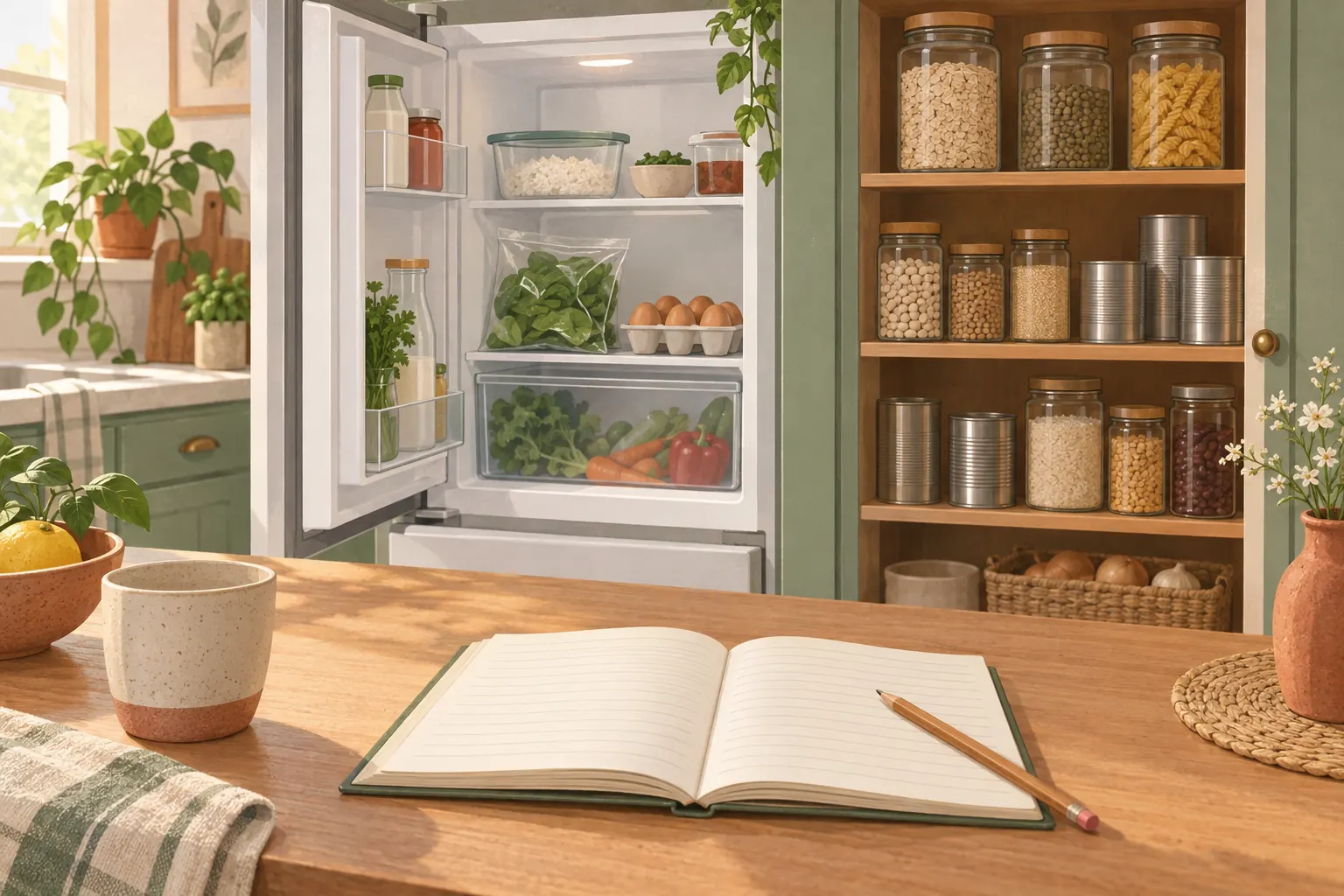
To meal plan from your pantry, you plan the week around what's already in the kitchen and shop only for the gaps. It takes five steps and about half an hour:
- Take a quick inventory of the fridge, freezer and cupboards.
- Sort it into what needs using first and what can wait.
- Build each meal around one use-first item.
- Write a shopping list of only the gaps, with quantities.
- Put the meals that use the most perishable food at the start of the week.
The EPA's advice on preventing wasted food at home is the same idea in one line: look in your refrigerator, freezer and pantry first, make a list each week of what needs to be used up, and plan upcoming meals around it. What follows is how to actually do that without it turning into a Sunday project.
Step 1: take a 15-minute inventory
You don't need a perfect count. You need to know what's there and roughly how much. When the plan needs quantities rather than dishes, the portion planner turns a headcount into weights.
Go in this order, because it's roughly the order things go off:
- Fridge: leftovers, opened jars and cans, fresh meat and fish, produce, dairy.
- Freezer: anything you'd forgotten, which is usually more than you think.
- Cupboards: grains, pasta, cans, sauces, the half bag of lentils.
Write it on anything. The back of an envelope works. If you do this every week, a pantry inventory list taped inside the cupboard door and a freezer inventory sheet on the freezer turn step 1 into a glance, because you're updating a list rather than rediscovering the kitchen.
Step 2: sort it into "use first" and "can wait"
This is the step that makes the plan work, and most pantry meal plans skip it. They say "look at what you have" and then plan around whatever sounds good, which is how the half bag of spinach turns to slime while you cook the rice that would have lasted a year. Produce stored in the right place lasts longer to begin with; how to store produce has the chart.
Sort what you found into four groups:
| Group | What goes in it | Why it's here |
|---|---|---|
| Use in the next 2 days | Leftovers, opened cans and jars, fresh fish, ground meat, soft herbs, salad leaves, ripe fruit | Short windows |
| Use this week | Other fresh meat, firm vegetables, opened dairy | A few days to about a week |
| Freezer | Everything frozen | Holds quality for months |
| Can wait | Dry and canned goods, unopened jars | Months to years |
The time limits for the first group aren't guesswork. USDA's Food Safety and Inspection Service says leftovers can be kept in the refrigerator for 3 to 4 days or frozen for 3 to 4 months. For opened canned food, FSIS gives 3 to 4 days in the fridge for low-acid foods such as beans, soups and vegetables, and 5 to 7 days for high-acid foods such as tomatoes, fruit and pickles. The federal cold food storage chart gives raw ground meat and raw poultry 1 to 2 days in the fridge.
We're not a food safety authority, and we won't tell you whether something in your fridge is still fine. Those FSIS figures are the ones to go by, and if you're unsure what a date on a package means, we've set out what USDA and FDA say about each label in best before vs use by vs sell by.
The "use in the next 2 days" group is your starting point for the plan. Everything else is supporting cast.
Step 3: build each meal around one use-first item
Take one item from the top of your list and ask what it could go into. Most use-it-up cooking falls into a handful of shapes, and the EPA's list of ways to repurpose odds and ends is a good one: soups, casseroles, stir fries, frittatas, sauces, baked goods, pancakes or smoothies.
| Meal shape | Uses up | Usually needs from the cupboard |
|---|---|---|
| Frittata or omelet | Eggs, cooked vegetables, cheese ends, herbs | Oil, salt |
| Fried rice | Cooked rice, odd vegetables, a little meat | Soy sauce, oil, an egg |
| Soup | Soft vegetables, leftover meat, beans | Broth or bouillon, canned tomatoes |
| Pasta with sauce | Wilting greens, half a jar of sauce, cheese | Pasta, garlic, olive oil |
| Stir fry | Any vegetables, a protein | Rice or noodles, soy sauce |
| Tacos or wraps | Leftover meat, beans, salsa, cheese | Tortillas |
| Grain bowl | Cooked grains, roasted vegetables, a protein | A dressing |
| Sheet-pan dinner | Firm vegetables, sausages or chicken pieces | Oil, spices |
A useful rule of thumb: one thing to use up, one base from the cupboard, one flavor. Leftover chicken, rice and salsa is a burrito bowl. Spinach, pasta and garlic is dinner. You don't need a recipe for most of these, which is the point.
Aim for four or five dinners, not seven. Leave room for leftovers, a night out and the evening you won't feel like cooking.
Step 4: shop only for the gaps, with quantities
Now write the shopping list. It should be short, because most of each meal is already in the kitchen.
The EPA's tip here is a good one: put quantities on the list, noting how many meals each item is for. Its example is "salad greens, enough for two lunches". That's the difference between buying what you need and buying a family bag that turns into next week's use-first problem.
Our printable grocery list has a "Have" column for exactly this: tick the items you already have at home and only the unticked ones get bought.
Step 5: order the week by what spoils first
Put the meals that use the most perishable food on Monday and Tuesday, and the pantry-heavy meals at the end of the week.
- Monday: the meal that uses leftovers or fish.
- Tuesday: the one with salad leaves or soft herbs.
- Midweek: firmer vegetables and fresh meat.
- Thursday and Friday: freezer and cupboard meals.
If the week goes sideways, it's the Friday pasta that gets pushed, not the Monday fish.
A worked example
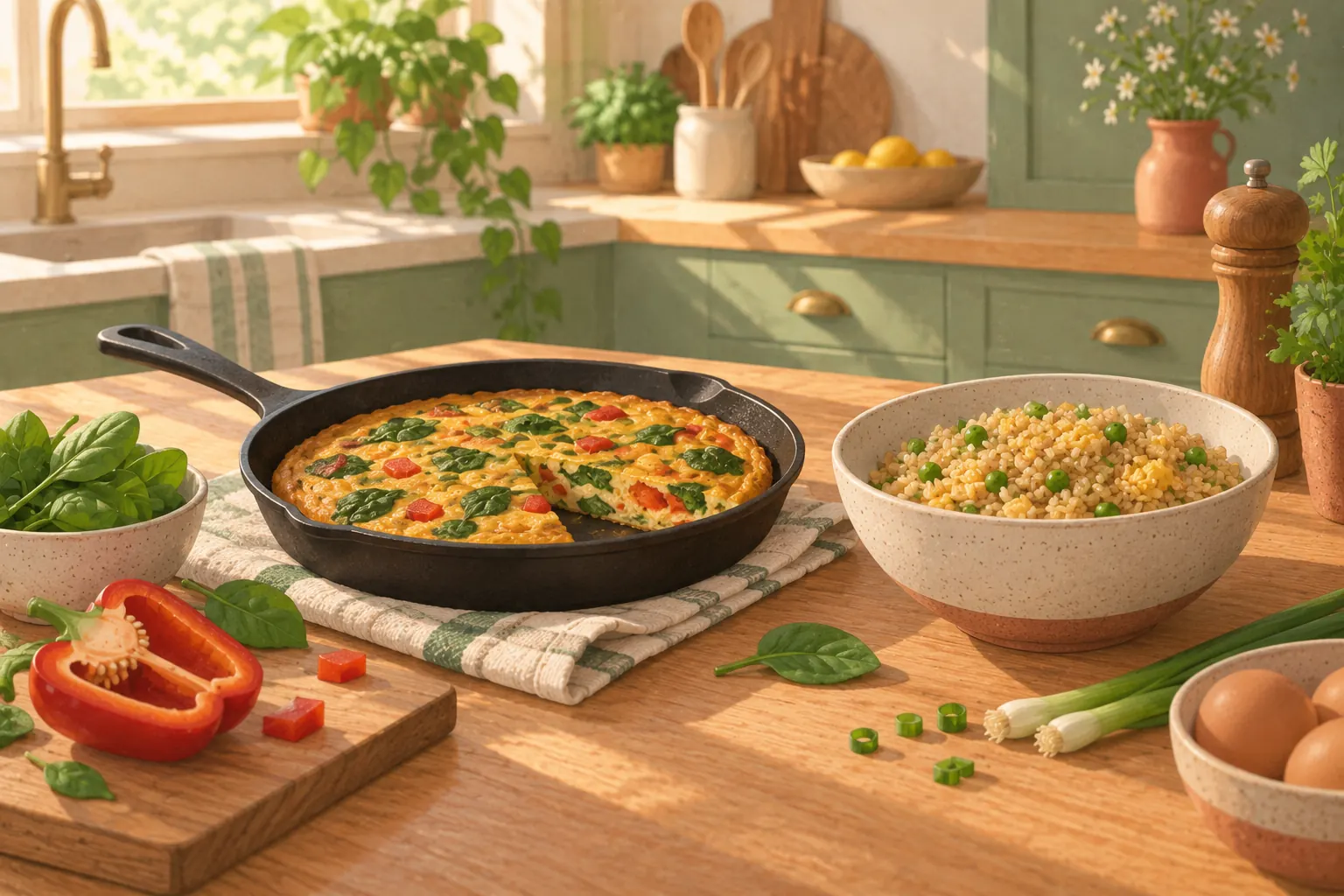
Say a quick look through the kitchen on Sunday turns up this:
- Fridge: half a container of cooked rice from Friday, most of a bag of spinach, four eggs, half a jar of salsa, a block of cheddar, two peppers, half a rotisserie chicken.
- Freezer: a bag of peas, some sausages.
- Cupboard: a can of chickpeas, a can of tomatoes, pasta, lentils, tortillas, a jar of curry paste.
Sorted and planned:
| Day | Dinner | Uses up |
|---|---|---|
| Sunday | Chicken and spinach quesadillas | Rotisserie chicken, some spinach, cheddar, salsa, tortillas |
| Monday | Fried rice with egg, peas and peppers | Cooked rice, eggs, one pepper, frozen peas |
| Tuesday | Spinach and tomato pasta | The rest of the spinach, canned tomatoes, pasta |
| Wednesday | Chickpea and pepper curry | Chickpeas, the other pepper, curry paste |
| Thursday | Sausage and lentil stew | Frozen sausages, lentils |
The shopping list for those five dinners: an onion or two, garlic, and rice to go with the curry. Everything else was already there.
Does meal planning actually save food?
The research is thinner than the confident blog posts suggest, but it points the same way.
A large French study of 40,554 adults, Ducrot and colleagues in 2017, found that 57% planned meals at least occasionally, and planners were more likely to have a healthier diet and more food variety. The authors are careful to say no causality can be inferred.
On waste, a nationally representative Australian study of 1,462 households who kept a 7-day diary (Ananda and colleagues, 2025) found that households threw away 35.2 kg of avoidable fruit and vegetables a year on average, and that more frequent grocery shopping was associated with more waste while higher use of a shopping list was associated with less.
Neither study is American, and both show associations rather than cause and effect. The EPA puts the cost of food a US family of four doesn't eat at almost $3,000 a year. If you want your own number rather than a national one, our food waste calculator works it out from what you spend. For the habits beyond meal planning, see how to reduce food waste at home.
Keeping track between weeks
The hard part of cooking from the pantry isn't the cooking. It's knowing what's there without opening every cupboard.
Two things help. The first is writing dates down when food comes in, so the "use first" list builds itself: an expiration date tracker does that on paper. The second is keeping a short list of staples you always want on hand, so the "base" part of every meal is already covered. Our pantry staples list is a good place to start.
Duneed, our iPhone app, builds the pantry list from photographed grocery receipts, and if you give an item a date it flags it amber as the date approaches and red once it has passed. That's the use-first list from step 2, kept up to date without the Sunday inventory. It doesn't plan meals or suggest recipes; that part is still yours.
Common questions
What is a pantry challenge?
A pantry challenge is a set period, usually a week or two, where you cook mainly from what you already have and only buy essentials like milk and fresh produce. For a timed version, use our 7-day pantry challenge and printable worksheet to record starting stock, meals, shopping gaps and what remains at the end.
What should I use first from my fridge?
Leftovers and opened cans or jars, then fresh fish and ground meat, then salad leaves, soft herbs and ripe fruit. FSIS gives leftovers 3 to 4 days in the fridge, and opened canned food 3 to 4 days for low-acid foods or 5 to 7 days for high-acid foods such as tomatoes. The fridge and freezer times for everything else are in how long does food last in the fridge. A pantry laid out by zone, as in how to organize a pantry, makes this check a glance.
How do I meal plan with what I have when I don't know what to make?
Start with one item that needs using and pick a meal shape: frittata, fried rice, soup, pasta, stir fry, tacos or a grain bowl. Each of those works with almost any vegetables and a cupboard base, so you don't need a specific recipe.
How many meals should I plan a week?
Four or five dinners is enough for most households. Planning seven usually means buying for meals that don't happen, which is where a lot of waste starts.
How long does it take to meal plan from the pantry?
About half an hour the first time: 15 minutes for the inventory and 15 for the plan and list. It gets faster once you keep a running inventory, because step 1 mostly disappears.
Sources
- preventing wasted food at home epa.gov
- leftovers fsis.usda.gov
- opened canned food fsis.usda.gov
- cold food storage chart foodsafety.gov
- Ducrot and colleagues in 2017 doi.org
- Ananda and colleagues, 2025 doi.org
Found a mistake? Tell us and we will correct it: support@duneed.app