
Can you freeze it? What freezes well, and what doesn't
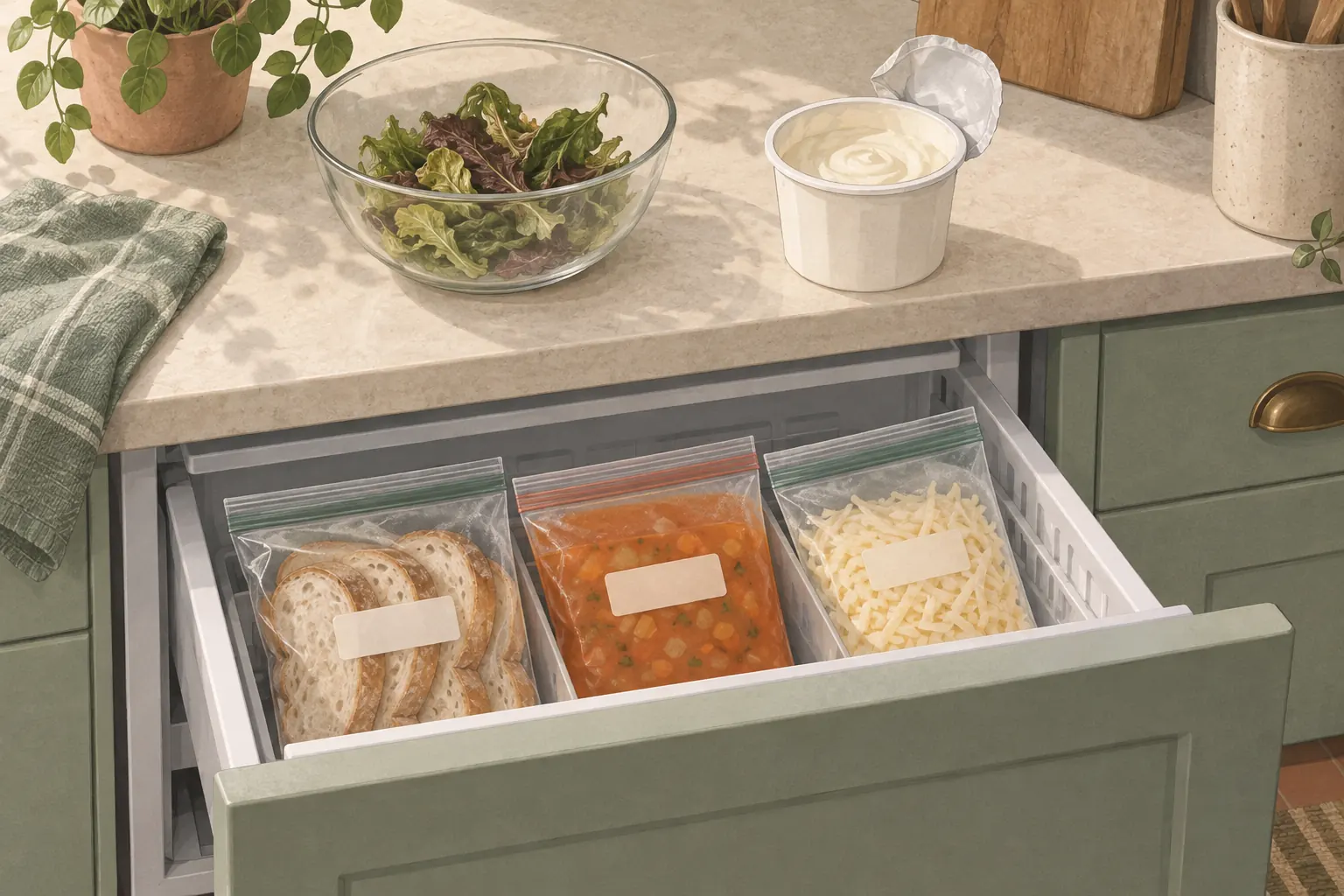
"You can freeze almost any food. Some exceptions are canned food or eggs in shells." That is USDA's Food Safety and Inspection Service, and it settles the first half of the question. The useful half is what survives the thaw, and there the answers split cleanly: bread, cheese, butter, milk, soup, cooked meat, bananas and most raw fruit and vegetables come back fine, while salad leaves, boiled potatoes, cooked egg whites, sour cream, custard fillings and anything fried come back as something you would rather not eat.
That second list is not folklore. The National Center for Home Food Preservation publishes it, with a column for what each food turns into, and it is the fastest way to settle an argument with the fridge door open.
Foods that don't freeze well
From NCHFP's Foods That Do Not Freeze Well:
| Food | Usual use | Condition after thawing |
|---|---|---|
| Cabbage, celery, cress, cucumbers, endive, lettuce, parsley, radishes | As raw salad | Limp, water-logged, quickly develops oxidized color, aroma and flavor |
| Irish potatoes, baked or boiled | In soups, salads, sauces or with butter | Soft, crumbly, water-logged, mealy |
| Cooked macaroni, spaghetti or rice | When frozen alone for later use | Mushy, tastes warmed over |
| Egg whites, cooked | In salads, creamed foods, sandwiches, sauces, gravy or desserts | Soft, tough, rubbery, spongy |
| Meringue | In desserts | Soft, tough, rubbery, spongy |
| Icings made from egg whites | Cakes, cookies | Frothy, weeps |
| Cream or custard fillings | Pies, baked goods | Separates, watery, lumpy |
| Milk sauces | For casseroles or gravies | May curdle or separate |
| Sour cream | As topping, in salads | Separates, watery |
| Cheese or crumb toppings | On casseroles | Soggy |
| Mayonnaise or salad dressing | On sandwiches (not in salads) | Separates |
| Gelatin | In salads or desserts | Weeps |
| Fruit jelly | Sandwiches | May soak bread |
| Fried foods | All except French fried potatoes and onion rings | Lose crispness, become soggy |
Read the middle column before you write anything off. Cabbage is on the list "as raw salad", which is true: frozen and thawed cabbage is limp. Frozen cabbage in a soup is cabbage in a soup. The same goes for the potato row, which is about boiled and baked potatoes, not the bag of fries in the freezer aisle.
Two more that are not on the table but come up constantly. Raw eggs in the shell are a no: the FoodSafety.gov cold storage chart says "Do not freeze in shell", because the contents expand and the shell gives way. Hard-cooked eggs get the same "Do not freeze". Egg, chicken, ham, tuna and macaroni salads read "Does not freeze well" on the same chart, which matches the mayonnaise row above.
The ones people search for, one by one
Rice and pasta, cooked. NCHFP puts them on the do-not-freeze list when frozen alone, and describes the result as mushy. Frozen inside a dish, with sauce, they are fine. If you do freeze plain rice, freeze it in one flat layer and reheat it straight from frozen rather than thawing it first.
Cheese. Hard and semi-hard cheese freezes. NCHFP says it "can be frozen if cut in 1-1/2- to 1-pound sizes and packaged in moisture-vapor resistant material", keeps about 6 months, and that it "may become crumbly and mealy when frozen, but will retain its flavor". Grate it before it goes in if it is destined for cooking; crumbly is irrelevant once it is melted. Cream cheese, cottage cheese and ricotta are not recommended.
Milk. It freezes. Fat separates and the texture goes grainy, so it comes back best in cooking, baking and coffee rather than in a glass. Leave room in the container: liquid expands.
Butter. The easy one. It holds its texture where most dairy does not, and it is worth buying on offer for exactly that reason. It is also on the keep side of the federal power outage chart, where milk is not.
Bananas. Peel them first. The peel turns black and welds itself to the fruit in the freezer, and nobody has ever enjoyed peeling a frozen banana.
Bread. Freezes well sliced, and toasts straight from frozen. A loaf frozen whole has to thaw whole, which is how half a loaf ends up stale on the counter anyway.
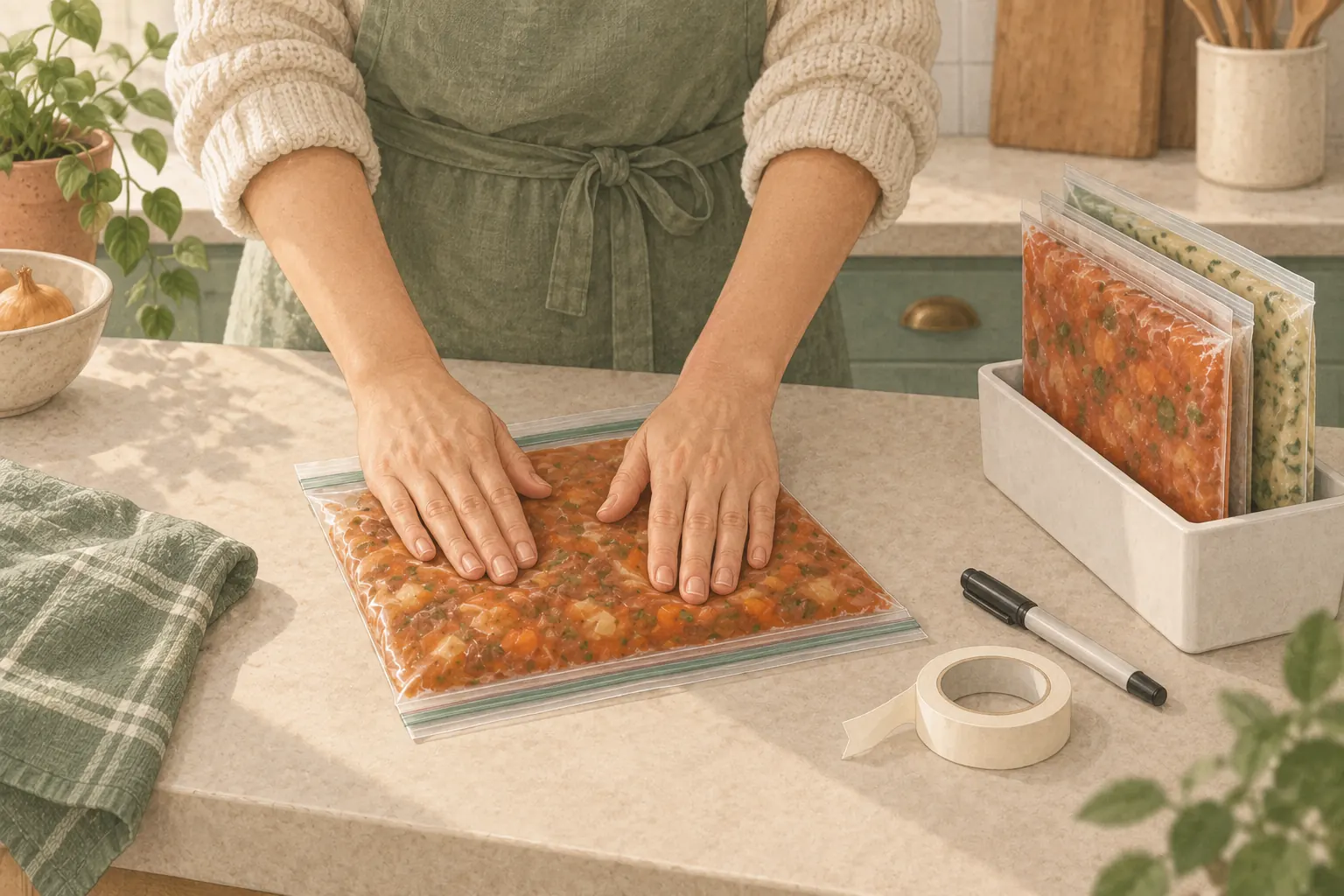
Soups and stews. The FoodSafety.gov chart gives 2 to 3 months for quality. Freeze them flat in bags rather than upright in tubs; a flat bag thaws in a fraction of the time and stacks like a book. Get them into the freezer or the fridge inside the two hours USDA allows, not after the washing up.
Tomatoes. Whole raw tomatoes freeze, and the skins slip off under warm water as they thaw, which is a genuinely good trick. They come back soft, so they are for sauce, not salad.
How long frozen food keeps
Freezer time is about quality, not storage limits. USDA's Food Safety and Inspection Service is blunt about it on its Freezing and Food Safety page: "Freezer storage is for quality only. Frozen foods remain safe indefinitely." The months below are from the chart on that page, for a freezer at 0°F (-18°C):
| Item | Months |
|---|---|
| Bacon and sausage | 1 to 2 |
| Casseroles | 2 to 3 |
| Egg whites or egg substitutes | 12 |
| Frozen dinners and entrees | 3 to 4 |
| Gravy, meat or poultry | 2 to 3 |
| Ham, hot dogs and lunchmeats | 1 to 2 |
| Meat, uncooked roasts | 4 to 12 |
| Meat, uncooked steaks or chops | 4 to 12 |
| Meat, uncooked ground | 3 to 4 |
| Meat, cooked | 2 to 3 |
| Poultry, uncooked whole | 12 |
| Poultry, uncooked parts | 9 |
Our food storage time lookup searches the companion FoodSafety.gov chart, which covers fish, eggs and leftovers as well, and the fridge and freezer chart prints both columns for the kitchen door.
Packaging is most of the battle
Freezer burn, in the agency's words, "does not make food unsafe, merely dry in spots", and it "is caused by air coming in contact with the surface of the food". It shows up as greyish-brown leathery patches. Three habits fix most of it. The full account is in what freezer burn is.
- Squeeze the air out, or use a container the food actually fills. Half-empty tubs are where the grey patches grow.
- Freeze flat and freeze fast. Thin packages freeze quicker, which means smaller ice crystals and less damage to the texture.
- Label everything with what it is and the date it went in. A freezer full of unlabelled bricks is a freezer that gets emptied into the bin once a year. Our freezer inventory sheet is one page for the door if a marker on the bag is not enough.
Duneed, our iPhone app, won't tell you what's in the freezer versus the fridge. It keeps a list of what you bought from photographed receipts, and if you give an item a date, it flags it as that date gets close.
Common questions
Can you freeze milk?
Yes. It separates and turns grainy as it thaws, so it is better in cooking, baking or coffee than in a glass. Leave headspace in the container, because liquid expands as it freezes.
Can you freeze cheese?
Hard and semi-hard cheese, yes. NCHFP recommends cutting it into 1 to 1.5 lb pieces, wrapping it in moisture-vapor resistant material, and gives about 6 months; the texture turns crumbly but the flavor holds. Cream cheese, cottage cheese and ricotta are not recommended.
Can you freeze cooked rice?
You can, but NCHFP lists cooked rice among the foods that do not freeze well when frozen on its own, and calls the result mushy. Frozen in a finished dish it is fine.
Can you freeze eggs?
Not in the shell. The FoodSafety.gov chart says "Do not freeze in shell" for raw eggs and "Do not freeze" for hard-cooked ones. Raw whites and yolks, out of the shell, are on the same chart at 12 months.
Does freezing kill bacteria?
FSIS puts it this way: freezing to 0°F "inactivates any microbes" in food, but "once thawed, however, these microbes can again become active, multiplying under the right conditions". Thawed food is handled like any perishable food, which is why the method matters and why the agency publishes thawing rates. Ours are in the defrost time calculator.
How long can food stay frozen?
Indefinitely, in terms of safety, at 0°F or below, on FSIS's own wording. Quality is the limit, and the chart above is the agency's guide to it.
Sources
- Foods That Do Not Freeze Well nchfp.uga.edu
- FoodSafety.gov foodsafety.gov
- Freezing and Food Safety fsis.usda.gov
Found a mistake? Tell us and we will correct it: support@duneed.app