
Freezer inventory sheet: a free printable and a system that keeps it accurate
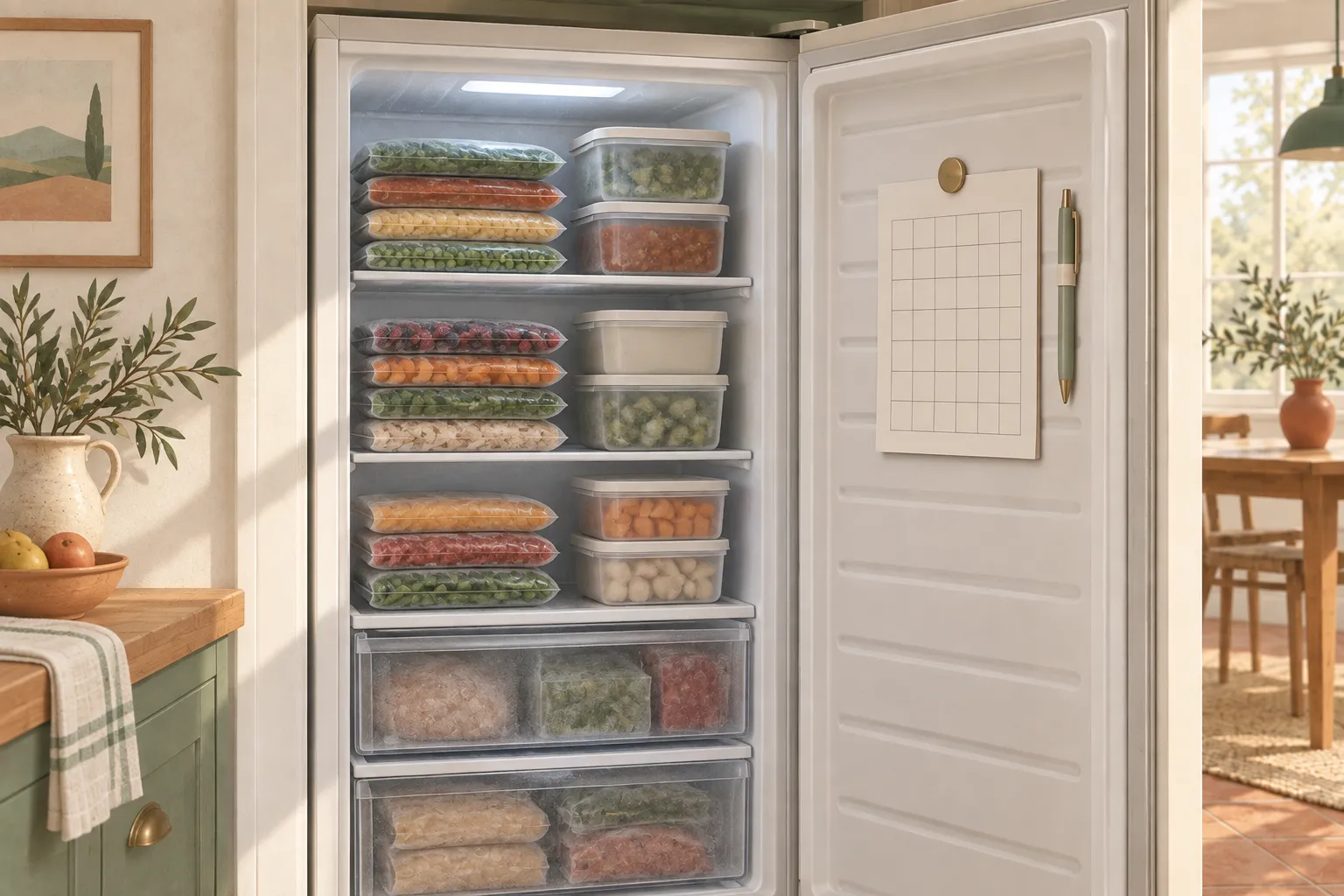
Our free freezer inventory sheet is one portrait page with room for about 28 items, grouped the way freezers actually fill up. Get the US Letter PDF, the A4 PDF if you're in the UK, Europe or anywhere else that prints on A4, or the CSV if you'd rather keep your freezer inventory list in a spreadsheet.
The sheet is the easy part. A freezer inventory usually fails the same way: the paper and the freezer quietly drift apart. The rest of this page is the routine that stops that drift, plus the USDA, FDA and extension-service storage times you need to fill in the "Best quality by" column. A one-page chart of the federal fridge and freezer times to print alongside it is in how long does food last in the fridge.
How to keep a freezer inventory
Label every package with the item, the number of portions and the date you froze it. Give each shelf or basket one job. Log everything on one sheet, grouped by category, and put new food behind older food of the same kind. Update the sheet the moment something comes out, not later that evening.
What's on the printable freezer inventory sheet
The template has six columns and six sections.
| Column | Example entry | Why it's there |
|---|---|---|
| Item | Beef chili; chicken thighs, bone-in | Specific enough that you could find it without reading every bag |
| Portions | 4 | You plan dinners in meals, not in pounds |
| Shelf / drawer | Top shelf; Basket 2 | Tells you where to reach before the door is open |
| Date frozen | 9/14/26 | The one fact you can't reconstruct six months later |
| Best quality by | 11/14/26 | Date frozen plus the storage time from the charts below |
| Taken out | Checkbox | Tick it when the last portion is gone |
The sections are Meat & poultry, Fish & seafood, Cooked meals & leftovers, Vegetables & fruit, Bread & baked goods, and Other. "Other" is for butter, cheese, nuts, ice cream and the tub of egg whites left over from a lemon curd. Before something goes on the sheet, can you freeze it says whether it is worth freezing in the first place.
Two choices on the sheet are deliberate. There's no weight column, because nobody weighs a bag of shrimp before taking half of it out, and a number you won't keep current is worse than no number. And the date column says "Best quality by", not "Expires". The times you'll write there are quality guidance. The USDA's position is that food kept constantly at 0°F stays safe (more on that below), so a column called "Expires" would suggest something the charts don't say.
The CSV has the same columns plus a Category column, which lets you sort the whole freezer by date in one click in Google Sheets, Excel or Numbers. To fill "Best quality by" automatically, a formula like =EDATE(E2,3) adds three months to a date; swap E2 for the cell that holds the date frozen and 3 for the months you want. For how long each thing keeps once it is in there, the food storage time lookup has the federal freezer times, and the defrost time calculator works out when to take it out again.
Print the paper version on the size you actually own. Letter printed on A4 paper (or the reverse) gets scaled or clipped, and the last rows are the first casualty. Slide it into a sheet protector and use a dry-erase or wet-erase marker if you want to reuse it. Twenty-eight rows cover a fridge-top freezer and most uprights. A packed chest freezer will need a second copy. It earns its keep in a power cut, when the 48-hour rule means deciding fast without holding the door open.
How to set up a freezer inventory in one afternoon
- Clear some counter space and get a cooler bag ready. Work one shelf or basket at a time instead of emptying the whole freezer onto the counter, so the job doesn't turn into a race.
- Sort what comes out into the sheet's six sections.
- Label anything that isn't labeled. If you have no idea when the bag of meatballs went in, write "date unknown" and put it in your eat-first spot (see zones below). The USDA Food Safety and Inspection Service says food that isn't on its chart can be judged for quality after thawing, and food that's no longer good enough to serve on its own may still work in soups or stews.
- Decide your zones and put things back by zone.
- Fill in the sheet as each package goes back in. Doing it from memory afterward is how the first row goes missing.
- Hang the sheet where the freezer opens: on the door in a sheet protector, or taped inside a cupboard door next to a chest freezer. Tie a pen to it. A pen on a string gets used; a pen "in the drawer" doesn't.
How to label freezer food so the sheet matches
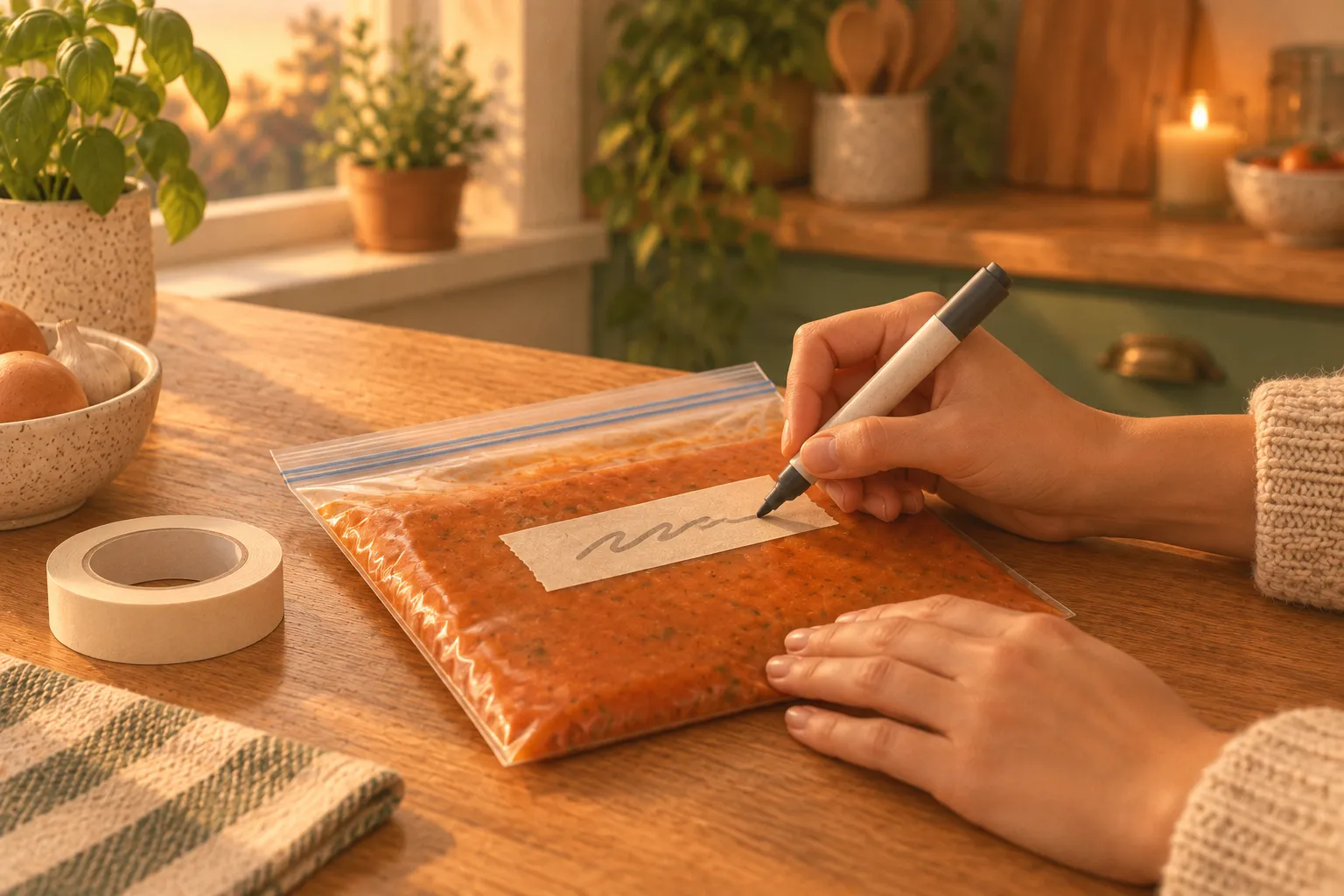
Write four things on every package: what it is, how many portions, the date frozen and, if you can, the best-quality date. Something like "Chili, 2 portions, frozen 14 Sep 26, best by Nov 26". The same habit works for the fridge and the cupboard with an expiration date tracker.
Write the month as a word. On a US label 9/10/26 means September 10; to someone who grew up in the UK or most of Europe it means 9 October. Three letters of month settle it for everyone in the house.
Write on the bag before you fill it. Marker goes onto a dry, flat bag easily and onto a frosty, lumpy one barely at all. On reusable containers, masking tape is the better label because it peels off before the dishwasher. To print labels instead, the freezer label maker lays them out for common Avery sheets or plain paper.
A few packing habits make the inventory easier to keep, because they turn a frozen block into countable portions:
- Freeze food in the amount you'll thaw at once. Four one-portion bags of chili are four separate dinners; one quart block is a commitment.
- Freeze bags flat, then stand them up like files once solid. FSIS advises spreading new packages in a single layer and stacking them only after they're frozen solid, because fast freezing forms smaller ice crystals and keeps texture better. By its guidance, food 2 inches thick should freeze completely in about 2 hours.
- Overwrap supermarket packaging for anything staying long. FSIS says the original wrap is safe to freeze in but lets air through, so quality can fade over time. The FDA's refrigerator and freezer chart puts the cut-off at 2 months for meat and poultry in its store package.
- Squeeze the air out. FSIS describes freezer burn as grayish-brown leathery spots caused by air touching the food, and says it doesn't make food unsafe, only dry in spots. You can cut those parts away before or after cooking.
Freezer zones for upright, chest and fridge-top freezers
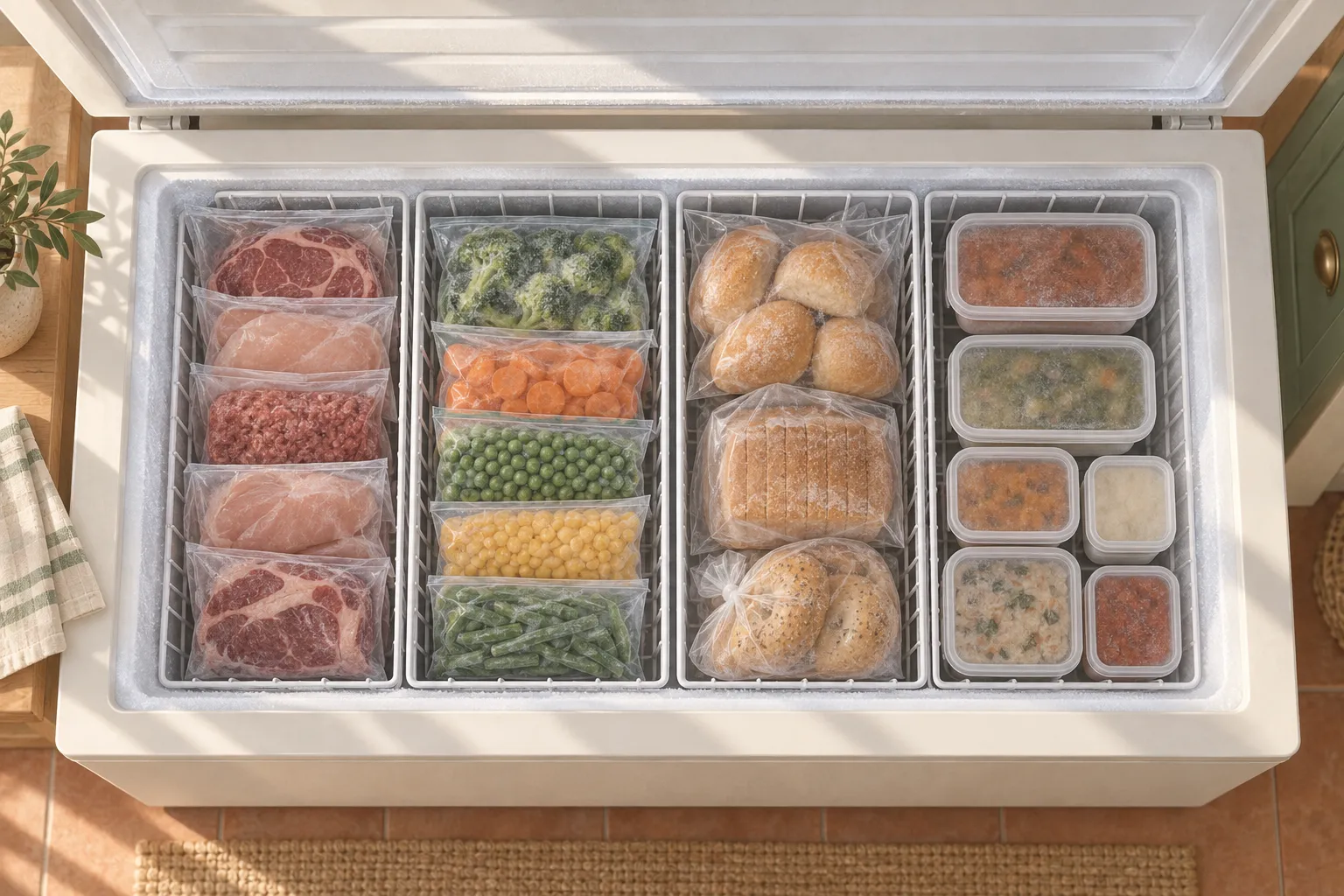
The "Shelf / drawer" column only works if each spot in the freezer has a name and a job. Name zones by position ("Top shelf", "Basket 2"), not by content. The Item and section columns already say what the food is; this column's only job is to tell you where to reach. For a layout by freezer type, see how to organize a freezer.
| Freezer type | Suggested zones | What goes where |
|---|---|---|
| Upright with shelves or drawers | Top shelf, middle shelf, bottom drawer, door | Top: cooked meals and eat-first food at eye level. Middle: bread, vegetables, fruit. Bottom drawer: raw meat, poultry and fish. Door: butter, nuts, small odds and ends |
| Chest freezer | Top baskets, bottom layer, one eat-first basket | Top baskets: cooked meals, bread, anything you reach for weekly. Bottom layer: long keepers like a whole turkey or roasts. One basket reserved for eat-first |
| Fridge-top or freezer drawer | Front and back (or left and right) | Front: eat-first and this week's food. Back: everything else. Keep it short-term |
Raw meat goes lowest for a reason FSIS gives in its power-outage advice: keep meat and poultry apart from other foods so that if they start to thaw, their juices don't drip onto anything else.
The bottom of a chest freezer is where food goes to be forgotten. Only put things there that hold their quality longest. FSIS lists uncooked whole poultry at 12 months and uncooked roasts at 4 to 12 months, while cooked meat gets 2 to 3.
Fridge-top freezers deserve lower expectations. FSIS says a refrigerator's freezing compartment that can't hold 0°F, or whose door is opened often, should be used for short-term storage, with a freestanding freezer at 0°F or below for long-term storage. If your inventory is mostly a fridge-top freezer, keep the sheet to what you'll eat in the next month or two and it'll stay honest.
Every freezer needs an eat-first spot, whatever its shape. That's where the date-unknown bags go, along with half-used packages and anything whose best-quality date is coming up.
First in, first out without reorganizing every week
First in, first out (FIFO) sounds like warehouse jargon, but in a home freezer it comes down to a few habits.
- New food goes behind or under older food of the same kind. When the new pack of ground beef goes in, the old one moves to the front.
- New rows go at the bottom of their section on the sheet. That way the top row of each section is always the oldest, and you can see it at a glance.
- Once a month, read down the "Best quality by" column. Anything due in the next few weeks moves to the eat-first spot, and a dinner or two gets planned around it. Our guide to meal planning from your pantry covers that planning step.
- When about a third of the rows are ticked, print a fresh sheet and copy over only the live rows, oldest first. A sheet full of crossed-out lines stops getting read.
Don't log everything. Ice packs, ice cubes and the open bag of frozen peas you top up every week don't need rows. Track the food you'd be annoyed to find freezer-burned: meat, fish, batch-cooked meals, the good bread.
Worked example: filling in the sheet
Say it's September 14, 2026, and five things go into the freezer.
- You make six portions of beef chili, eat two and freeze four. FSIS lists soups and stews at 2 to 3 months. Take the short end: 9/14/26 plus 2 months is 11/14/26.
- A six-pack of bone-in chicken thighs goes in as three bags of two. FSIS gives uncooked poultry parts 9 months, so 6/14/27.
- Two pounds of ground beef become two flat one-pound bags. Uncooked ground meat is 3 to 4 months: 12/14/26 at the short end.
- Four salmon fillets. FoodSafety.gov lists fatty fish such as salmon at 2 to 3 months: 11/14/26.
- Half a sliced sourdough loaf, about eight slices bagged in pairs. The storage chart published by Ohio State University Extension gives fresh bread 3 months: 12/14/26.
On the sheet, those rows look like this:
| Section | Item | Portions | Shelf / drawer | Date frozen | Best quality by | Taken out |
|---|---|---|---|---|---|---|
| Meat & poultry | Chicken thighs, 2 per bag | 3 | Bottom drawer | 9/14/26 | 6/14/27 | |
| Meat & poultry | Ground beef, 1 lb bags | 2 | Bottom drawer | 9/14/26 | 12/14/26 | |
| Fish & seafood | Salmon fillets | 4 | Bottom drawer | 9/14/26 | 11/14/26 | |
| Cooked meals & leftovers | Beef chili | 4 | Top shelf | 9/14/26 | 11/14/26 | |
| Bread & baked goods | Sourdough, 2 slices per bag | 4 | Middle shelf | 9/14/26 | 12/14/26 |
Two weeks later you take out a chili portion: cross out the 4, write 3. On October 20 the last salmon fillet goes into the oven: tick "Taken out". At the monthly check in early November, the column tells you the three chili portions are due on the 14th, so they move to the eat-first spot and become two dinners and a lunch.
Using the short end of each range is the cautious choice for quality. It nudges you to eat food earlier, and the longer figure is still there as slack if a week gets away from you.
Paper sheet, magnet board, spreadsheet or app
There's no single right format for a freezer inventory tracker. It depends on who opens the freezer and where you are when you decide what to buy.
| Option | Good at | Falls down when | Best for |
|---|---|---|---|
| Printed sheet in a sheet protector | Always visible on the door; anyone in the house can update it | Rows run out; you can't sort it | Upright and fridge-top freezers |
| Magnetic dry-erase freezer inventory board | Lives on the door; quick to change a count | Smudges when brushed; small writing space | A small freezer with a handful of rotating items |
| Spreadsheet (our CSV) | Sorting by date; formulas; unlimited rows | Only current if someone walks to the computer after every change | Chest freezers, bulk buyers, anyone who buys half a cow |
| Phone app | It's with you in the store, so you don't buy a third bag of shrimp | Only as accurate as what gets entered, by everyone | People who already manage groceries on their phone |
A sensible split is paper on the door plus something that travels. The sheet knows which basket the chicken is in. A phone knows what you bought last week while you're standing in the frozen aisle. If you're weighing apps, our roundup of the best pantry inventory apps compares the options.
To be clear about our own app: Duneed doesn't track freezer shelves or zones, and it doesn't know what's in your freezer versus your cupboard. What it does is turn a photo of a grocery receipt into a list of what you bought, and flag an item as a date you set gets close. If you want your purchases and the dates you've chosen on your phone, the paper sheet can keep handling where things live.
How long can food stay in the freezer?
Start with what the USDA actually says. On its freezing and food safety page, FSIS states: "Food stored constantly at 0 °F will always be safe." It adds that only the quality suffers with long storage, and its chart is labeled as being for quality only. FoodSafety.gov says the same: frozen foods stored continuously at 0°F (-18°C) or below can be kept indefinitely, and its freezer times are for quality.
So the numbers below are about flavor, texture, color and freezer burn. They're the dates for your "Best quality by" column. FSIS also recommends keeping an appliance thermometer in the freezer, since all of this assumes it really is holding 0°F. The tables follow the sheet's sections. Where the federal charts disagree, both figures are shown.
Meat and poultry
| Food (uncooked unless noted) | Best quality in the freezer | Source |
|---|---|---|
| Ground beef, turkey, chicken, pork, lamb | 3 to 4 months | FoodSafety.gov, FSIS |
| Steaks | 4 to 12 months (FDA chart: 6 to 12) | FoodSafety.gov, FDA |
| Chops | 4 to 12 months (FDA chart: 4 to 6) | FoodSafety.gov, FDA |
| Roasts | 4 to 12 months | FoodSafety.gov, FSIS |
| Chicken or turkey, whole | 12 months | FSIS, FoodSafety.gov |
| Chicken or turkey, parts | 9 months | FSIS, FoodSafety.gov |
| Giblets | 3 to 4 months | FSIS |
| Wild game | 8 to 12 months | FSIS |
| Bacon | 1 month | FoodSafety.gov |
| Sausage, raw | 1 to 2 months | FoodSafety.gov |
| Hot dogs and lunch meat | 1 to 2 months | FoodSafety.gov |
| Ham, cooked, store-wrapped | 1 to 2 months | FoodSafety.gov |
FSIS notes that raw meat and poultry keep their quality longer than cooked versions, because cooking drives out moisture. If you have the choice, freeze the raw pork shoulder and cook it later rather than freezing the pulled pork.
Fish and seafood
| Food | Best quality in the freezer | Source |
|---|---|---|
| Lean fish (cod, flounder, haddock, halibut, sole) | 6 to 8 months | FoodSafety.gov, FDA |
| Lean fish (pollock, ocean perch, rockfish, sea trout) | 4 to 8 months | FoodSafety.gov |
| Fatty fish (salmon, tuna, mackerel, catfish, bluefish) | 2 to 3 months | FoodSafety.gov, FDA |
| Cooked fish | 4 to 6 months | FDA |
| Smoked fish | 2 months | FDA |
| Shrimp | 6 to 18 months (FDA chart: 3 to 6) | FoodSafety.gov, FDA |
| Squid | 6 to 18 months (FDA chart: 3 to 6) | FoodSafety.gov, FDA |
| Crab meat or lobster, fresh | 2 to 4 months | FoodSafety.gov |
| Shucked clams, mussels, oysters, scallops | 3 to 4 months | FoodSafety.gov |
The shrimp gap is the widest disagreement in these charts. FoodSafety.gov's current page says 6 to 18 months; the FDA's 2018 chart says 3 to 6. For a quality date, 6 months is a sensible compromise that sits inside both.
Cooked meals and leftovers
| Food | Best quality in the freezer | Source |
|---|---|---|
| Soups and stews | 2 to 3 months | FSIS, FoodSafety.gov |
| Casseroles | 2 to 3 months | FSIS |
| Cooked meat | 2 to 3 months | FSIS |
| Cooked poultry | 4 months | FSIS |
| Cooked meat or poultry leftovers (combined figure) | 2 to 6 months | FoodSafety.gov |
| Gravy and meat broth | 2 to 3 months | FSIS, FDA |
| Frozen dinners and entrees (store-bought) | 3 to 4 months | FSIS |
| Pizza | 1 to 2 months | FoodSafety.gov |
| Chicken nuggets or patties | 1 to 3 months | FoodSafety.gov |
Vegetables and fruit
The federal charts above barely cover produce, so these figures come from the Ohio State University Extension storage chart, which credits Clemson University Cooperative Extension.
| Food | Best quality in the freezer |
|---|---|
| Vegetables, commercially frozen | 1 year |
| Asparagus, green beans, broccoli, peas, corn, cauliflower | 8 to 12 months |
| Spinach, kale, collards, Swiss chard | 8 to 12 months |
| Carrots, beets | 8 to 12 months |
| Mushrooms (sliced and sautéed first) | 8 to 12 months |
| Bell peppers (raw, in strips or diced) | 3 to 4 months |
| Tomatoes (for cooking) | 3 to 4 months |
| Fruit, commercially frozen | 1 year |
| Peaches, pears, plums, apricots, grapes | 6 months |
| Cranberries | 8 to 12 months |
| Melon | 8 to 12 months |
Home-frozen vegetables need one extra step. FSIS explains that freezing only slows the enzymes in vegetables, so most need blanching (a brief boil or microwave, then a fast chill) to keep them from deteriorating in the freezer.
Bread and baked goods
| Food | Best quality in the freezer |
|---|---|
| Bread, fresh | 3 months |
| Muffins, rolls, quick breads | 1 to 2 months |
| Pancakes and waffles | 1 to 2 months |
| Tortillas | 3 months |
| Bread or roll dough, unbaked | 2 months |
| Cookies, baked | 4 to 6 months |
| Cookie dough, homemade | 6 months |
| Layer cakes | 2 to 4 months |
| Fruit pies, baked | 1 year |
Source: Ohio State University Extension storage chart.
Other: dairy, eggs and staples
| Food | Best quality in the freezer | Source |
|---|---|---|
| Butter | 6 to 9 months | OSU Extension |
| Hard cheese (cheddar, Swiss) | 6 months; crumbles, best for cooking | OSU Extension |
| Ice cream and sorbet | 1 to 2 months | OSU Extension |
| Milk | 1 month; use for cooking and baking | OSU Extension |
| Yogurt | 1 to 2 months; texture changes | OSU Extension |
| Raw egg whites | 12 months | FSIS |
| Nuts | 2 years | OSU Extension |
| Flour, white or bread | 1 year | OSU Extension |
| Tofu | 5 months | OSU Extension |
Foods that don't freeze well
Knowing what to leave out of the freezer saves a few rows of disappointment. These notes are about quality unless an authority says otherwise.
- FSIS names canned food and eggs in the shell as exceptions to "you can freeze almost any food". Once food is out of the can, FSIS says it can be frozen.
- Mayonnaise, cream sauces and lettuce are FSIS's own examples of foods that don't freeze well. Emulsions like mayo separate and look curdled.
- FoodSafety.gov lists egg, chicken, ham, tuna and macaroni salads as not freezing well, and says hard-cooked eggs shouldn't be frozen.
- The OSU Extension chart adds cabbage and green onions (watery, limp), cottage cheese and ricotta (grainy), sour cream (separates), cream-based soups and chowders (curdle), and custard pies (watery filling, soggy crust).
- Chili with beans can turn mushy, according to the same chart, while all-meat chili holds up better.
If you batch-cook a cream soup, one workaround is to freeze the base before the cream goes in and add the dairy while reheating.
Freezer inventory FAQ
How often should you update a freezer inventory?
Every time something goes in or comes out, which takes a few seconds with a pen tied to the sheet. Add a monthly read of the "Best quality by" column, and a full recount a couple of times a year when you'd be defrosting or cleaning anyway. If you're keeping a separate pantry inventory list, doing both counts on the same day keeps them from overlapping.
Does the date on the package matter once food is frozen?
The Ohio State University Extension chart says its storage times run from the date of purchase and that it isn't important if a package date expires after the food is frozen. That's why the sheet tracks "Date frozen" instead of copying the printed date. If the different package dates confuse you, our guide to best before vs use by vs sell by explains what each one means.
What should you do with the inventory after a power outage?
Follow FSIS guidance on the food itself. FSIS says a full freezer will usually keep about 2 days with the door shut and a half-full one about a day, and it explains when food can be refrozen or should be discarded on its freezing and food safety page. For the sheet, note the outage date in the margin so you remember which items went through it.
Can you refreeze food that has thawed?
FSIS says food thawed in the refrigerator can be refrozen without cooking, though there may be some loss of quality from the moisture lost in thawing. On the sheet, keep the original "Date frozen" rather than writing a new one. The best-quality date still counts from the first time it was frozen.
Sources
- USDA Food Safety and Inspection Service fsis.usda.gov
- FDA's refrigerator and freezer chart fda.gov
- FoodSafety.gov foodsafety.gov
- Ohio State University Extension fayette.osu.edu
- FoodSafety.gov foodsafety.gov
Found a mistake? Tell us and we will correct it: support@duneed.app