
Best before vs use by vs sell by: what food date labels mean in the US, UK and EU
Read a food date together with the country that printed it. Best before vs use by is a clean split in the UK and EU, where one date is about quality and the other is a legal safety limit. In the US, "Use By" usually means peak quality, "Sell By" is aimed at the store, and only one food has a federally required date.
"Best before" and "Best if Used By" tell you when a food is at its best quality. "Sell by" and "Display until" are stock rotation dates for the retailer. "Use by" is a safety date in the UK and EU, but in the US, USDA says it's a peak quality date on everything except infant formula.
Every food date label in one table
This is the whole article compressed. The right-hand column is what the relevant authority says, not our advice.
| Label | Where | What it's about | What the authority says |
|---|---|---|---|
| Best if Used By / Best By / Best Before | US | Quality | USDA FSIS: shows when a product will be of best flavor or quality; "not a purchase or safety date" |
| Best before / Best before end | UK, EU | Quality | UK Food Standards Agency: after the date, food is usually safe to eat but may not be the same quality |
| Use by | UK, EU | Safety | EU law: after the date the food is "deemed to be unsafe." FSA: eating it afterward could make you ill, unless it was cooked or frozen on or before the date |
| Use-By (most foods) | US | Peak quality | USDA FSIS: not a safety date, except on infant formula |
| Use-By (infant formula) | US | Nutrient content, federally required | USDA FSIS: don't buy or use formula after its Use-By date |
| Sell-By | US | Stock rotation | USDA FSIS: tells the store how long to display the product; not a safety date |
| Display until / Sell by | UK | Stock rotation | WRAP: no legal basis; recommends businesses stop printing them next to another date |
| Freeze-By | US | Quality | USDA FSIS: when to freeze to keep peak quality; not a purchase or safety date |
| Frozen on | EU, UK | Record of freezing | Required on frozen meat, frozen meat preparations and frozen unprocessed fish |
| Pack codes, can codes | US and elsewhere | Traceability | USDA FSIS: codes for tracking and recalls, not meant to be read as a "Best if Used By" date |
The same words mean different things on each side of the Atlantic
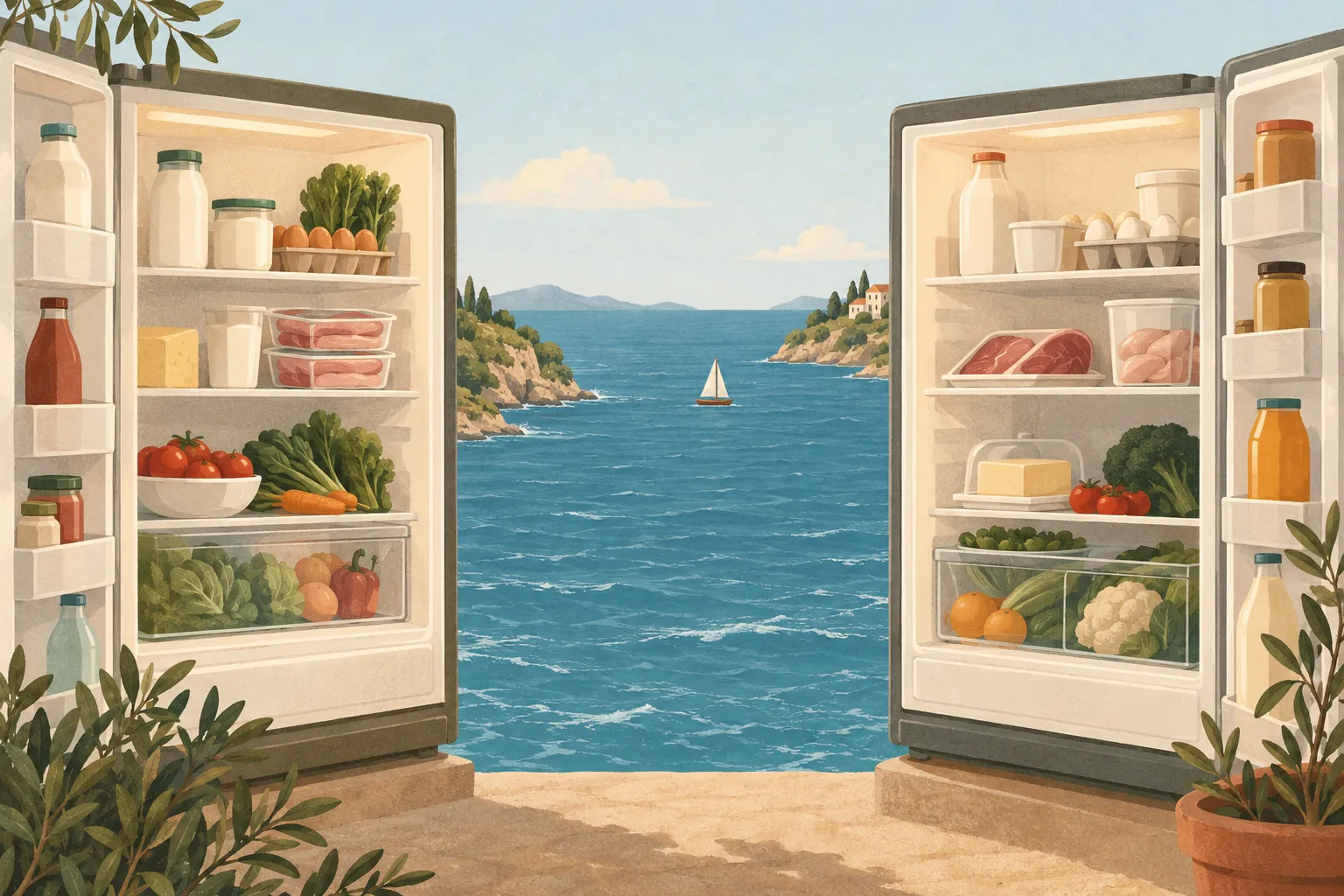
The trickiest phrase is "use by," because it does two different jobs. A pack of sliced ham in a London supermarket that says "use by 18 September" is carrying a legal safety limit. A bottle of salad dressing in Ohio that says "Use By" is, according to USDA's Food Safety and Inspection Service, carrying the manufacturer's estimate of peak quality.
An imported jar, a recipe blog written in another country, or a relative who learned the rules somewhere else can all point you at the wrong meaning. The rest of this guide takes the US system first, then the UK and EU. Storage times are a separate question from the label: the food storage time lookup gives the federal fridge and freezer figures for meat, poultry, fish, eggs and leftovers.
US food date labels, explained
Does federal law require expiration dates on food?
No, with one exception. USDA FSIS states that except for infant formula, product dating is not required by federal regulations, and that dates are not an indicator of a product's safety. The FDA says the same thing on its food waste guidance page: manufacturers aren't required by federal law to put quality-based date labels on packaged food, infant formula aside.
When a meat, poultry or egg product does carry a date, FSIS has format rules. The date must show the month and day (plus the year for shelf-stable and frozen products), and a phrase explaining the date, such as "Best if Used By," must sit right next to it.
"Best if Used By" meaning
"Best if Used By" (and its shorter cousins "Best By" and "Best Before") is the manufacturer's estimate of when the food will be at its best flavor and quality. FSIS recommends it as the phrase food makers should use, because research found it tells shoppers the date is about quality.
The FDA backed the same phrase in a May 23, 2019 letter to the food industry. It said FDA "strongly supports" industry's voluntary move to "Best if Used By" when a company chooses to put a quality date on a package. The letter cites an estimate that confusion over date labels accounts for about 20 percent of consumer food waste. How that sits next to the other national figures is in our food waste statistics. It also said FDA was not addressing a "Use By" label for safety reasons at that time. There's still no federal safety date phrase for most foods.
After the date passes, FSIS says foods not showing signs of spoilage "should be wholesome and may be sold, purchased, donated and consumed" beyond a "Best if Used By" date. The FDA adds that if a product past the date has changed noticeably in color, consistency or texture, consumers may want to avoid eating it. Those are the agencies' words. We're not going to add a food-by-food verdict of our own.
Sell-By
A "Sell-By" date tells the store how long to display the product, for inventory management. FSIS is explicit that it isn't a safety date. For planning your week, it's the least useful date on the package, because it describes the store's shelf, not your fridge.
Use-By
In the US, FSIS defines "Use-By" as the last date recommended for using the product at peak quality, and says it isn't a safety date except on infant formula. That makes "Use By" on a US yogurt cup and "use by" on a UK yogurt pot two different statements. If the product came from the UK or EU, read it the UK way.
Freeze by date
A "Freeze-By" date tells you when to freeze a product to maintain peak quality. FSIS says it isn't a purchase or safety date. The practical reading is simple: if you won't cook it before that date, the date tells you when the freezer is the better place for it.
Infant formula: the one federally required date
Federal regulations require a "Use-By" date on infant formula regulated by the FDA. According to FSIS, using formula by that date ensures it contains each nutrient in the amount listed on the label and still flows through an ordinary bottle nipple. The manufacturer sets the date from product testing. FSIS's instruction is direct: don't buy or use baby formula after its Use-By date.
Egg cartons, pack dates and closed dates
FSIS describes two kinds of product dating. "Open dating" is a calendar date you can read. "Closed dating" is a code of letters or numbers that identifies when the product was made. Can codes are closed dates: they let manufacturers rotate stock and find products during a recall, and FSIS says they aren't meant to be read as a "Best if Used By" date.
Eggs are the one closed date worth learning. Cartons with the USDA grade shield must show a three-digit pack date, the day the eggs were washed, graded and packed, counted from January 1 as 001. So 032 is February 1. If that carton also carries a sell-by date, FSIS says it can't be more than 30 days after the pack date, which in a non-leap year puts the latest possible sell-by at March 3.
Pack dates like that are counted the same way on cans and boxes, and our Julian date converter turns one into a calendar date, leap years included.
Whether eggs carry a "Sell-By" or "Expiration" date at all depends on the state. FSIS notes that some state egg laws require one and some don't allow a sell-by date.
Food date labeling rules vary by state
Because federal law leaves most dating voluntary, states fill the gap differently. The Public Health Law Center's March 2025 guide to food date labels notes that some states restrict the sale or donation of food after the date and others don't. Its example is Minnesota, which requires an open date or "quality assurance date" on most foods (meat and poultry, frozen food and fresh produce excepted), while stating in law that a passed quality assurance date doesn't by itself mean the food is unsafe. If you run a food pantry or a small shop, your state's rules are the ones to check.
Is the Food Date Labeling Act law?
Not as of September 2026. The Food Date Labeling Act of 2025 was introduced in the Senate as S. 2541 on July 30, 2025, and in the House as H.R. 4987 on August 15, 2025. According to Congress's bill status records (last updated in July 2026), the Senate bill sits with the Health, Education, Labor, and Pensions Committee, and the House bill's most recent action was a referral to two Agriculture subcommittees on January 13, 2026. Neither chamber has passed it.
If it became law, voluntary quality dates would have to use "BEST If Used By" (or "BB" on tiny packs) and discard dates "USE By" (or "UB"), with "or freeze by" allowed after either. States couldn't require different date phrases, though they could still ban selling or donating food past a discard date. Infant formula would stay under its existing rules. Separately, USDA and FDA asked the public for information on date labeling in December 2024, with comments closing March 5, 2025.
UK and EU date labels, explained
The EU's food information rules, Regulation (EU) No 1169/2011, make a date mandatory on most prepacked food, and that date is one of two kinds. The UK still uses the same two-date system.
Use by: the legal safety date
Article 24 of the regulation reserves "use by" for foods that, from a microbiological point of view, are highly perishable and likely to become an immediate danger to health after a short period. After that date, the food is legally deemed unsafe. The date has to show at least the day and month, has to be followed by storage conditions, and has to appear on each individual prepacked portion.
In the UK, government guidance for food businesses from Defra and the FSA says it's a criminal offence to sell food past its use-by date. WRAP's industry guidance lists the foods that normally get one: fresh meat, fish and poultry, fresh pasta, chilled ready meals, cooked sliced meats, pâtés, cut fruit and sandwiches.
For shoppers, the Food Standards Agency's guidance says eating food after the use-by date could make you ill. It gives two exceptions: food cooked or frozen on or before the use-by date. Cooked food should be cooled, kept in the fridge and eaten within 48 hours or frozen. Frozen food should be kept at -18°C and used within 24 hours of defrosting. The FSA also recommends a fridge at 5°C or below where a label says to refrigerate.
The sniff test doesn't apply here. The FSA's home food fact checker says it isn't safe for any food with a use-by date, because you can't smell the bugs that cause food poisoning. Food Standards Scotland puts it the same way: food past its use-by date should not be eaten, even if it looks and smells fine.
Best before and best before end
The regulation calls this the "date of minimum durability," defined as the date until which the food keeps its specific properties when properly stored. The format depends on shelf life:
- Food that keeps 3 months or less: "Best before" with the day and month.
- 3 to 18 months: "Best before end" with the month and year.
- More than 18 months: "Best before end" with just the year.
The FSA lists frozen foods (peas, chips, ice cream), dried foods (pasta, rice), tinned foods and cheese as typical best-before products. After the date, it says food is usually safe to eat but may not be the same quality, and that you can use sight, taste or smell to decide, for example by tasting biscuits (cookies) or crisps to see if they've gone stale, or looking for visible mold on bread. UK guidance says food can legally be sold after its best-before date as long as it's still safe.
UK eggs are a special case. WRAP's labelling guidance, written with the FSA and Defra, notes that egg regulations require a best-before date no more than 28 days after laying, and that eggs must be sold within 21 days of laying.
Display until and sell by in the UK
These are stock control dates. WRAP says there's no legal basis for them, that research found they confuse shoppers and lead to good food being thrown out, and it recommends against printing a "Display until" date alongside a best before or use by date. The shift has mostly happened: WRAP found almost 40% of packs carried two dates in 2009, and fewer than 3% did by 2015.
Foods with no date at all
Some foods are exempt from date marking under Annex X of the regulation: uncut fresh fruit and vegetables (sprouting seeds excepted), wine, drinks at 10% alcohol or more, bakery goods normally eaten within 24 hours, vinegar, cooking salt, solid sugar, confectionery made almost entirely of sugar, and chewing gum. WRAP goes further and recommends no date on most prepacked uncut produce, because its research found a date makes people more likely to throw produce away once the date passes.
Frozen on
Frozen meat, frozen meat preparations and frozen unprocessed fishery products must show a "Frozen on" date (the first freezing date, if frozen more than once). It records when the product was frozen. It isn't a best before or use by date and doesn't replace one.
Expiration date vs best before: which one is the "expiry date"?
"Expiration date" and "expiry date" are everyday phrases, not the terms on most labels. In the US, at the federal level, the closest thing to a legally meaningful expiry date is the Use-By date on infant formula. In the UK and EU, it's the use-by date. Everything labeled best before, best by or best if used by is a quality date in all three places.
Do expiration dates matter? What to do with each label
They matter, just not all in the same way. In a kitchen we'd sort them like this:
- UK or EU use-by date: treat it as the hard deadline. Plan those foods first, and if plans change, the FSA's guidance is to freeze or cook them on or before the date.
- Infant formula Use-By (US): FSIS says don't buy or use it after the date.
- Best before, Best by, Best if Used By: quality dates. Use them to decide the order you eat things in.
- Freeze-By: your cue to move something to the freezer if it isn't getting cooked in time.
- Sell-By, Display until: the store's date. Note it, then ignore it for planning.
Storage decides how well any of these dates hold up. FSIS says food spoils much faster when it isn't stored or handled properly, and the FSA warns that food stored badly can become unsafe before its use-by date. Research cited in WRAP's labelling guidance found only around 30% of UK home fridges running within the recommended range, so a fridge thermometer is a cheap check worth making.
How to use best-before food before it slips
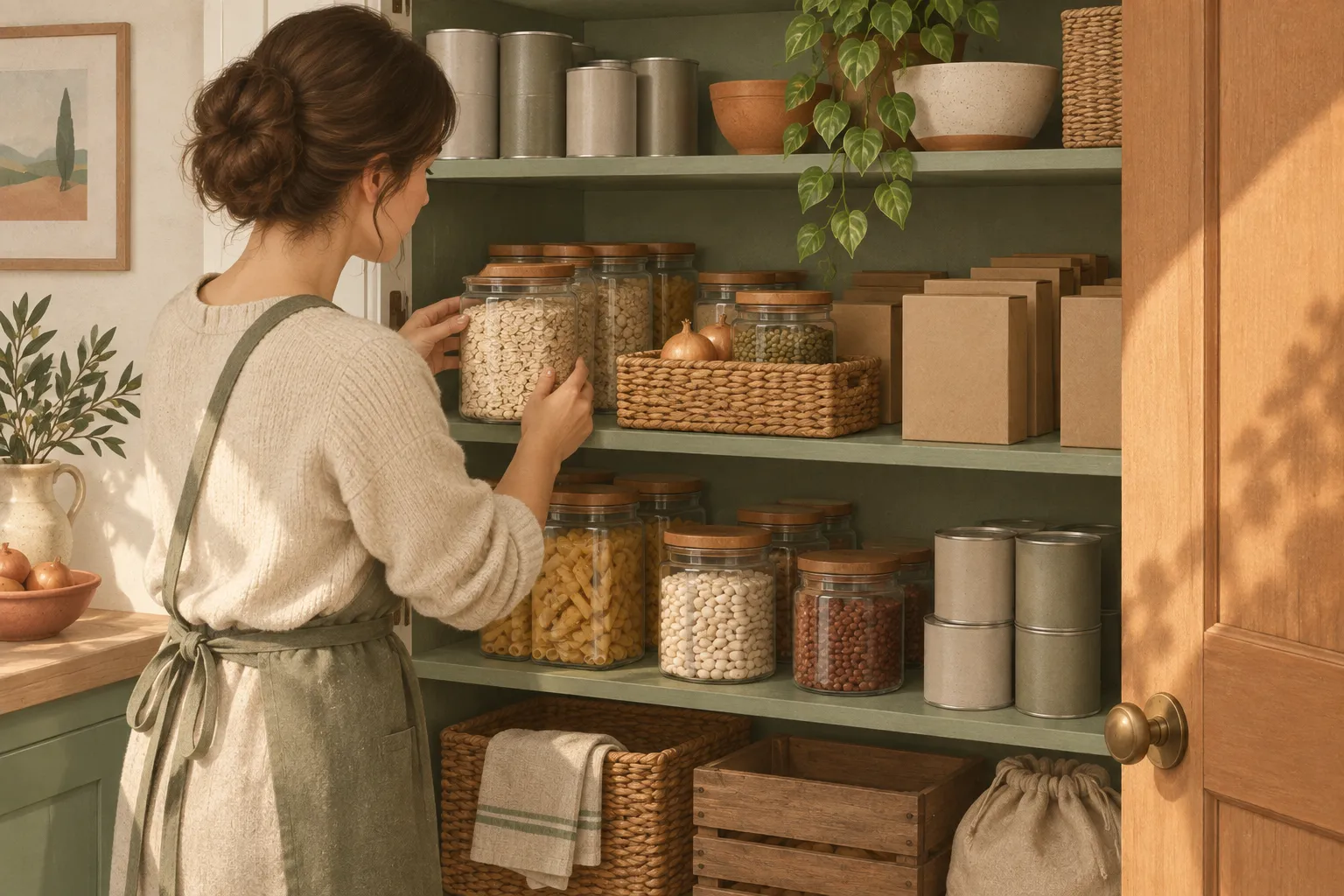
Best-before foods are the easiest to lose track of, because nothing forces a decision. A box of crackers doesn't announce itself when it goes stale. You find out when you open it. The fix is a simple first in, first out routine.
Put new purchases behind older ones on the shelf, so the nearest date is always in front. Once a week, pull out anything that reaches its best-before date in the next 14 days and move it to one visible spot, a basket or the front of one shelf. That's your use-first zone.
Say the weekly check turns up 3 items due in the next 14 days: half a bag of tortilla chips, a jar of pesto and a box of oatmeal. Spread across 14 days, that's one item planned into a meal roughly every 4 to 5 days (14 ÷ 3 ≈ 4.7).
Opened packs follow different rules (our pantry staples list has quality times for common staples once opened). WRAP's guidance separates "use within x days of opening," which is set for safety, from "best within x days of opening," which is about quality. WRAP also notes that the date and its storage conditions apply to the food as bought, while it's unopened. Once the jar of pesto is open, the open-life line on the label is the one to follow.
Longer dates don't need weekly attention. "Best before end 2028" on a can of chickpeas can go into a quarterly check instead. If you'd rather keep this on paper, our pantry inventory list template has a date column, and the freezer inventory sheet records what went in and when.
A spreadsheet or a sheet on the fridge works fine for a few dozen items. Past that, a reminder does the remembering for you. In Duneed, our iPhone app, you type in the date from the package, and the item turns amber a few days before it and red once it has passed, with one evening notification listing what's due. It doesn't guess dates; you set them. For a closer look at paper, spreadsheet and app options, see our guide to tracking expiration dates.
FAQ
Can stores sell food past the date?
In the US it depends on the label and the state. FSIS says foods not showing signs of spoilage may be sold past a "Best if Used By" date, and state laws on selling past a date vary. In the UK, selling food past its use-by date is a criminal offence, while food past its best-before date can be sold if it's still safe.
Can food banks accept food past its best by date?
FSIS says yes: food can be donated after the date passes, and food banks and other charities should check quality before handing it out. In the UK, WRAP's guidance says food past its best-before date can be redistributed, but food past its use-by date must not be.
Is "best by" the same as "best before"?
Yes, both are quality dates. "Best by" and "Best if Used By" are the US versions, and FSIS treats "Best if Used By/Before" as one category. "Best before" and "best before end" are the legal UK and EU wording.
Sources
- USDA's Food Safety and Inspection Service fsis.usda.gov
- food waste guidance page fda.gov
- May 23, 2019 letter to the food industry fda.gov
- March 2025 guide to food date labels publichealthlawcenter.org
- H.R. 4987 govinfo.gov
- asked the public for information on date labeling fda.gov
- Regulation (EU) No 1169/2011 eur-lex.europa.eu
- government guidance for food businesses gov.uk
- Food Standards Agency's guidance gov.uk
- home food fact checker gov.uk
- Food Standards Scotland foodstandards.gov.scot
- WRAP's labelling guidance wrap.ngo
Found a mistake? Tell us and we will correct it: support@duneed.app