
Free pantry inventory list template (printable PDF and spreadsheet)
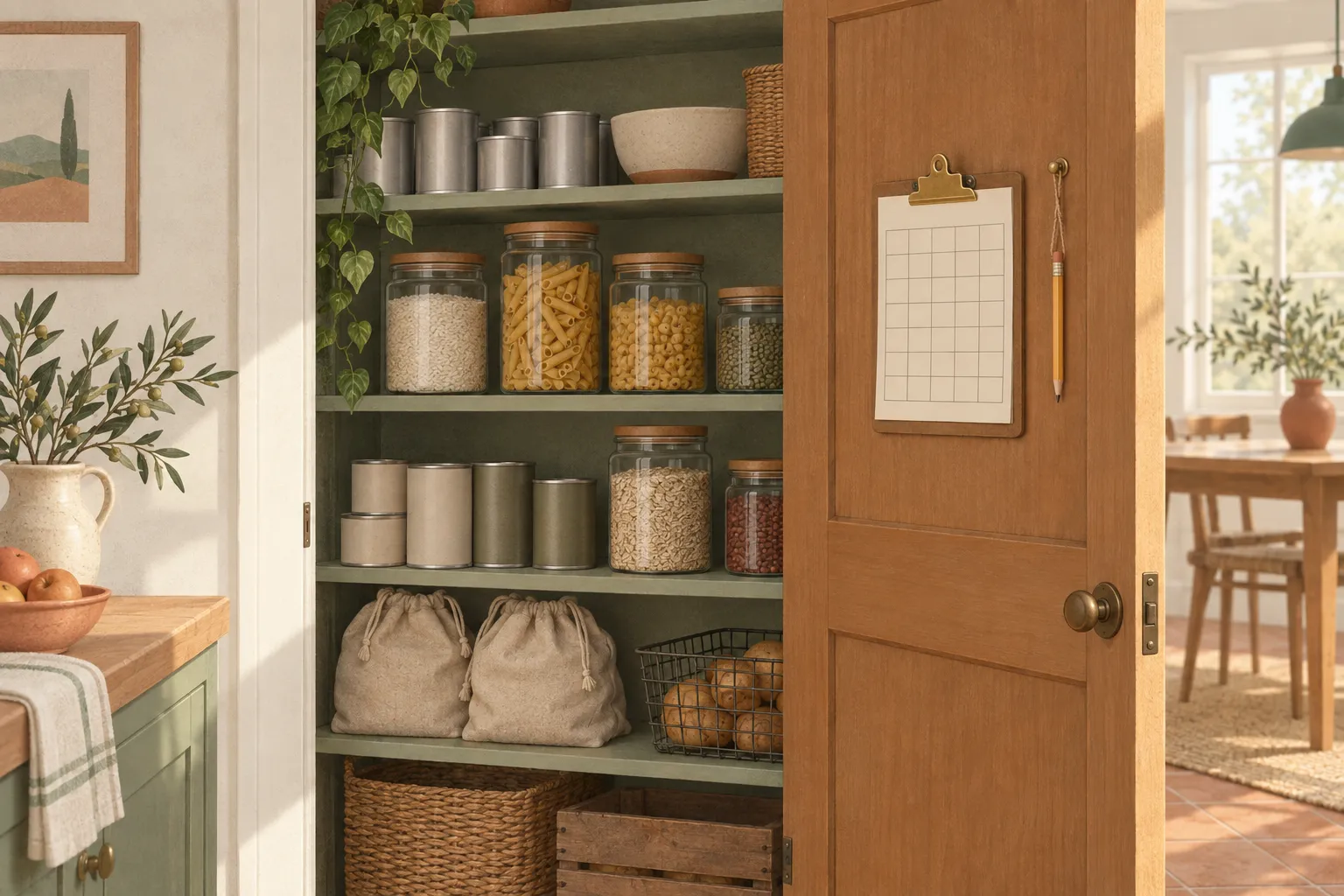
This free pantry inventory list is a one-page table with five columns: the item, how many you have, when you bought it, its best-by date, and a box to tick when it's used up. Download the US Letter PDF, the A4 PDF if you're in the UK or Europe, the Excel workbook with restock formulas, or the plain CSV file. There's no email sign-up; the links go straight to the files.
Printing the sheet takes a minute. Keeping it accurate a month later is the hard part, so that's where most of this page goes.
A pantry inventory list records the shelf-stable food you already own: each item, the quantity, the purchase date and the best-by date. To build one, clear one shelf at a time, write each item under its category and put the oldest in front. After that, add groceries after every shop and cross items off as you finish them.
What's in the free pantry inventory template
The printable has about 30 rows on a single portrait page, split by light section bands so you're not hunting for where the lentils went: Canned & jarred; Grains, pasta & rice; Baking; Oils, sauces & condiments; Spices & seasonings; Snacks & breakfast; Drinks; and Other.
| Column | What to write | Why it's there |
|---|---|---|
| Item | "Chickpeas, 15 oz can" or "Jasmine rice, 5 lb bag" | The size tells you whether two entries are the same thing |
| Qty | Sealed containers you can count: 3 cans, 2 boxes | Counting containers is fast; weighing flour is not |
| Bought | The date of the shop | Lets you use the oldest first even when the package has no date |
| Best by | The best-by date printed on the package; leave blank if absent | Shows what to cook this week |
| Used up | A tick | A ticked row is a candidate for the shopping list |
A few opinions on filling it in. Qty means containers, not how full they are: half a bottle of soy sauce is 1. For spices, don't bother with Qty at all, since nobody measures how much cumin is left; write the jar once and tick it when it's empty. And if you run out of rows, print a second copy instead of squeezing two items onto one line, because a cramped sheet is the first one you stop reading.
The CSV has the same columns plus a Category column, so a spreadsheet can sort and filter by section instead of relying on printed bands.
Download the Excel inventory with restock formulas
The ready-to-use pantry inventory workbook adds 100 item rows, a category dropdown, a shelf or location field, quantity and unit, your own restock threshold, and a manually entered package date and label. The existing PDFs and CSV remain available above.
- Open the Inventory tab and enter an item in row 7. Fill the yellow columns A to H; column I calculates stock status.
- Use the same unit for Quantity and Restock at. For two cans of chickpeas, enter 2, cans and a threshold such as 1.
- At or below that threshold, the status reads Restock. Use 0 if you only want to restock when empty. Missing numbers ask for input instead of treating an empty cell as zero.
- Filter Stock status to Restock before you shop. Clear columns A to H to remove an item while keeping the formula.
- Copy the date and label from the package. Leave them empty when there is no date. The status compares quantities only; it does not assess food safety or calculate an expiry date.
Excel opens the file directly. For Google Sheets, upload the .xlsx to Drive and open it with Google Sheets. The How to use tab includes example quantities and expected statuses to check after importing. Keep the .xlsx or Google Sheets format when saving; CSV cannot preserve formulas, dropdowns or formatting.
To put your list to work for a single week, the 7-day pantry challenge worksheet gives each starting ingredient a meal and records shopping gaps.
Printable, spreadsheet or app: which pantry inventory format fits
All three work. They fail in different places. None of them is a shopping list; for the list you take to the store, there's our printable grocery list by category.
| Printable sheet | Spreadsheet (Excel, Google Sheets) | Pantry app | |
|---|---|---|---|
| Cost | A sheet of paper | Free | Free tiers, with limits that vary |
| Where it lives | Inside the pantry door | Laptop, or phone if cloud-synced | Phone |
| Adding a big shop | Handwrite every line | Type every line | Some apps read receipts; otherwise type |
| Marking an item used up | Tick with the pen next to it | Open the file, find the row, edit | Usually a tap |
| Sorting by best-by date | Not possible; you scan by eye | One click | Usually built in |
| Checking it at the store | Only if you photographed it | Yes, if it's in the cloud | Yes |
| Sharing with a household | Everyone sees the door | Share the file | Depends on the app |
Paper suits a small pantry, one or two people and one weekly shop. A spreadsheet is the better choice if you keep deep stock (a basement shelf of canned goods, 25 lb bags of rice) where sorting by date actually matters. An app makes sense if you know you won't handwrite 20 lines every Saturday. We compare the options in our roundup of pantry inventory apps.
How to make a pantry inventory list from scratch
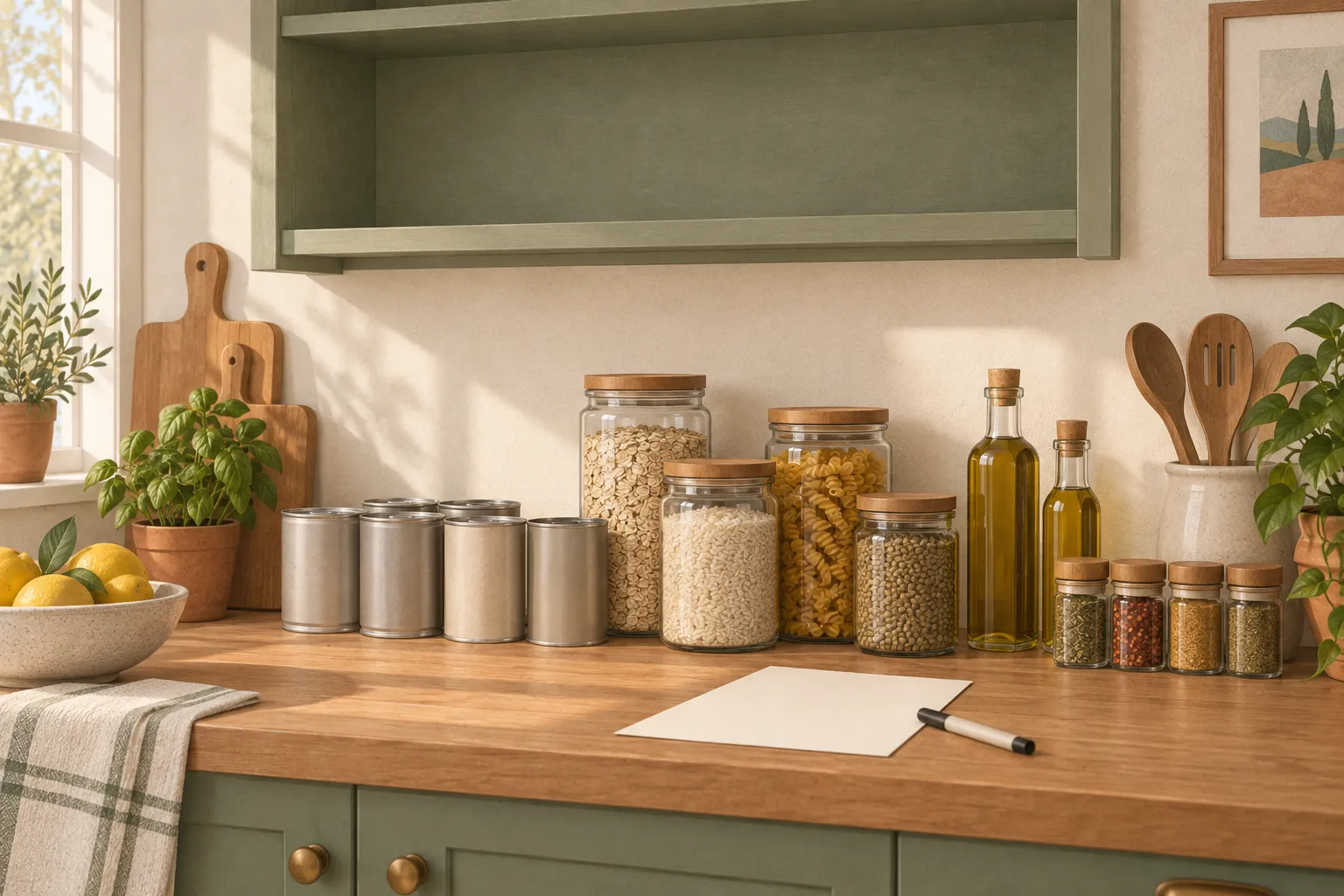
Don't try to do the whole kitchen in one evening. A pantry cabinet takes long enough.
- Take everything off one shelf. Wipe it while it's empty. If you're reorganizing at the same time, how to organize a pantry has the zone layout.
- Check containers as you go. NDSU Extension's shelf-life guide lists leaking, swollen, rusty, cracked or badly dented cans among the containers not to eat from, and says not to taste suspicious foods.
- Sort what's left into the template's sections on the counter.
- Count sealed containers and write each item once, with its Qty.
- Fill in Bought if you know it. If you don't, leave it blank and rely on Best by. For anything you buy from now on, Utah State University Extension recommends writing the purchase month and year on the can lid with a marker, which also helps when you decant into jars and throw away the bag with the date on it.
- Put things back with the oldest at the front. USU calls this FIFO, first in, first out: use your oldest cans first. USDA's shelf-life ranges for cans are in canned food shelf life.
- Move to the next shelf.
Where you keep the food matters for quality. Purdue Extension gives 50 to 70°F as the range for storing canned food and says temperatures over 100°F can make it deteriorate. By that measure the cabinet above the stove or beside the dishwasher is a poor pantry, whatever the kitchen designer intended.
What to write in the Best by column
Copy the date from the package. In the US, the FDA's food waste tips note that manufacturers aren't federally required to put date labels on packaged food, infant formula excepted, and that confusion over date labels accounts for an estimated 20 percent of consumer food waste. The FDA backs "Best if Used By" as the standard wording for a quality date.
UK and EU labels split the job in two. Food Standards Scotland explains that a use-by date is about safety and a best-before date is about quality, and that best-before dates only hold if the food is stored as the label says. Most pantry food carries a best-before. Our guide to best before vs use by vs sell by goes through each label.
Some food has no date you can read: rice from a bulk bin, spices from a market stall, anything decanted into a jar. For those, NDSU Extension's guide (adapted from a food bank chart and citing FoodSafety.gov) gives storage times counted from the date of purchase:
| Item | Storage time from purchase, per NDSU Extension |
|---|---|
| White rice | 2 years |
| Brown rice | 1 year |
| Ground spices | 2 to 3 years |
| Whole spices | 3 to 4 years |
| Peanut butter | 6 to 24 months |
| Whole-bean coffee | 3 to 5 months |
| Tea bags | 18 to 36 months |
| Granulated sugar | Indefinitely |
For commercially canned food, USU Extension says it should keep its best quality until the code date on the can, usually 2 to 5 years from manufacture. Where a range is given, write the short end. You're choosing a date to cook it by, and an early one costs nothing.
A worked example: one shop on the sheet
Say a two-person household does its main shop on Saturday, September 12, and brings home 12 pantry items. The first six rows look like this:
| Item | Qty | Bought | Best by | Used up |
|---|---|---|---|---|
| Diced tomatoes, 14.5 oz | 3 | 9/12/26 | 3/2028 | |
| Chickpeas, 15 oz | 2 | 9/12/26 | 11/2027 | |
| Spaghetti, 1 lb | 2 | 9/12/26 | 8/2028 | |
| Jasmine rice, 5 lb (in a jar) | 1 | 9/12/26 | 9/2028 | |
| Olive oil, 1 L | 1 | 9/12/26 | 6/2027 | |
| Ground cumin | 1 | 9/12/26 | 9/2028 |
The rice went into a jar, so its Best by comes from the table above: bought September 2026, plus 2 years for white rice, gives September 2028. The cumin came from a market stall with no date, so it got the short end of the 2 to 3 year range. On an A4 sheet in the UK you'd write the dates day first (12/9/26).
Now the arithmetic. If each item gets its own row, twelve items with four handwritten fields each is 48 entries after a single shop. Over 52 weekly shops that's 624 rows, roughly 21 full sheets a year. Then there's the other direction: when the spaghetti runs out on Tuesday, one box goes from 2 to 1, and someone has to walk to the pantry door and change it.
Why pantry inventories go stale
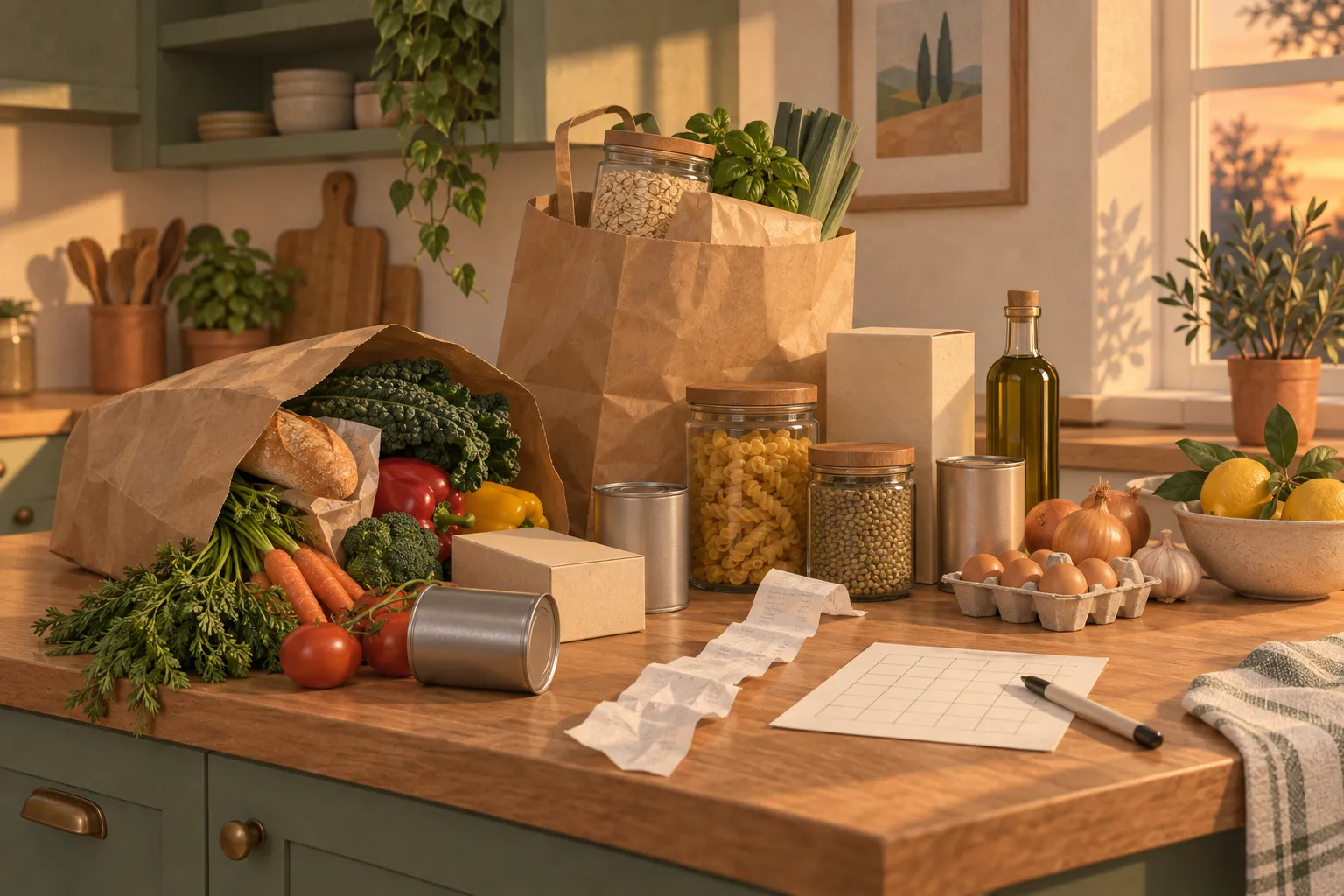
A pantry inventory is two jobs with very different shapes, and most advice treats them as one.
Adding is a batch. Ten to thirty lines land at once, right when bags are on the counter, the frozen stuff is softening and nobody wants to write anything. It gets postponed to "later," and later the receipt is in the trash.
Using up is a trickle. One item at a time, several times a week, usually mid-cooking with wet hands while the sheet is in another room or the spreadsheet is on a laptop upstairs. Nearly every guide you'll find says to cross things off as you use them. That's correct, and it's also the exact step that breaks.
The failure compounds. Miss three ticks and the sheet says you have two cans of chickpeas when you have none. You buy nothing, discover the empty shelf mid-recipe, and stop trusting the list. Once you stop trusting it you stop checking it, and once you stop checking it there's no reason to update it.
What helps, in rough order of how much:
- Tape the sheet inside the pantry door and tie a pen to it. A pen in a drawer is a missed tick.
- Tick at the moment the empty container goes in the trash or recycling. That moment happens anyway; you're attaching the update to it.
- Track less. Salt and the vinegar you use twice a year don't need rows. Track the things you double-buy, the things that cost real money, and the things with a date you'd otherwise miss.
- Before writing the shopping list, spend five minutes checking the sheet against the shelves and fix whatever drifted. The FDA's first waste tip is to plan the shopping list before you go.
- Take a photo of the sheet on your way out. A pantry list that stays home can't stop you buying a third jar of tahini.
Where scanning a receipt helps, and where it doesn't
The adding half is mostly copying. Everything you just bought is already printed on the receipt, names and prices included, so software can do the transcription.
That's the idea behind Duneed, our iPhone app. You photograph a paper grocery receipt or take a screenshot of a digital one, and it pulls out the line items, assigns each a category and carries over the price you paid. You review the list before anything's saved and can rename, reprice or delete any line. That review step matters: receipts abbreviate heavily (what those receipt codes mean) and they include dish soap and paper towels alongside the food.
Scanning doesn't touch the other half. When the olive oil runs out, you still tell the app, one tap per item. It also doesn't guess best-by dates: you enter the date, and the pantry flags the item as that date gets close.
How often should you update a pantry inventory?
Match the update to the event instead of picking a calendar day:
| When | What to do |
|---|---|
| After every shop | Add new items the same day, before the receipt is thrown out |
| When you finish something | Tick Used up, or lower the Qty |
| Before each shopping list | Check the sheet against the shelves for about 5 minutes |
| Every 3 months | Recount one shelf at a time, pull the oldest forward, start a fresh sheet |
On paper, start a fresh sheet once about a third of the rows are ticked. With 30 rows that's around 10 used-up lines, the point where live items get hard to spot among the dead ones.
Using the plain CSV in Excel, Numbers or Google Sheets
The CSV is a plain text file with no formulas and no formatting, which is why it opens nearly anywhere.
- Excel: open the file directly. Numbers on a Mac opens it too and converts it to a Numbers spreadsheet.
- Google Sheets: File > Import > Upload, then pick the file.
- Type dates as year-month-day (2026-09-12). That order sorts correctly and avoids the 9/12 versus 12/9 argument between US and UK settings.
- Sort by Best by to see what to cook first, and filter out rows with Used up filled in.
- In Google Sheets you can turn the Used up column into real checkboxes with Insert > Checkbox.
- Once you've added formatting (a frozen header row, colors), save as .xlsx, Numbers or a Google Sheet. CSV can't store formatting and will drop it.
Editing a spreadsheet cell on a phone while holding a pan is fiddly. A shared Google Sheet does let two people keep one list from their own phones, which paper on a door can only half do. If the list you really need to share is the shopping list, our guide to a shared grocery list covers the easier options.
FAQ
What should go on a pantry inventory list?
Shelf-stable food: cans and jars, grains and pasta, baking supplies, oils and sauces, spices, snacks, breakfast food and drinks. For what's worth stocking in the first place, see our pantry staples list. Leave out the fridge and freezer. They turn over faster and need a different sheet; see our freezer inventory sheet for that one.
Should I laminate my pantry inventory sheet?
Several printable sites suggest laminating the sheet and using a wet-erase or dry-erase marker. It works well for a quantity-only checklist. For this template, with its Bought and Best by dates, plain paper is better: dates are what you most need to read months later, and they're the first thing a sleeve brushing past will smudge.
Is there a free pantry inventory app?
Yes, several apps have free plans, each limited in a different way. Duneed's free plan includes 3 receipt scans a month and unlimited items added by hand, with no time limit.
Sources
- NDSU Extension's shelf-life guide greatplainsfoodbank.org
- Utah State University Extension extension.usu.edu
- Purdue Extension extension.purdue.edu
- food waste tips fda.gov
- Food Standards Scotland foodstandards.gov.scot
- FoodSafety.gov foodsafety.gov
Found a mistake? Tell us and we will correct it: support@duneed.app