
How to organize a freezer: a zone chart for chest, upright, drawer and top freezers
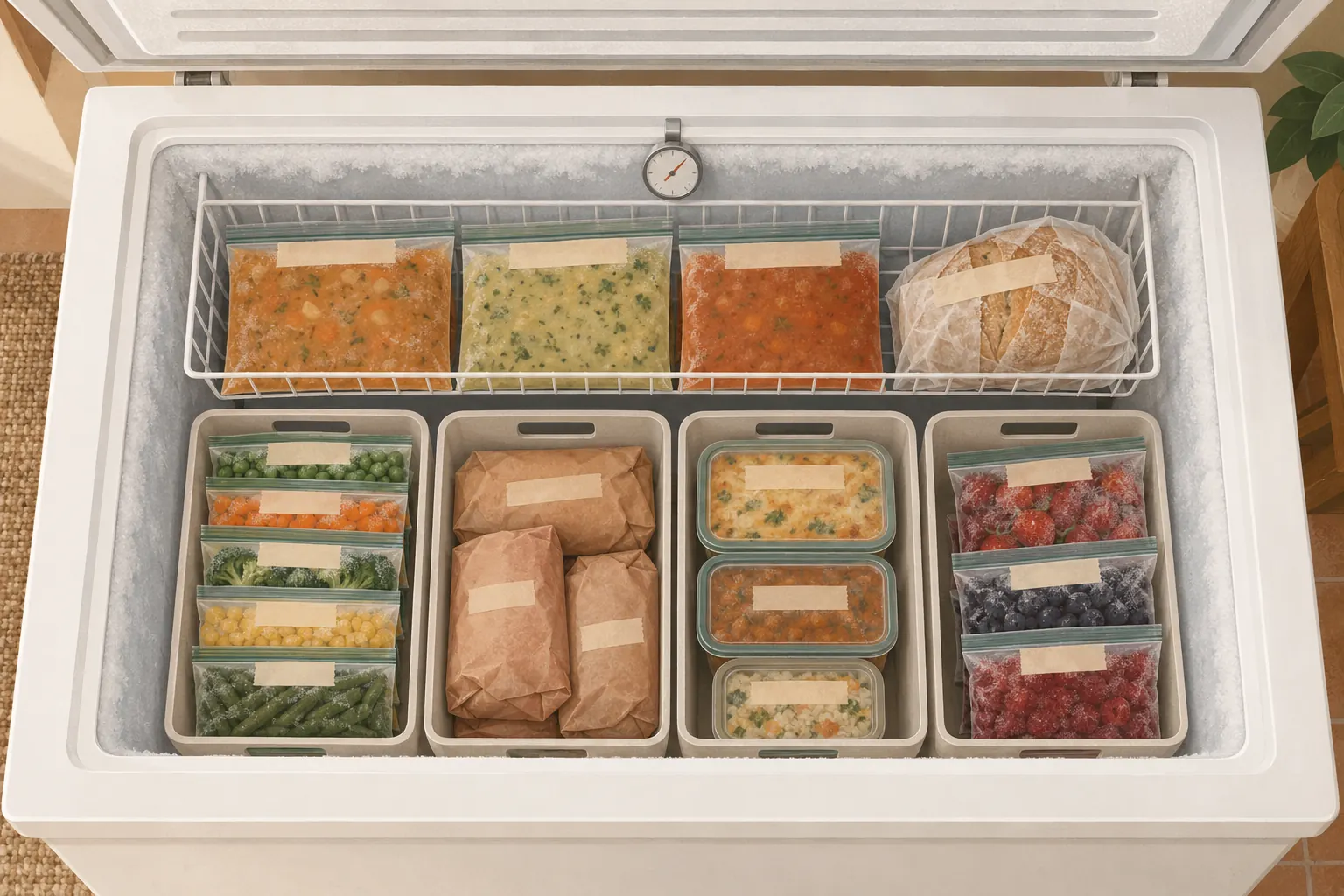
To organize a freezer, keep it at 0°F, give every shelf, basket or drawer one kind of food, and keep raw meat lowest. Freeze food flat in labeled, dated bags, then file the bags upright like folders. New packages go behind or under the old ones, and a list on the door says what's inside.
That's the whole system. The chart below says where each kind of food goes in the five common freezer types, and the rest of this page covers the parts other guides skip: what to write on a label, how much unfrozen food a freezer can take at once, how full it should be, and a ten-minute monthly check.
Freezer organization chart by freezer type
A freezer organization chart assigns each zone a job based on two things: how easy the spot is to reach, and whether a leak there could drip onto other food. Food you reach for weekly goes where you can see it; raw meat goes lowest; long keepers go to the spots you rarely dig into.
| Freezer type | Easiest to reach (top, front, eye level) | Middle | Lowest or deepest | Door or shallow top drawer | Watch out for |
|---|---|---|---|---|---|
| Chest (deep freezer) | Hanging baskets: cooked meals, bread, this month's food | Bins by category: vegetables, fruit | Bottom layer: raw meat in bins, whole turkeys, roasts | None | Food lost at the bottom for a year |
| Upright (standing freezer) | Top and eye-level shelves: cooked meals, leftovers, bread | Vegetables, fruit, ice cream | Bottom shelf or drawer: raw meat, poultry and fish | Butter, nuts, flour, ice packs, frozen herb cubes | Wire shelves where small bags slip through |
| Bottom drawer (French door) | Shallow top drawer: ice packs, herb cubes, open bags clipped | Main drawer front: this week's food | Main drawer, one side: raw meat filed upright | Shallow drawer doubles as the door | Stacks that bury everything under them |
| Side-by-side | Shelves at eye level: cooked meals, soups, leftovers | Vegetables, fruit, bread | Bottom shelf: raw meat, poultry and fish in a bin | Nuts, butter, bread, ice packs in skinny bins | Narrow shelves that won't take a large pizza |
| Top freezer (fridge-top) | Front of the shelf: this week's food, ice cream | Back of the shelf: bags of vegetables | Raw meat in a bin on the freezer floor | Nuts, butter, ice packs, open bags | Short-term storage only (see below) |
The zones matter less than the temperature. The FDA says the freezer should be at 0°F (-18°C), and the UK Food Standards Agency gives the same figure, around -18°C. Put an appliance thermometer at the front, where you can read it without moving anything.
The door is the warmest part of the freezer because it swings out into the room every time it opens. Whirlpool, which makes these appliances, says the door "is going to be the warmest part of a side-by-side freezer", so ice cream stays inside and the door gets food that doesn't mind small swings.
Why raw meat goes lowest in the freezer too
Raw meat goes on the bottom shelf of a freezer for the same reason it does in the fridge: if a package thaws, its juices can't drip onto anything else. The USDA Food Safety and Inspection Service (FSIS) gives this advice for power outages, telling people to "separate meat and poultry items from other foods" so that thawing juices won't reach them. The shelf order for the fridge below it is in how to organize your fridge.
How to organize a chest freezer
A chest freezer (also sold as a deep freezer) works best with bins that lift out, so you pull a whole category up instead of digging through loose bags. Measure the inside length, width and depth before you buy anything, then fill the floor with rectangular bins with handles, one category each: beef, chicken, fish, vegetables, fruit, bread, cooked meals.
The hanging baskets that come with most chests are the top layer. Keep cooked meals, bread and anything you'll eat this month there, plus one basket marked "eat first". The bottom layer is where food gets forgotten, so put only the long keepers down there. FSIS lists uncooked whole poultry at 12 months and uncooked roasts at 4 to 12 months, while cooked meat and casseroles get 2 to 3.
Three habits keep a chest freezer usable:
- Stack only like with like. Chicken thighs on chicken thighs, never pork chops on top of the peas.
- Tape a map to the lid: a rough sketch of the bins and what each holds. You'll open the lid knowing which bin to lift.
- File bags upright inside the bins so each label faces up. A bin of flat bags stacked on each other is just a smaller pile.
Milk crates and dollar-store bins work fine. What matters is that every bin can be lifted with one hand when full, so keep them small enough to do that.
How to organize an upright freezer
An upright freezer (a standing or garage freezer) organizes itself more easily than a chest, because every shelf is already a zone. Give each shelf one job and label the shelf edge as well as the bins, so anyone in the house can put things back.
Cooked meals and leftovers go at eye level, where you see them first. Bread and baked goods go on the top shelf, vegetables and fruit in the middle, and raw meat, poultry and fish on the bottom shelf or in the bottom drawer. Clear bins with handles turn a wire shelf into pull-out drawers and stop small bags slipping through the gaps. If the shelves hold only a few bins, "freezer organization with shelves" means little more than that: one category per bin, bins labeled on the front.
How to organize freezer drawers
A bottom-drawer freezer is the hardest to keep organized because everything is viewed from above, so the only system that works is filing food upright. Freeze bags flat, then stand them on their edges in the main drawer like records, labels facing up. Magazine files and narrow bins hold them in rows.
Zone the main drawer from side to side rather than front to back: cooked meals on one side, vegetables and fruit in the middle, raw meat filed on the other side, ice cream wherever it stands flat. The shallow top drawer is for small, loose things (ice packs, frozen herb cubes, butter, open bags of peas clipped shut) that would otherwise sink.
Stacking is fine in a drawer only when every item in the stack is the same food. If you stack, put new packages underneath, so the oldest one is always on top.
How to organize a side-by-side freezer
A side-by-side freezer has lots of narrow shelves, so the zones come ready-made and the trick is keeping each shelf to one category. Put cooked meals and soups at eye level, vegetables and fruit on the next shelves down, and raw meat in a bin on the bottom shelf.
Skinny bins on the door hold nuts, butter, bread and ice packs, the food that tolerates the door's temperature swings. Large items are the weak point: a family-size pizza may only fit upright, or on a shelf you take out entirely.
How to organize a top freezer
A top freezer on a fridge is best treated as short-term storage. FSIS says that if a refrigerator freezing compartment "can't maintain zero degrees or if the door is opened frequently, use it for short-term food storage", and use a freestanding freezer at 0°F or below for long-term storage.
With one shelf and a door, make your own drawers: two clear bins on the floor of the freezer (raw meat in one, cooked meals in the other), bags of vegetables filed upright behind them, and ice cream at the front. Keep a top freezer to what you'll eat in the next month or two.
How to organize a freezer in 7 steps
Organizing a freezer from scratch takes an hour or two, most of it sorting. Do it before a grocery run, when the freezer is emptiest.
- Get a cooler or insulated bags ready and empty one shelf, basket or drawer at a time, so food spends only a few minutes out.
- Check the thermometer. The National Center for Home Food Preservation (NCHFP) says to keep the freezer at 0°F or lower, because "at higher temperatures, foods lose quality much faster".
- Sort what comes out into groups: raw meat and poultry, fish, cooked meals, vegetables, fruit, bread, desserts. NCHFP's own advice is to organize the freezer "into food groups for ease in locating".
- Label anything unlabeled (what to write is in the next section). If you don't know when something went in, write "date unknown" and put it in the eat-first spot.
- Repack loose or boxed food. Take waffles and nuggets out of the box, tape the cooking instructions to the bag, and overwrap supermarket meat that's staying more than a few weeks.
- Load by zone from the chart above: raw meat lowest, the eat-first spot where you'll see it, long keepers in the spots you rarely reach.
- Write the inventory as the food goes back in, not afterward from memory.
Leave the air vent clear while you load. Whirlpool says to locate the vent, usually on a side wall, and leave space around it on all sides.
Freeze flat, then file upright
Freezing food flat and filing it upright makes every freezer type easier to organize. A quart of chili frozen flat in a bag is a thin slab that stands on its edge, shows its label and thaws faster than a round tub.
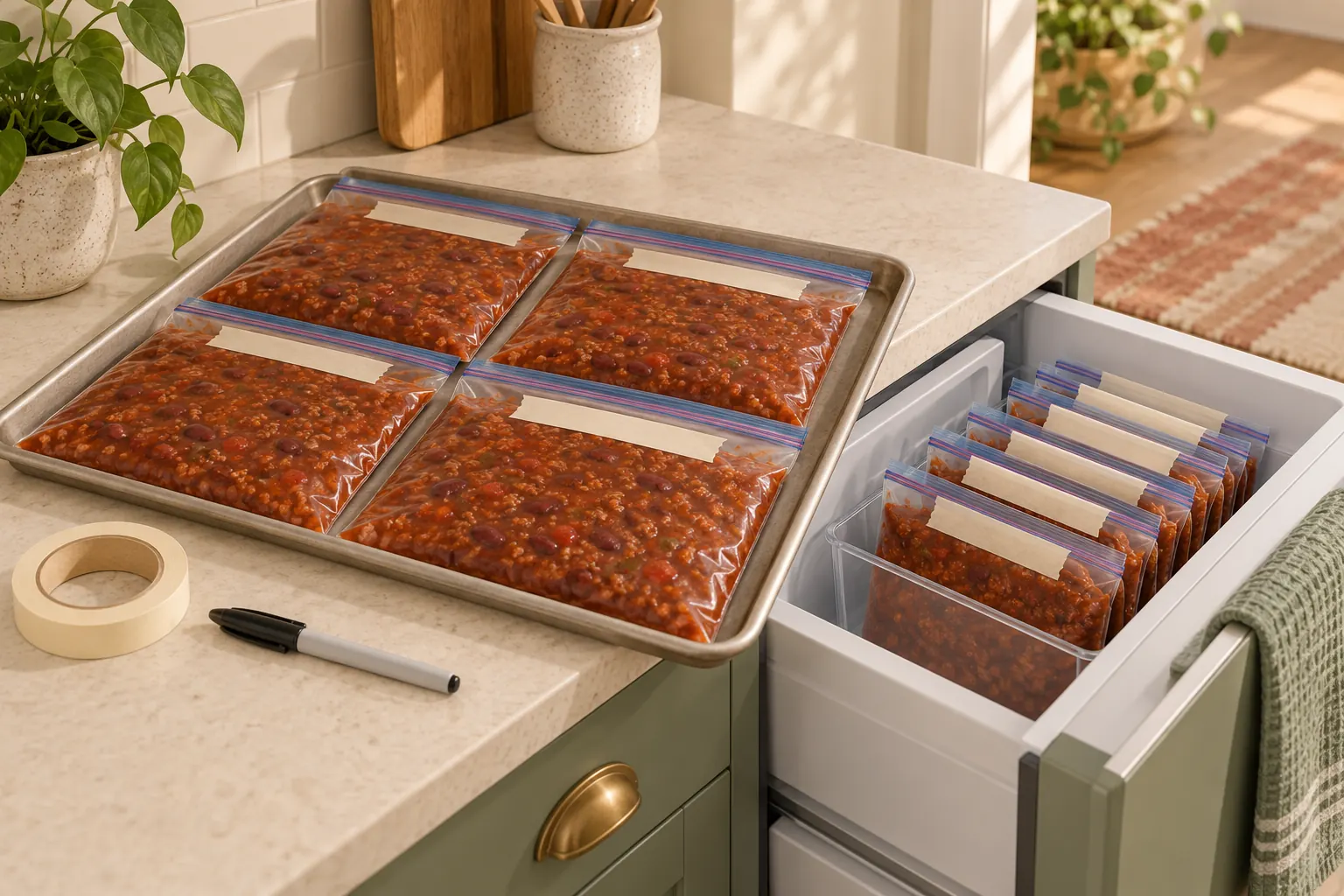
FSIS explains why the first freeze should be spread out: rapid freezing makes smaller ice crystals and keeps texture, and "a food 2-inches thick should freeze completely in about 2 hours." FSIS says never to stack packages that are still freezing; spread them in one layer and stack them only after they're frozen solid. NCHFP adds that packages should have a little space between them while they freeze, and can go close together afterward.
A metal baking sheet makes this easy. Lay the filled bags on it, freeze overnight, then file them into their bin. Portion first: NCHFP says to pack food "in quantities that will be used for a single meal", which in practice means four one-portion bags of chili, not one block you have to thaw all at once. Leftovers are the obvious candidates: FoodSafety.gov gives cooked meat and poultry leftovers 3 to 4 days in the fridge, so freeze what you won't eat by then (more in how long leftovers last).
How to label and date freezer food
Every freezer package needs a label with what it is and the date it was frozen. NCHFP's list is longer and worth following for anything homemade: the name of the food, any added ingredients, the packaging date, the number of servings or the amount, and its form (whole, sliced, ground). The UK Food Standards Agency puts it more memorably: label food you freeze so you don't end up with "Unidentified Frozen Objects".
A good label reads something like "Beef chili, 2 portions, frozen 27 Sep 26, best by Nov 26". Write the month as a word so no one in the house reads 9/10 as October. Write on the bag before you fill it; a marker glides over a dry, flat bag and skips on a frosty one. Masking tape works on containers and peels off before the dishwasher. If you'd rather print, our freezer label maker makes sheets of freezer and leftover labels with space for all of this.
The "best by" date on a freezer label is about quality, not safety. FSIS says "food stored constantly at 0 °F will always be safe" and that freezer storage times are for quality only; FoodSafety.gov's chart says the same. That's why some organizing guides are wrong to tell you to throw out anything you can't date. For food not on its chart, FSIS says you may judge quality after thawing, starting with the smell, and use food that isn't good enough to serve on its own in soups or stews. To work out the best-quality date for a label, look the food up in our food storage time tool, which uses the FoodSafety.gov figures.
First in, first out in a freezer
First in, first out means new food goes behind or under older food of the same kind, so the oldest package is always the one you reach first. NCHFP's version: arrange packages so that those which have been in the freezer longest "are the first ones used".
In practice that's one rule per freezer type. In a chest or drawer, new bags go underneath. On a shelf, new packages go to the back. In a bin of flat bags, new ones go at the back of the row. The one exception is a big shop: if twenty pounds of meat goes in at once, freeze it spread out first (see below) and only then file it behind the old stock.
Every freezer also needs an eat-first spot: one basket, bin or front corner for date-unknown bags, half-used packages and anything close to its best-quality date. It's the freezer version of the fridge's eat-first bin, and it's the first place to look when you plan the week's dinners.
Keep a freezer inventory
A freezer inventory is a list of what's in the freezer and when each thing went in, posted where you'll see it. NCHFP recommends exactly this: "Post a frozen foods inventory near the freezer", add foods and freezing dates as they go in, and check them off as they come out. It matters most for a chest or garage freezer, where you can't see the contents without opening it and digging.
Our freezer inventory sheet is a free printable built for this, with columns for portions, shelf and best-quality date, and a worked example of filling it in. A magnetic whiteboard on the freezer door does the same job for a small freezer.
If you'd rather keep the list on your phone, Duneed, our iPhone app, builds a list of what you bought from a photographed grocery receipt, so the chicken thighs and frozen peas are on it without typing. Give an item a date and it flags that item as the date gets close. It doesn't know which items are in the freezer and which are in the fridge, and it doesn't guess how long frozen food keeps; you set the dates. For a freezer, that means one date per item you care about, with the sheet on the door still holding the shelf and portion detail.
How full should a freezer be?
A freezer should be full but not packed so tightly that air can't move. NCHFP says "a full freezer is most energy efficient", and FSIS says a full freezer keeps food frozen for about 2 days in a power outage if the door stays shut, against about a day for a half-full one. The FDA's limit on the other side: don't crowd the freezer "so tightly that air can't circulate".
The number most guides miss is how much unfrozen food a freezer can take at once. NCHFP says to add only what will freeze within 24 hours, "usually 2 to 3 pounds of food per cubic foot of storage space". Overloading slows freezing, and slowly frozen food loses quality.
Say you have a 7-cubic-foot chest freezer and come home from a warehouse club with 25 pounds of meat. At 2 to 3 pounds per cubic foot, the freezer can freeze 14 to 21 pounds in a day. Freeze about half the meat on day one, keep the rest in the fridge, and freeze it the next day, within the time the fridge allows for raw meat (FoodSafety.gov gives ground meat and poultry 1 to 2 days). Whether that bulk buy saves money after the food you don't finish is a separate question, and our bulk buy calculator answers it.
A monthly freezer check
A monthly freezer check takes about ten minutes and keeps the inventory honest. Do it the night before a grocery run.
- Read the thermometer. It should say 0°F or lower.
- Compare the inventory with the freezer. Cross off what's gone, add what was never written down.
- Read down the dates. Anything due in the next few weeks moves to the eat-first spot, and a dinner or two gets planned around it.
- Look for torn packages. FSIS says a torn package is still safe to use; "merely overwrap or rewrap it".
- Check for frost. NCHFP says a manual-defrost freezer needs defrosting at least once a year, or when frost is more than a quarter inch thick over a large area. Plan it for a month when the freezer is nearly empty.
Frost on the food itself and pale, dry patches are freezer burn, which FSIS calls a quality problem, not a safety one. What causes it and how to stop it is in what is freezer burn.
Freezer bins and organizers: which are worth buying
Most freezers need three things: a few bins with handles, a marker, and a roll of masking tape. Everything past that is optional.
Buy bins after you've measured, and buy them for the freezer you have: tall rectangular bins for a chest, narrow ones for side-by-side shelves and doors, magazine files for a drawer. Clear bins help on shelves where you see them from the front; in a chest or drawer you see them from above, so the label on the food matters more than the bin. Matching containers stack well but cost the most, and the flat freezer bag beats all of them on space. Vacuum sealers are good for meat that stays months, and not worth it for food you'll eat in three weeks.
Not everything belongs in the freezer in the first place. Which foods freeze well and which turn watery or grainy is in can you freeze it.
Common questions
How do you organize a freezer without shelves?
Use bins as removable shelves and drawers. In a chest or drawer freezer, fill the floor with bins by category, file flat bags upright inside them, and keep a basket or shallow bin on top for this week's food.
What should go in the freezer door?
Food that tolerates temperature swings: butter, nuts, flour, bread, ice packs and frozen herb or tomato paste cubes. Ice cream and raw meat belong inside, because the door is the warmest part of the freezer.
What temperature should a freezer be?
A freezer should be at 0°F (-18°C) or lower. The FDA, FSIS and NCHFP all give 0°F, and the UK Food Standards Agency gives about -18°C. Check it with an appliance thermometer rather than the dial.
How long can food stay in the freezer?
Food kept constantly at 0°F stays safe indefinitely, according to FSIS and FoodSafety.gov, but quality drops over time. For best quality, FSIS gives soups and stews 2 to 3 months, uncooked ground meat 3 to 4 months and uncooked whole poultry 12 months.
How do you organize a freezer for food safety?
Keep the freezer at 0°F, put raw meat, poultry and fish on the lowest shelf or in their own bin, and label every package with its contents and freezing date. FSIS also says to keep meat and poultry separate from other foods so thawing juices can't drip onto them.
How should you organize a small freezer?
Keep a small or fridge-top freezer for food you'll eat within a month or two, freeze everything flat, and use two bins as drawers. FSIS advises using a freezer compartment that can't hold 0°F, or is opened often, for short-term storage only.
How do you keep a freezer organized?
Give every zone one job, put new food behind or under old food, keep an inventory on the door and do a ten-minute check once a month. A freezer rarely falls apart in one day; it drifts when bags go in unlabeled and the list stops matching the shelves.
Sources
- 0°F (-18°C) fda.gov
- "is going to be the warmest part of a side-by-side freezer" whirlpool.com
- "separate meat and poultry items from other foods" fsis.usda.gov
- "at higher temperatures, foods lose quality much faster" nchfp.uga.edu
- FoodSafety.gov foodsafety.gov
- name of the food, any added ingredients, the packaging date, the number of servings or the amount, and its form nchfp.uga.edu
- label food you freeze gov.uk
- FoodSafety.gov's chart foodsafety.gov
- add only what will freeze within 24 hours nchfp.uga.edu
Found a mistake? Tell us and we will correct it: support@duneed.app