
How to plan grocery shopping for a week, with quantities that fit your household
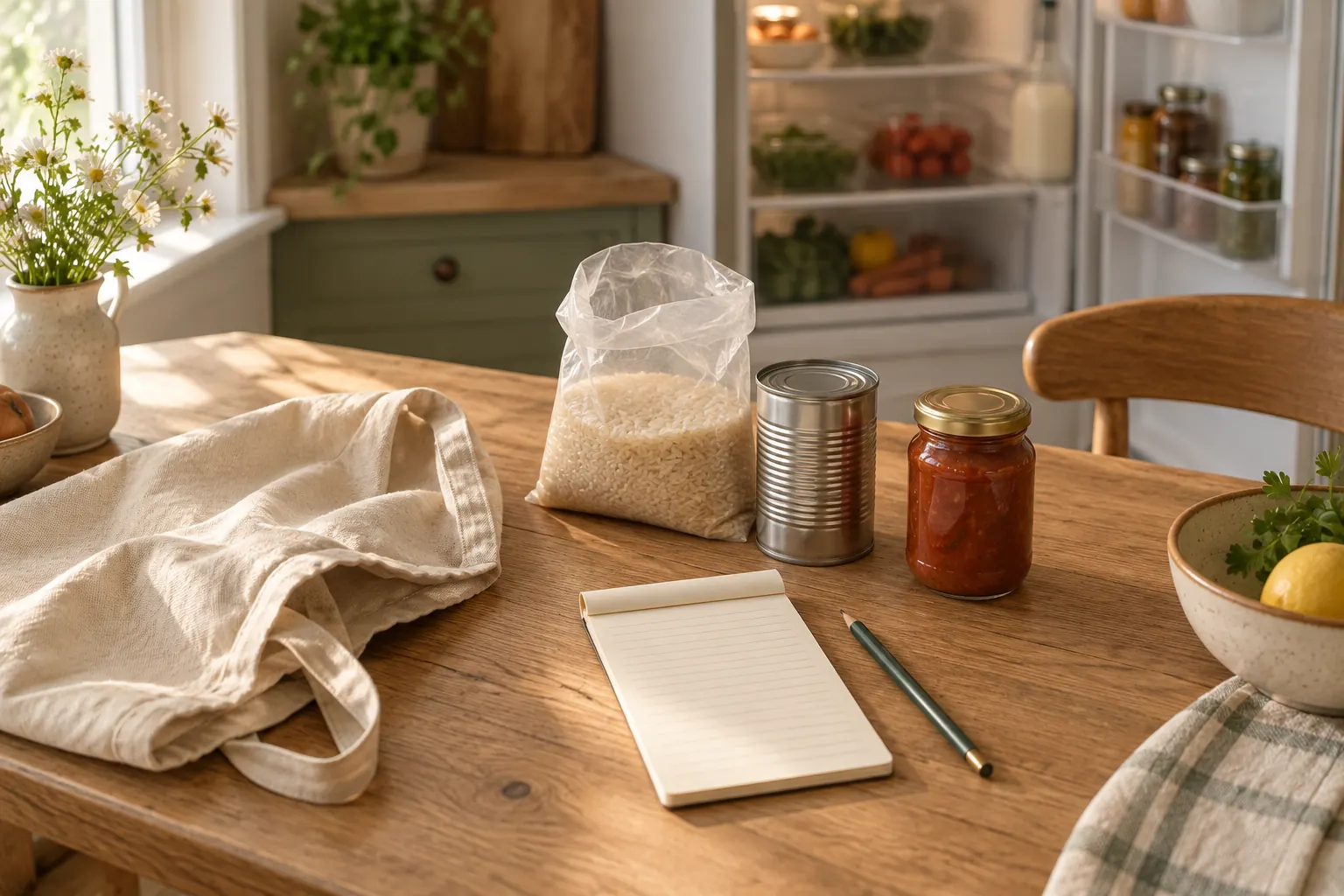
To plan grocery shopping for a week, start from what's already in your kitchen and end with the food put away oldest-in-front. In between sit five steps most routines skip or rush: meals, a list by store section, a quantity on every line, a budget check and one trip. The whole thing takes 30 to 45 minutes once it's a habit.
- Check what you already have in the fridge, freezer and cupboards.
- Plan four or five dinners around it, most perishable first.
- Write the list in the order of your store's sections.
- Put a quantity on every line, checked against USDA's weekly amounts.
- Price the list and compare it with your weekly budget.
- Shop the list in one trip, cold food last.
- Put it away first in, first out, and freeze what you won't cook in time.
Below, each step in detail, then a full week for two adults with pounds and a shopping list, how often to shop, and what changes when you shop for one.
Step 1: check what you already have
Checking the kitchen before writing anything is the step that decides whether the week's shop saves money or duplicates it. The EPA's page on preventing wasted food at home puts it plainly: "Look in your refrigerator, freezer, and pantry first to avoid buying food you already have."
Go in the order food spoils: fridge, then freezer, then cupboards. In the fridge, look for leftovers, opened jars, fresh meat and anything soft in the crisper. In the freezer, look for the forgotten bag of shrimp. In the cupboards you're mostly checking staples: rice, pasta, oil, canned tomatoes, the spice you think you're out of.
Write down two things as you go. First, what needs eating this week, because that becomes next step's starting point. Second, what's running low. The EPA's advice on preventing wasted food at home is the same pair: look in the refrigerator, freezer and pantry first, and "make a list each week of what needs to be used up." A running list on the fridge door, added to as things run out, turns this step into a glance rather than a search.
The check gets faster the less you rely on memory. A pantry inventory list on the cupboard door works on paper. Duneed, our iPhone app, builds that pantry list from photographed grocery receipts, so the list of what you bought last week already exists when you sit down to plan this one.
Step 2: plan meals around what you have
A weekly meal plan for shopping needs four or five dinners. The other nights go to leftovers, a meal out or the evening you don't feel like cooking, and planning seven dinners is the easiest way to buy food for meals that never happen.
Build the first two or three dinners around the use-first items from step 1. Then fill the rest of the week with meals that use food bought fresh, in order of how fast it goes. The federal cold food storage chart gives raw ground meat and raw chicken 1 to 2 days in the fridge and fresh steaks and chops 3 to 5 days, so a Saturday shop means chicken on Sunday and ground beef either cooked early or frozen the day you bring it home.
Breakfasts and lunches don't need a plan so much as a stock: oats or cereal, bread, eggs, fruit, milk, sandwich fillings, and leftovers from dinner. If you want to plan the week strictly from what's already in the kitchen, how to meal plan from your pantry has the full method with a sorting table.
Step 3: write the list by store section
A grocery list grouped by store section is faster to shop and harder to forget things on. You can group it by store section or by food group. Store section wins if you shop the same store every week, because you walk the list top to bottom.
Go through each planned meal and write every ingredient under its section. Then cross off what step 1 already found. Add the regulars that run out every week without being planned: milk, bread, coffee, bananas.
Our printable grocery list has ten sections in a common supermarket order, from produce to frozen, with a column for "have" and one for quantity. Rearrange the sections once to match your store and keep that version.
Step 4: put a quantity on every line
A quantity on each line is what separates a shopping plan from a guess. "Chicken" gets you whatever pack is on the shelf; "3 lb chicken thighs" gets you three dinners. Most weekly grocery routines stop at the item name, and that's where overbuying and the mid-week second trip both come from.
For a sense of scale, USDA's Thrifty Food Plan, 2021 publishes a "market basket": the pounds of food, as purchased, that a person needs in a week for a healthy diet at low cost, by category. These are the weekly amounts for one adult aged 20 to 50, from the report's Appendix 4:
| Weekly amount, as purchased | Woman, 20 to 50 | Man, 20 to 50 |
|---|---|---|
| Vegetables | 8.35 lb | 11.73 lb |
| Fruits (including 100% juice) | 6.64 lb | 8.75 lb |
| Grains | 3.14 lb | 4.88 lb |
| Dairy | 10.13 lb | 11.12 lb |
| Protein foods (meat, poultry, fish, eggs, nuts) | 4.19 lb | 4.94 lb |
| Other (oils, sauces, coffee, snacks) | 1.31 lb | 3.32 lb |
| Total | 33.74 lb | 44.74 lb |
For the report's reference family of four (two adults and two children aged 6 to 11), Table 1 gives 140.94 lb a week. Our food per week calculator adds up the right tables for your own household, by age and sex, and splits them into subcategories such as poultry, eggs and starchy vegetables.
Three things to know before you use these numbers:
- They assume every meal and snack is eaten at home. If you both eat lunch at work, you'll need noticeably less.
- They already include a 5% allowance for food that goes uneaten, which the report calls "a modest measure of food loss." Buying well above these amounts mostly adds to what gets thrown away.
- Milk and yogurt are counted in pounds. The report's own conversion is to multiply by 15.34 for fluid ounces, so 10 lb of milk is about 153 fl oz, a little over a gallon.
The market basket is a cost model built to meet the Dietary Guidelines, not a personal nutrition plan. Use it to spot a list that's wildly short or wildly long, not as a target to hit to the ounce.
Step 5: check the list against your budget
A priced list tells you before you leave the house whether the week fits the budget. Write an expected price next to each line (last week's receipt is the best source) and add it up. If it's over, cut or swap at the kitchen table, where it's easy, rather than at the checkout.
If you don't have a number to aim for, USDA's monthly food plans give one. On the July 2026 Thrifty plan, a woman aged 20 to 50 costs $58.60 a week and a man $73.70; add USDA's 10% two-person adjustment and a couple comes to about $146 a week. The grocery budget calculator does that sum for any household across all four plans, and how much to spend on groceries explains what each plan assumes.
A weekly check keeps one shop honest. A monthly total tells you whether the habit is working, and that needs your real receipts added up by category, not the estimates on the list.
Step 6: shop the list in one trip
The shopping trip is the easiest part once steps 1 to 5 are done. Walk the list in order, tick each line as it goes in the cart, and treat anything not on it as a decision rather than a reflex.
Pick up refrigerated and frozen food last and go straight home. USDA's Food Safety and Inspection Service says to "never leave food out of refrigeration over 2 hours," or more than 1 hour above 90°F, on its danger zone page. That clock covers the drive home and the bags sitting on the counter.
If you shop with someone else, one list that both of you can see stops the double milk. Shared grocery list compares the free ways to set one up on iPhone and Android.
Step 7: put it away first in, first out
Putting groceries away is the last planning step. New food goes behind older food of the same kind, so the older yogurt or the opened bag of carrots is the one you reach for. That's first in, first out, and it works on every shelf.
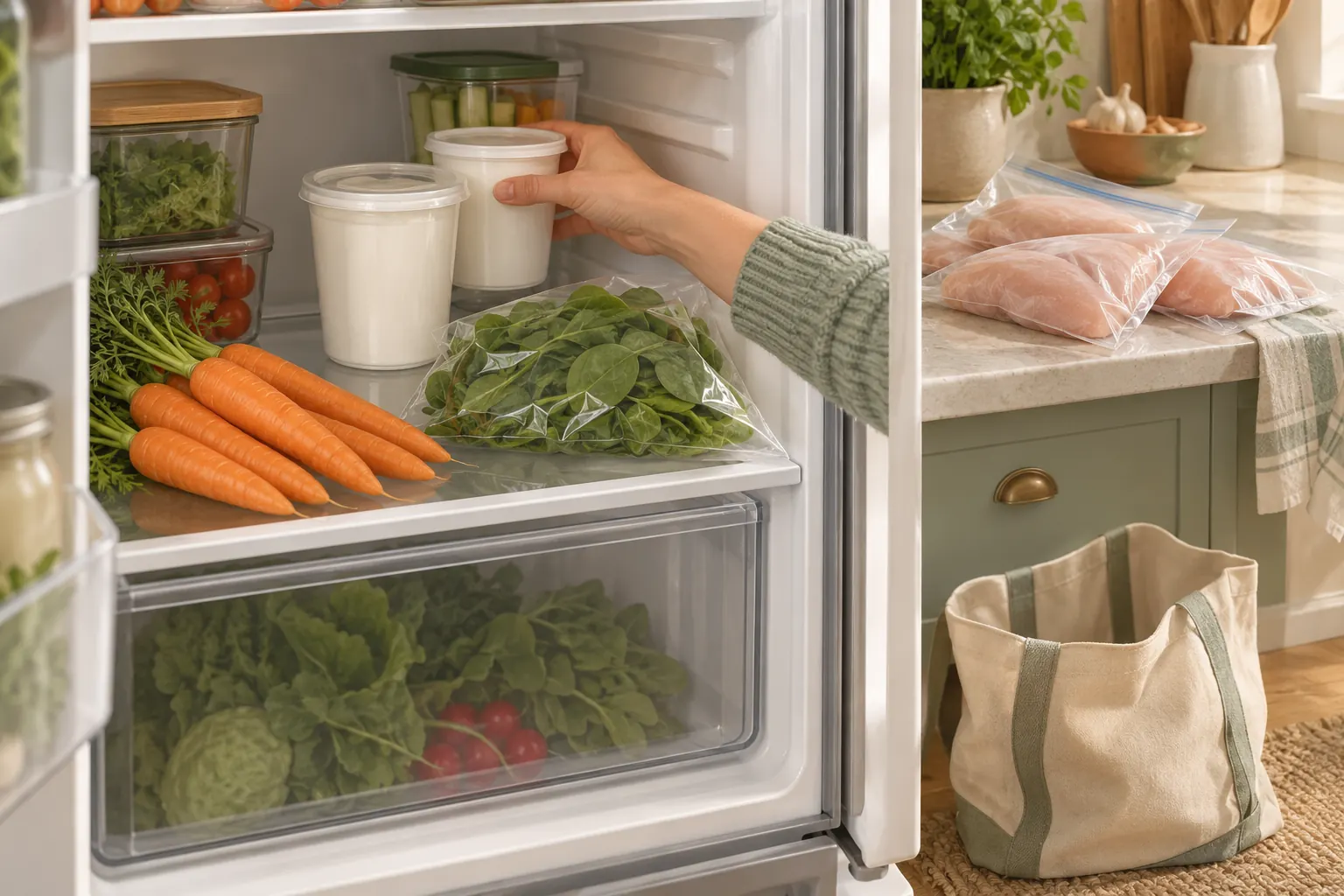
Deal with the short-life items the same day. Meat you won't cook within the 1 to 2 days the storage chart gives goes into the freezer now, portioned for one meal each. Leafy greens, berries and anything already ripe go where you'll see them. How to organize your fridge covers where each thing belongs and the eat-first bin that keeps it visible.
A worked example: a week of groceries for two adults
The whole method, applied to one household: a couple, both aged 20 to 50, shopping on Saturday and cooking most meals at home. Adding USDA's two Appendix 4 tables gives the couple's weekly market basket (rows may not add exactly because of USDA's rounding):
| Category | Woman | Man | Couple, per week |
|---|---|---|---|
| Vegetables | 8.35 lb | 11.73 lb | 20.08 lb |
| Fruits | 6.64 lb | 8.75 lb | 15.39 lb |
| Grains | 3.14 lb | 4.88 lb | 8.02 lb |
| Dairy | 10.13 lb | 11.12 lb | 21.25 lb |
| Protein foods | 4.19 lb | 4.94 lb | 9.13 lb |
| Other | 1.31 lb | 3.32 lb | 4.63 lb |
| Total | 33.74 lb | 44.74 lb | 78.48 lb |
Two conversions make the dairy and protein rows usable. Milk and yogurt together come to 20.73 lb, and 20.73 × 15.34 = 318 fl oz, or about 2.5 gallons. Eggs are 1.30 lb, or about 21 oz. USDA's shell egg standard sets a dozen large eggs at a minimum of 24 oz, so that's about 10 large eggs.
Step 1 turned up half a bag of rice, a can of tomatoes, most of a jar of salsa, frozen peas and a block of cheddar. The dinners, in order of what spoils first:
| Day | Dinner | Why that day |
|---|---|---|
| Sunday | Roast chicken thighs, potatoes and carrots | Fresh chicken: 1 to 2 days in the fridge |
| Monday | Chicken and black bean tacos with salsa | Uses Sunday's extra chicken |
| Tuesday | Spinach and egg fried rice with peas | Spinach before it wilts; rice and peas on hand |
| Wednesday | Leftovers or eating out | A planned gap |
| Thursday | Beef and tomato pasta | Ground beef frozen on Saturday, thawed in the fridge overnight |
| Friday | Baked fish, rice and green beans | Frozen fish, so no rush |
The shopping list, by section, with quantities sized to the basket:
| Section | Item and quantity |
|---|---|
| Produce | 5 lb potatoes, 2 lb carrots, 2 lb onions, 1 lb broccoli, 10 oz spinach, 1 head lettuce, 3 lb bananas, 3 lb apples, 2 lb oranges |
| Bakery | 1 loaf whole-wheat bread, 1 pack tortillas |
| Meat and seafood | 3 lb chicken thighs, 1 lb ground beef |
| Dairy and eggs | 2 gallons milk, 32 oz yogurt, 1 dozen eggs |
| Pantry and dry goods | 1 lb whole-wheat pasta, 1 container oats |
| Cans and jars | 4 cans black beans (15 oz), 1 can crushed tomatoes (28 oz), 2 cans tuna |
| Frozen | 1 lb fish fillets, 1 lb green beans, 1 lb corn, 1 lb mixed berries |
Checked against the basket, fresh and frozen vegetables come to about 13 to 14 lb, and the canned beans and tomatoes add about 5.5 lb (USDA counts beans as a vegetable), which puts the week near the 20 lb it models. The 9 lb of whole fruit matches the basket's 8.98 lb; the list skips juice, which is a choice. Protein comes to about 7 lb (chicken, beef, fish, tuna and a dozen eggs), under the 9.13 lb total, so a jar of peanut butter or a second pack of fish would close the gap. Two gallons of milk and a quart of yogurt are about 18.7 lb against 20.73 lb, and the cheddar at home covers the cheese.
Priced, a list like this should land near the couple's $146 Thrifty line from step 5, depending on your store. If it doesn't, the protein and dairy rows are where most of the money is.
How often should you go grocery shopping?
How often to shop is a trade-off between waste and time, and no authority sets a right answer. Most households do better with one planned weekly shop and, at most, one short top-up trip for milk and fresh produce.
The numbers behind that:
- Americans already shop more than weekly. In USDA's FoodAPS survey of a week in 2012, households that got food from a large grocery store or supermarket did so an average of 2.8 times that week.
- More trips go with more waste in the best recent data. A nationally representative Australian study of 1,462 households who kept a 7-day diary (Ananda and colleagues, 2025) found that more frequent grocery shopping was associated with more fruit and vegetable waste, and more use of a shopping list with less. That's an association, not proof that fewer trips cause less waste.
- Extension services land in the same place. Colorado State University's Food Smart Colorado calls shopping every seven to ten days "a good option."
Each extra unplanned trip is a chance to buy things that aren't on a list. Stretching to two weeks has its own cost: fresh produce and fresh meat don't last that long, so the second week runs on frozen, canned and root vegetables.
| Rhythm | Works well for | Watch out for |
|---|---|---|
| One weekly shop | Most households; anyone cooking fresh food | The mid-week "just milk" trip that turns into a full shop |
| Weekly shop plus one top-up | Families with a lot of milk and fruit | Take a list for the top-up too |
| Every two weeks | Freezer space, a long drive to the store, a pantry you keep stocked | Week-two meals must lean on frozen and canned food |
| Every few days, no plan | Very small households with a store on the way home | The most chances for impulse buys |
To shop every two weeks, plan the second week around the freezer and the pantry from the start. Buy frozen vegetables and fish, keep canned beans and tomatoes, and freeze half the fresh meat the day you buy it. Roots and hard fruit (potatoes, carrots, onions, apples) cover fresh produce into week two.
Planning a week of groceries for one person
Grocery shopping for one person follows the same seven steps with smaller amounts and one extra rule: buy fresh food for only three or four dinners. The rest come from leftovers and the freezer, because there's nobody else to finish the second half of the spinach.
USDA's market basket for one woman aged 20 to 50 is 33.74 lb a week and for a man 44.74 lb, as in the table in step 4. Broken down for a woman, that's about 8 lb of vegetables, 5 lb of whole fruit, 3 lb of grains, 9.6 lb of milk and yogurt (about 1.15 gallons by the 15.34 conversion) and just over 4 lb of protein foods. For your own age, the food per week calculator gives the split.
What changes when you shop for one:
- Buy meat in family packs only if you'll split them into single portions and freeze them the same day.
- Choose frozen vegetables and fruit for anything past day four. Fresh greens bought on Saturday are a Tuesday problem.
- Cook once, eat twice: a dinner that makes two portions covers the next day's lunch.
- Small packs of perishables are usually worth their higher unit price; big packs of rice, oats, pasta and canned beans aren't a waste risk.
For the money side, grocery budget for one person has USDA's July 2026 figures with the 20% adjustment for living alone, and how to reduce food waste at home has a section on not wasting food when you live alone.
Keeping the plan going from week to week
The weekly plan gets cheaper to run when last week's shop feeds the next one. Your receipts already say what you bought and what you paid, which is most of step 1 and step 5.
Duneed reads those receipts into a pantry list and a monthly spending total by category, and it has a shopping list you tick off in the store. It doesn't plan meals; step 2 stays with you. On paper, a pantry list on the cupboard door and a notebook of weekly totals do the same job with more writing. How to save money on groceries ranks the other habits that lower the bill.
Common questions
How do I make a grocery list for the week?
Check the fridge, freezer and cupboards first, then plan four or five dinners around what needs using. Write every ingredient under its store section, cross off what you have, add the weekly regulars and put a quantity on each line.
How much food should I buy for one week?
USDA's Thrifty Food Plan market basket puts one adult aged 20 to 50 at about 34 lb (woman) to 45 lb (man) of food a week as purchased, and a family of four with two young children at about 141 lb. Those amounts assume every meal is eaten at home.
How long does it take to plan grocery shopping for a week?
About 30 to 45 minutes once it's routine: 10 minutes to check the kitchen, 15 to plan meals and write the list, and a few minutes to price it. The first week takes longer because you're building a list of regulars and learning your store's order.
Is it cheaper to go grocery shopping once a week?
For most households, one planned weekly shop costs less than several unplanned ones, because each extra trip is a chance for impulse buys. Research links more frequent shopping with more fruit and vegetable waste, though it shows an association, not proof of cause.
How do I plan groceries for two weeks?
Plan the second week around food that keeps: frozen vegetables and fish, canned beans and tomatoes, roots such as potatoes and carrots, and meat frozen on the day you buy it. Put the fresh-food meals in week one.
Sources
- preventing wasted food at home epa.gov
- cold food storage chart foodsafety.gov
- Thrifty Food Plan, 2021 fns-prod.azureedge.us
- July 2026 Thrifty plan fns-prod.azureedge.us
- danger zone page fsis.usda.gov
- shell egg standard ams.usda.gov
- 2.8 times that week ers.usda.gov
- Ananda and colleagues, 2025 doi.org
- Food Smart Colorado foodsmartcolorado.colostate.edu
Found a mistake? Tell us and we will correct it: support@duneed.app